Michigan scientists working on super-fast, secure computing
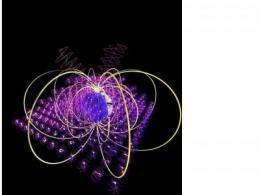
Air Force Office of Scientific Research(AFOSR)-supported physicists at the University of Michigan are developing innovative components for quantum, or super-fast, computers that will improve security for data storage and transmission.
According to Professor Duncan Steel, lead researcher from the University of Michigan, the long-term goal of this basic research is to push the frontier of modern electronics and optics into the realm of quantum behavior, where more complex computing problems can be solved at faster speeds.
To accomplish this goal, Steel and his team have started by exploring ways to optically create and maintain quantum coherence using a single electron or hole in a quantum dot structure. Maintaining a constant electrical charge for an extended period of time in a solid-state nanostructure, like a quantum dot, is likely key to long-term success.
Steel's next challenge has been investigating how to manipulate the electrical charge to perform basic computing tasks. In this phase of his research, he has focused on "spin and phase" -- quantum properties of the electron and hole that can be used to transport and store information. By demonstrating well-defined "spin and phase," the researchers have been better able to control and maintain information.
Building on this conceptual model, the team was able to move on to more complex applications needed for quantum computing.
"State-of-the-art frequency, stabilized lasers and the advanced laser control system, developed with AFOSR support will make optical control possible from this time forth," said Steel.
With their collaborators at the Naval Research Laboratory, the researchers have successfully learned how to optically control and measure the spin of an extra electron in a quantum dot.
In the process of conducting this research, Steel and his co-researchers, including L.J. Sham at the University of California at San Diego, have also advanced the understanding of optical control. With a new knowledge of how "spin and phase" information is lost and how that loss can be reduced, they have been able to demonstrate an increase in quantum storage time. With the use of ultra-fast laser technology, this increase will allow for over a million quantum operations to take place before information is lost.
"The most significant aspect of this milestone is there has been widespread concern that semiconductors, while extremely successful in modern electronics and photonics would not be successful in quantum computing if they lead to loss of coherence of the electron spin," said Steel. "Now the problem is, in principle, no longer an issue because of the research we have completed."
Source: Air Force Office of Scientific Research


