Study confirms classic theory on the origins of biodiversity
September 9, 2009 By Krishna Ramanujan
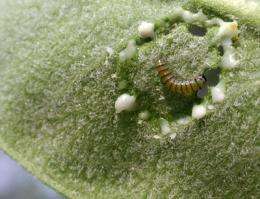
Before eating a common milkweed leaf, a newly hatched monarch butterfly caterpillar trims leaf hairs and cuts the leaf's veins to drain poisonous latex before feeding on the leaf tissue inside the circle. Image: Anurag Agrawal
(PhysOrg.com) -- A Cornell study on the diversity of milkweed plants has used new techniques to prove an old theory that explains how the arms race between attacking insects and defended plants led to great diversity of both.
The widely accepted 1964 theory, proposed by population control advocate Paul Ehrlich and botanist Peter Raven, outlined a process called adaptive radiation -- when species rapidly multiply and diversify for a time as they colonize new resources and then level off. For example, plants may diversify as they develop new chemical defenses to ward off foraging insects. In turn, insects adapt to the new chemicals and then diversify as they exploit new niches of chemically similar but distantly related plants.
The Cornell study, appearing online this week in the Proceedings of the National Academy of Sciences (PNAS) Early Edition, is one of the first to test the adaptive radiation theory proposed 45 years ago.
Using molecular techniques developed in the past decade, the researchers found that adaptive radiation did occur in milkweeds with a rapid burst followed by a plateau of new species in response to highly specialized caterpillars, including monarchs, that eat them. As milkweed plants developed prickly, hairy leaves, highly toxic chemicals (cardenolides) and gooey white latex that gums up a predator's mouth, the caterpillars evolved to become immune to the toxins, learned to cut the veins in the leaves to drain the latex before they ate them and shaved off leaf hairs with adapted mouths.
However, the study also found that instead of continuing to adapt and develop more defenses, as the adaptive radiation theory proposed, milkweed defense traits then declined; instead, the plants increased their ability to grow leaves back quickly, which the researchers said may be a more cost-effective strategy.
"The consistent decline in these defense traits is exactly opposite to what Ehrlich and Peters had proposed," said Anurag Agrawal, associate professor of ecology and evolutionary biology and the paper's lead author. "The surprising result is that the defensive declines in milkweed occurred early on in diversification and then slowed down. Adaptive radiation theory predicts this early change, but we did not expect the consistent declines," he added.
Using molecular genetic data on milkweed species, the researchers built a treelike classification diagram (a phylogeny) that reveals lineages of plant species branching off as they diversify from a common ancestor.
The study is one of a series -- organized by Agrawal and also published in PNAS -- of nine papers on applying modern phylogenetic approaches to study the history of life. In an introduction to the series, Agrawal and former Cornell undergraduate student Douglas Futuyma review the co-evolution of plants and insects and how their interactions led to greater diversification of both groups.
"We estimate there are somewhere between five and 10 million species on the planet," Agrawal said, excluding the relatively unknown world of bacteria, fungi and viruses and other species too small to see with the naked eye.
Of those larger organisms, there are about 5,000 known mammals and 10,000 birds, but perhaps 300,000 flowering plants and likely more than 3 million herbivorous (plant-eating) and up to 9 million total insect species.
"It's still a mystery why there are 300 times more herbivorous insects than bird species, but now we are able to implicate traits of both plants and insects that have given rise to so many species," said Agrawal. "The interaction between plants and insects has been part of their adaptive radiation."
-
Researcher shows evolution of milkweed defense system
Jul 22, 2008 |
not rated yet |
0
-
Milkweed's evolutionary approach to caterpillars: Counter appetite with fast repair
Jul 22, 2008 |
not rated yet |
0
-
New study reveals hidden neotropical diversity
May 15, 2008 |
not rated yet |
0
-
Darwin told us so: Researcher shows natural selection speeds up speciation
Apr 02, 2008 |
not rated yet |
0
-
Insects use plant like a telephone
Apr 23, 2008 |
not rated yet |
0
-
Fast photon control brings quantum photonic technologies closer
1 hour ago |
5 / 5 (2) |
0
-
Engineers build first sub-10-nm carbon nanotube transistor
Feb 01, 2012 |
4.9 / 5 (33) |
30
-
Something old, something new: Evolution and the structural divergence of duplicate genes
Jan 31, 2012 |
4.6 / 5 (7) |
1
-
The hidden nanoworld of ice crystals: Revealing the dynamic behavior of quasi-liquid layers
Jan 30, 2012 |
5 / 5 (5) |
1
-
Stock market network reveals investor clustering
Jan 27, 2012 |
3.9 / 5 (23) |
8
-
Factors affecting beet root cell membrane
Feb 12, 2012
-
Stem cell question.
Feb 10, 2012
-
Protease cleavage
Feb 10, 2012
-
Pertubance in a model
Feb 10, 2012
-
Cancer drugs and Alzheimer's, Oh my!
Feb 09, 2012
-
Squishing cells
Feb 09, 2012
- More from Physics Forums - Biology
More news stories
Big Society could threaten biodiversity conservation
A study of the Moray Firth Seal Management Plan (MFSMP), in north-east Scotland, identified four key conditions for long-term success, three of which pointed to the importance of direct government involvement.
1 hour ago |
not rated yet |
0
New molecule has potential to help treat genetic diseases and HIV
(PhysOrg.com) -- Chemists at The University of Texas at Austin have created a molecule that's so good at tangling itself inside the double helix of a DNA sequence that it can stay there for up to 16 days before ...
3 hours ago |
5 / 5 (2) |
0
|
Biobased approaches examined in fight against zebra chip
Thanks to investigations by scientists-turned-detectives with the U.S. Department of Agriculture (USDA) and other agencies, potato growers in the western United States and abroad now know the identities of ...
1 hour ago |
not rated yet |
0
Integrated pest management recommendations for the southern pine beetle
The southern pine beetle, Dendroctonus frontalis Zimmermann, is a chronic insect pest within pine forests in the southeastern United States. Under favorable environmental and host conditions, it is an agg ...
6 hours ago |
not rated yet |
0
A mitosis mystery solved: How chromosomes align perfectly in a dividing cell
Although the process of mitotic cell division has been studied intensely for more than 50 years, Whitehead Institute researchers have only now solved the mystery of how cells correctly align their chromosomes during symmetric ...
21 hours ago |
4.5 / 5 (24) |
0
|
Fast photon control brings quantum photonic technologies closer
(PhysOrg.com) -- Using photons instead of electrons to transmit information could lead to faster and more secure ways to communicate, among other advantages. Now a team of physicists has taken another step toward realizing ...
Planck mission steps closer to the cosmic blueprint
(PhysOrg.com) -- ESA's Planck mission has revealed that our Galaxy contains previously undiscovered islands of cold gas and a mysterious haze of microwaves. These results give scientists new treasure to mine ...
New ability to regrow blood vessels holds promise for treatment of heart disease
(Medical Xpress) -- University of Texas at Austin researchers have demonstrated a new and more effective method for regrowing blood vessels in the heart and limbs a research advancement that could have ...
Slowing ocean current caused Earth to spin faster
(PhysOrg.com) -- Most people probably didn’t notice it, but back in 2009, the Earth spun around on its axis a tiny bit faster than usual, making for some slightly shorter days. It only happened for a ...
Myths and shame keep many from seeking bankruptcy protection
(PhysOrg.com) -- Two interesting facts that may counter modern ideas about bankruptcy: The overwhelming majority of U.S. filings belong to individuals rather than corporations or entities, and most of these ...
Motivation to exercise affects behavior
(Medical Xpress) -- For many people, the motivation to exercise fluctuates from week to week, and these fluctuations predict whether they will be physically active, according to researchers at Penn State. In an effort to ...
Sep 09, 2009
Rank: 1 / 5 (1)
Sep 10, 2009
Rank: not rated yet
their fighting species invasion is preventing diversity (though it can only occur in time frames outside human perceptions).