Walruses congregate on Alaska shore as ice melts
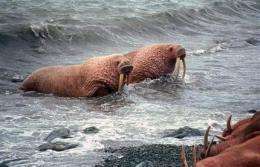
(AP) -- Thousands of walruses are congregating on Alaska's northwest coast, a sign that their Arctic sea ice environment has been altered by climate change.
Chad Jay, a U.S. Geological Survey walrus researcher, said Wednesday that about 3,500 walruses were near Icy Cape on the Chukchi Sea, some 140 miles southwest of Barrow.
Animals the agency tagged with satellite transmitters also were detected on shore at Cape Lisburne about 150 miles farther down the coast.
Walruses for years came ashore intermittently during their fall southward migration but not so early and not in such numbers.
"This is actually all new," Jay said. "They did this in 2007, and it's a result of the sea ice retreating off the continental shelf."
Federal managers and researchers say walruses hauling out on shore could lead to deadly stampedes and too much pressure on prey within swimming range. Projections of continued sea ice loss means the phenomenon likely is not going away.
"It's more of the same," Jay said. "What we've been seeing over the past few years with reduced sea ice conditions, we might be seeing this more and more often, and it's probably not good for the walruses," he said.
Unlike many seals, walruses cannot swim indefinitely and must rest periodically between feeding forays. They rely on sea ice as a platform for foraging for clams in the shallow waters of the outer continental shelf. They can dive up to 630 feet for clams and other sea floor creatures but mostly feed in waters of less than 330 feet, Jay said. Beyond the continental shelf, water can reach depths of 10,000 feet or more.
An estimated 6,000 or more walruses congregated on Alaska's shore in the fall of 2007, taking scientists by surprise.
Herds were in the tens of thousands at some locations on the Russian side of the Chukchi Sea, with an estimated 40,000 animals at Point Shmidt. Russian biologists reported 3,000 to 4,000 walruses out of population of perhaps 200,000 died, mostly young animals crushed in stampedes.
Alaska herds did not experience that sort of mortality but scientists acknowledge a concern when the marine mammals are concentrated on a rocky shore rather than hundreds of miles of sea ice edge.
"They may have a much higher predation pressure on those nearshore areas when they're using those land haulouts than when they're using sea ice," Jay said.
The Center for Biological Diversity has petitioned to list the Pacific walrus as an endangered or threatened because of habitat loss due to warming. The U.S. Fish and Wildlife Service on Tuesday agreed to begin a detailed status review. A 60-day public comment period will precede an agency listing decision by October 2010. A final decision would be made by the Interior secretary by October 2011.
The agency is working with the Federal Aviation Administration to warn away pilots, who can cause stampedes, said walrus researcher Joel Garlich-Miller. So can polar bears or human hunters. There is no legal mechanism to keep hunters away, he said, but people have been letting the animals rest.
USGS researchers plan to head to the Chukchi coast next week to place satellite tags on up to 30 animals so their foraging habits can be studied, Jay said.
The 2007 herds prompted researchers to gear up for studies of the animals' new habits last year. However, remnant ice floating apart from the main pack ice kept walruses off shore, Jay said. Their reappearance put the research plans into motion.
"We're trying to get more information on how the walruses are responding to the loss of sea ice over the continental shelf, where do they go when they do come to shore like this, how far offshore are they foraging," he said.
On land, walruses have to swim out and return rather than diving vertically. That could lead to nutritional stress.
"We suspect that it's going to cost them more energy to do that than if they were able to stay on the sea ice," he said.
Jay has not heard reports of walrus congregating on Russian shores. One animal tagged on the U.S. side has hauled out there and herds likely are gathering, he said.
©2009 The Associated Press. All rights reserved. This material may not be published, broadcast, rewritten or redistributed.


