Sickle cell study boosts call for improved childhood immunization programs in Africa
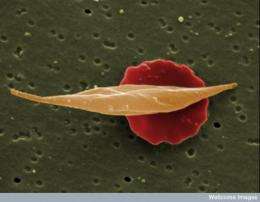
Children in Africa with sickle cell anaemia are dying unnecessarily from bacterial infections, suggests the largest study of its kind, funded by the Wellcome Trust. The results are published today in the journal the Lancet. The study has prompted calls for all children in Africa to receive vaccinations against the most common bacterial infections.
Sickle cell anaemia affects millions of people worldwide, but more than eighty per cent of cases are in Africa, where 200,000 children are born with the disease every year. It is a genetic disease, which leads to the formation of sickle-shaped red blood cells. These cells do not pass easily through blood vessels and can form clusters which block the flow of blood to limbs and organs, leading to pain, serious infections and organ damage.
Despite the huge number of children who are born with sickle cell anaemia in Africa annually, the diagnosis is often delayed and 90% of these children die before the disease is ever diagnosed. It has long been assumed that severe infections are responsible for many of these deaths, but this has never been properly investigated.
To find out the scale of the problem in Africa, researchers at the Kenya Medical Research Institute (KEMRI)-Wellcome Trust Programme in Kilifi, on the coast of Kenya, studied blood samples from all children aged under fourteen who were admitted to the local hospital during a ten year period between 1998-2008. They screened for cases of bacteraemia (bacterial infections of the blood) and then tested the positive samples for sickle cell anaemia.
By screening almost 40,000 admissions to the hospital, the researchers identified more than 2,000 cases of bacteraemia. However, whilst in the general population less than three in 1,000 children were found to have sickle cell anaemia, this figure increased more than twenty-fold - to over sixty per 1,000 - for children admitted to hospital with bacteraemia, confirming that, as in the developed world, African children with sickle cell anaemia are at huge risk of bacteraemia.
Amongst the most common causes of bacteraemia amongst children with sickle cell anaemia were Streptococcus pneumoniae (accounting for 41% of cases) and Haemophilus influenzae type b (12% of cases), both of which are serious infections, that may lead to pneumonia or meningitis, but are preventable by vaccination.
The research was led by Dr Tom Williams, a Wellcome Trust Senior Fellow and Reader in Tropical Medicine at the University of Oxford. He commented: "Our study provides strong impetus for the introduction of vaccination programmes for all children in Africa, a move that will dramatically improve the survival chances of children born with sickle cell anaemia. Health policies need to be based on solid evidence such as this research, rather than on rumour and personal preference."
The researchers estimate that in Kilifi, it is likely that up to one quarter of all child-deaths are attributable to sickle cell anaemia, with bacterial infections accounting for a sizable proportion.
Developing countries are working to reduce childhood mortality to meet one of the Millennium Development Goals. However, the focus is on the major causes of mortality - more than 70 per cent of child deaths every year are attributable to six causes: diarrhoea, malaria, neonatal infection, pneumonia, preterm delivery, or lack of oxygen at birth. As childhood mortality falls, Dr Williams believes that the relative contribution of sickle cell anaemia will increase without the development and implementation of specific interventions.
"To date, sickle cell anaemia has not enjoyed a high priority on African health agendas, despite the relatively high impact it has on childhood mortality, which far exceeds estimates for HIV," he says. "HIV commands vast attention from the international community, yet sickle cell anaemia is virtually invisible on the international health agenda."
Dr S K Sharif, Director of Public Health and Sanitation for the Kenyan government, says:
"This study will make a huge difference to the way my ministry thinks about sickle cell disease. We need much more information along these lines to help us develop appropriate policies that will help us to improve the lives of all Kenyans born with this condition."
Source: Wellcome Trust (news : web)


