Pandemic flu can infect cells deep in the lungs, says new research
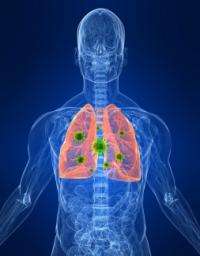
(PhysOrg.com) -- Pandemic swine flu can infect cells deeper in the lungs than seasonal flu can, according to a new study published today in Nature Biotechnology. The researchers, from Imperial College London, say this may explain why people infected with the pandemic strain of swine-origin H1N1 influenza are more likely to suffer more severe symptoms than those infected with the seasonal strain of H1N1. They also suggest that scientists should monitor the current pandemic H1N1 influenza virus for changes in the way it infects cells that could make infections more serious.
Influenza viruses infect cells by attaching to bead-like molecules on the outside of the cell, called receptors. Different viruses attach to different receptors, and if a virus cannot find its specific receptors, it cannot get into the cell. Once inside the cell, the virus uses the cell's machinery to make thousands more viruses, which then burst out of the cell and infect neighbouring ones, establishing an infection.
Seasonal influenza viruses attach to receptors found on cells in the nose, throat and upper airway, enabling them to infect a person's respiratory tract. Today's research, which was funded by the Wellcome Trust, the Medical Research Council and the Engineering and Physical Sciences Research Council, shows that pandemic H1N1 swine flu can also attach to a receptor found on cells deep inside the lungs, which can result in a more severe lung infection.
The pandemic influenza virus's ability to stick to the additional receptors may explain why the virus replicates and spreads between cells more quickly: if a flu virus can bind to more than one type of receptor, it can attach itself to a larger area of the respiratory tract, infecting more cells and causing a more serious infection.
Professor Ten Feizi, a corresponding author of today's paper from the Division of Medicine at Imperial College London, said: "Most people infected with swine-origin flu in the current pandemic have experienced relatively mild symptoms. However, some people have had more severe lung infections, which can be worse than those caused by seasonal flu. Our new research shows how the virus does this - by attaching to receptors mostly found on cells deep in the lungs. This is something seasonal flu cannot do."
The researchers found that pandemic H1N1 influenza bound more weakly to the receptors in the lungs than to those in the upper respiratory tract. This is why most people infected with the virus have experienced mild symptoms. However, the researchers are concerned that the virus could mutate to bind more strongly to these receptors.
"If the flu virus mutates in the future, it may attach to the receptors deep inside the lungs more strongly, and this could mean that more people would experience serious symptoms. We think scientists should be on the lookout for these kinds of changes in the virus so we can try to find ways of minimising the impact of such changes," added Professor Feizi.
The researchers compared the way seasonal and pandemic H1N1 flu viruses infect cells by identifying which receptors each virus binds to. To do this, the researchers used a glass surface with 86 different receptors attached to it, called a carbohydrate microarray. When viruses were added to the glass surface, they stuck to their specific receptors and the corresponding areas on the plate 'lit up'. This meant the researchers could see which receptors the different viruses attached to.
Pandemic H1H1 influenza could bind strongly to receptors called α2-6, which are found in the nose, throat and upper airway, and it could also attach more weakly to α2-3 receptors, which are found on cells deeper inside the lungs. However, seasonal H1N1 influenza could only attach to α2-6.
"Receptor binding determines how well a virus spreads between cells and causes an infection," said Professor Feizi. "Our new study adds to our understanding of how swine-origin influenza H1N1 virus is behaving in the current pandemic, and shows us changes we need to look out for."
More information: "Receptor-binding specificity of pandemic influenza A (H1N1) 2009 virus determined by carbohydrate microarray" Nature Biotechnology, 10 September 2009.
Source: Imperial College London (news : web)


