Giant stone-age axes found in African lake basin
September 10, 2009 Giant stone-age axes found in African lake basin

Enlarge

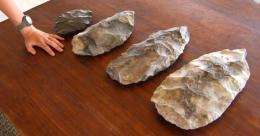
Four giant stone hand axes were recovered from the the dry basin of Lake Makgadikgadi in the Kalahari Desert.

(PhysOrg.com) -- A giant African lake basin is providing information about possible migration routes and hunting practices of early humans in the Middle and Late Stone Age periods, between 150,000 and 10,000 years ago.

Oxford University researchers have unearthed new evidence from the lake basin in Botswana that suggests that the region was once much drier and wetter than it is today.

They have documented thousands of stone tools on the lake bed, which sheds new light on how humans in Africa adapted to several substantial events during the period that coincided with the last Ice Age in Europe.

Researchers from the School of Geography and the Environment at the University of Oxford are surveying the now-dry basin of Lake Makgadikgadi in the Kalahari Desert, which at 66,000 square kilometres is about the same size of present day Lake Victoria.

Their research was prompted by the discovery of the first of what are believed to be the world’s largest stone tools on the bed of the lake. Although the first find was made in the 1990s, the discovery of four giant axes has not been scientifically reported until now. Four giant stone hand axes, measuring over 30 cm long and of uncertain age, were recovered from the lake basin.

Equally remarkable is that the dry lake floor where they were found is also littered with tens of thousands of other smaller stone-age tools and flakes, the researchers report.

Professor David Thomas, Head of the School of Geography and the Environment at the University of Oxford, said: ‘Many of the tools were found on the dry lake floor, not around its edge, which challenges the view that big lakes were only attractive to humans when they were full of water.

'As water levels in the lake went down, or during times when they fluctuated seasonally, wild animals would have congregated round the resulting watering holes on the lake bed. It’s likely that early human populations would have seen this area as a prolific hunting ground when food resources in the region were more concentrated than at times when the regional climate was wetter and food was more plentiful and the lake was full of water.’

This work is part of an ongoing project investigating the complex history of major changes in climate in Africa. Co-researcher Dr Sallie Burrough has dated the sediment and shorelines of the lake basin, which has shown that the mega lake was filled with water on multiple occasions in the last 250,000 years. The research team has also investigated islands on the floor of the lake - remnants of former sand dunes - which suggest the region’s climate has also been both windier and markedly drier than it is today.

Professor Thomas said: ‘The interior of southern Africa has usually been seen as being devoid of significant archaeology. Surprisingly, we have found and logged incredibly extensive Middle Stone Age artefacts spread over a vast area of the lake basin.

'The record the basin is revealing is one of marked human adaptation in the past. saw the opportunity to use the lake basin when it was not full of water, but at least seasonally dry. It shows that humans have adapted to climate change and variability in a sustained way.'

Many archaeologists believe that equivalent lakes in the North African Sahara desert played an important part in the ‘Out of Africa’ human expansion theory, as the ancestors of all modern humans would have chosen a wet route out of Africa. The new research is the first time that this giant Botswanan lake basin in southern Africa has been the focus of scientific research, and these findings could provide new evidence to support the theory about a hominid migration through and expansion from Africa.

Professor Thomas and Dr Burrough are planning further research into how the lake was formed and how it came and went. They say that the most likely explanation is that sustained periods of greater rainfall in the Angolan Highlands resulted in much greater flow in the Zambezi River, with the water being diverted into the lake basin due to a quirk of geology.

New research, beginning in 2010 and funded by the Leverhulme Trust, will investigate possible links between the lake basin and the Zambezi River, while initial discussions are in hand for setting up a major international geo-archaeologist programme to further unravel the complexities of human-climate-environment interactions in this important and under-researched region.

Provided by Oxford University (news : web)


print this article email this article download pdf blog this article bookmark this article     Stumble it Digg this share on Facebook retweet share on Reddit add to delicious
Rate this story - 4.3 /5 (18 votes)

Rank Filter

Move the slider to adjust rank threshold, so that you can hide some of the comments.


Display comments: newest first

  • fossilator - Sep 10, 2009
    • Rank: 5 / 5 (1)
    Giant axes = giant axe-bearers? Biblical literalists should have a field day with this.

    "There were giants in the earth in those days" (Genesis 6:4)
  • otto1923 - Sep 10, 2009
    • Rank: not rated yet
    Exactly what I was going to post... Nephelim :-)
    ‘The interior of southern Africa has usually been seen as being devoid of significant archaeology
    So maybe there's another species to be found, the source of legend. Grendl et al-
  • mvg - Sep 10, 2009
    • Rank: 3 / 5 (1)
    Any comments on what the axes would have been used for? and how they would have been used?

    Seems somewhat cumbersome for everyday kitchenware.
  • codesuidae - Sep 10, 2009
    • Rank: 2 / 5 (1)
    Wow, I wonder what they used for a flint-napping striker for those. Must have been a chore to make.
  • Mayday - Sep 10, 2009
    • Rank: 4 / 5 (1)
    They could have been used for ceremonial purposes. Or used symbolically. I think of the gigantic swords in Bagdad. Or they could be used for sacrifice or even execution.
  • defunctdiety - Sep 10, 2009
    • Rank: 4 / 5 (2)
    Any comments on what the axes would have been used for? and how they would have been used?

    Seems somewhat cumbersome for everyday kitchenware.

    Probably for cutting off legs, heads, of prey i.e. butchering, breaking the larger beast down to more manageable chunks for skinning, filleting, etc.
  • RayCherry - Sep 10, 2009
    • Rank: 4 / 5 (1)
    Fossilator & Otto: ancient manuscripts are littered with references to to giants, including Noah & Family, the Gilgamesh version, and the original inhabitants of Alba ... but these axes may not have been used by such large folks. Would be wonderful to find a large well-preserved skeleton though.

    mvg & defunctdiety: considering that these axes were found in an ancient lake bed, might they in fact be hand-shovels? Created to cut through baked soil crust (using both hands) and pull the loose soil out of the hole produced, to reveal subsurface mud/water?

    Mayday: if they were going to show off in the stone age, would they not leave behind a StoneHenge, or at least a Long Barrow?

    Keep up the good work, Oxford.
  • defunctdiety - Sep 10, 2009
    • Rank: not rated yet
    ...might they in fact be hand-shovels...

    It's certainly possible, I think no matter what they were used for, the largest of them were for sure two-handed implements.

    And I'm sure they can tell from wear and tear markings on the tools what they were used for, digging would be dulled and smoothed after lots of use, butchering would have indicative semi circular chips and what not, I would think.

    My only thought that might go against the shovel theory is that they would not have to, or want to, put that much effort into making a shovel.
  • otto1923 - Sep 10, 2009
    • Rank: not rated yet
    but these axes may not have been used by such large folks
    Jeez Ray thanks for the profundity 8-O

September 10, 2009 all stories

Comments: 9

4.3 /5 (18 votes)
  • Stumble this up

  • Digg this

  • share this

  • hide
  • Related Stories

  • Freshwater herring had salty origin
    created Apr 23, 2008 | popularity not rated yet | comments 0
  • Change from Arid to Wet Climate in Africa Altered Early Human Evolution
    created Sep 06, 2007 | popularity not rated yet | comments 0
  • Great lakes water levels expected to drop
    created Mar 19, 2007 | popularity not rated yet | comments 0
  • Climate change blamed for missing lake
    created Jul 05, 2007 | popularity not rated yet | comments 0
  • Drying African lakes pose health threat
    created Nov 02, 2005 | popularity not rated yet | comments 0


  • hide
  • Relevant PhysicsForums posts

  • Breeding program
    created 23 hours ago
  • How does a concentration gradient provide energy?
    created Nov 20, 2009
  • Eyesight and Neural Damage from Electronics
    created Nov 19, 2009
  • Quick question about the Golgi Apparatus?
    created Nov 19, 2009
  • The beginning of humans
    created Nov 18, 2009
  • Omega 3 questions
    created Nov 18, 2009
  • More from Physics Forums - Biology

Other News

Museum: Galileo's fingers, tooth are found (AP)

Museum: Galileo's fingers, tooth are found

Other Sciences / Archaeology & Fossils

created 9 hours ago | popularity not rated yet | comments 5

(AP) -- Two fingers and a tooth removed from Galileo Galilei's corpse in a Florentine basilica in the 18th century and given up for lost have been found again and will soon be put on display, an Italian museum ...


Measure to change U. of Neb. stem-cell rule fails (AP)

Measure to change U. of Neb. stem-cell rule fails (Update 2)

Other Sciences / Other

created 9 hours ago | popularity 5 / 5 (1) | comments 0

(AP) -- The University of Nebraska's governing board on Friday voted not to place tighter restrictions on embryonic stem cell research than those outlined under federal guidelines, which were expanded after ...


Researcher: Faint writing seen on Shroud of Turin (AP)

Researcher: Faint writing seen on Shroud of Turin (Update)

Other Sciences / Archaeology & Fossils

created Nov 20, 2009 | popularity 1.8 / 5 (20) | comments 22

(AP) -- A Vatican researcher has rekindled the age-old debate over the Shroud of Turin, saying that faint writing on the linen proves it was the burial cloth of Jesus. Experts say the historian may be reading ...


Three of a kind

Three of a kind: Revealing language’s universal essence

Other Sciences / Social Sciences

created Nov 20, 2009 | popularity 3.5 / 5 (8) | comments 6

(PhysOrg.com) -- On the surface, English, Japanese, and Kinande, a member of the Bantu family of languages spoken in the Democratic Republic of Congo, have little in common. It is not just that the vocabularies ...


Maya

New insights into the life of the Maya

Other Sciences / Archaeology & Fossils

created Nov 16, 2009 | popularity 4.6 / 5 (15) | comments 7

(PhysOrg.com) -- Ancient artifacts are almost always concerned with rich and powerful religious and political leaders, but new excavations of an ancient Maya site have unearthed a pyramid decorated with murals ...