Researchers develop drug delivery system using nanoparticles and lasers
September 10, 2009 Researchers develop drug delivery system using nanoparticles and lasers

Enlarge

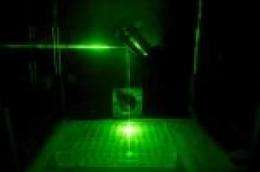
The near-infrared laser pathway into the cell culture plate, traced by visible laser for photo. Credit: Rod Rolle

Researchers at UC Santa Barbara have developed a new way to deliver drugs into cancer cells by exposing them briefly to a non-harmful laser. Their results are published in a recent article in ACS Nano, a journal of the American Chemical Society.

"This entirely novel tool will allow biologists to investigate how genes function by providing them with temporal and spatial control over when a gene is turned on or off," explained Norbert Reich, senior author and a professor in the Department of Chemistry and Biochemistry at UCSB. "In a nutshell, what we describe is the ability to control genes in cells -- and we are working on doing this in animals -- simply by briefly exposing them to a non-harmful ."

The scientists used cancer cells from mice, and grew them in culture. They then introduced gold nanoshells, with a peptide-lipid coating, that encapsulated "silencing ribonucleic acid" (siRNA), which was the drug that was taken up by the cells. Next, they exposed the cells to a non-harmful .

"A major technical hurdle is how to combine multiple biochemical components into a compact nanoparticle which may be taken up by cells and exist stably until the release is desired," said Gary Braun, first author and a graduate student in UCSB's Department of Chemistry and Biochemistry. "Laser-controlled release is a convenient and powerful tool, allowing precise dosing of particular cells within a group. The use of biologically friendly tissue penetration with near-infrared light is the ideal for extending this capability into larger biological systems such as tissues and animals."

The authors demonstrated, for the first time, the delivery of a potent siRNA cargo inside mammalian cancer cells, released by exposing the internalized for several seconds to a pulsed near-infrared laser tuned for peak absorption with a specific spatial pattern. The technique can be expanded to deliver numerous drug molecules against diverse biological targets.

Source: University of California - Santa Barbara (news : web)


print this article email this article download pdf blog this article bookmark this article     Stumble it Digg this share on Facebook retweet share on Reddit add to delicious
Rate this story - not rated yet

Rank Filter

Move the slider to adjust rank threshold, so that you can hide some of the comments.


Display comments: newest first

  • E_L_Earnhardt - Sep 10, 2009
    • Rank: not rated yet
    A cell malfunctioning due to electrons from cosmic and x-ray, etc., needs additional electrons from a laser like a drowning man needs a BRICK!

September 10, 2009 all stories

Comments: 1

not rated yet
  • Stumble this up

  • Digg this

  • share this

  • hide
  • Related Stories

  • Gold nanoparticles for controlled drug delivery
    created Dec 30, 2008 | popularity not rated yet | comments 0
  • Hollow gold nanospheres show promise for biomedical and other applications
    created Mar 22, 2009 | popularity not rated yet | comments 0
  • Scientists discover potential new drug delivery system
    created Aug 25, 2009 | popularity not rated yet | comments 0
  • Pack 'Em In -- Gold Nanoparticles Improve Gene Regulation
    created Feb 23, 2009 | popularity not rated yet | comments 0
  • Nanorods show benefits cancer treatment
    created Mar 14, 2006 | popularity not rated yet | comments 0


  • hide
  • Relevant PhysicsForums posts

  • What is transpulmonary pressure?
    created Nov 24, 2009
  • Is there a gay gene?
    created Nov 23, 2009
  • Super quick question about Starling forces?
    created Nov 22, 2009
  • Questions about diffusion
    created Nov 22, 2009
  • More from Physics Forums - Biology

Other News

Fast, easy, and highly sensitive arsenic detection with gold nanoparticles

Nanotechnology / Nanomaterials

created 7 hours ago | popularity 5 / 5 (1) | comments 0

(PhysOrg.com) -- Mention of arsenic poisoning usually brings to mind underhanded murder. However, the danger of arsenic poisoning from contaminated drinking water is far greater. Low concentrations of arsenic are found in ...


Nanotech in Space: Experiment To Weather the Trials of Orbit

Nanotech in Space: Experiment To Weather the Trials of Orbit

Nanotechnology / Nanomaterials

created 19 hours ago | popularity 4 / 5 (2) | comments 0

Novel nanomaterials developed at Rensselaer were sent into orbit on Nov. 16 aboard Space Shuttle Atlantis.


Water droplets direct self-assembly process in thin-film materials

Nanotechnology / Nanomaterials

created Nov 23, 2009 | popularity 5 / 5 (4) | comments 2

You can think of it as origami - very high-tech origami. Researchers at the University of Illinois have developed a technique for fabricating three-dimensional, single-crystalline silicon structures from thin films by coupling ...


Nanotube defects equal better energy and storage systems

Nanotube defects equal better energy and storage systems

Nanotechnology / Nanomaterials

created Nov 19, 2009 | popularity 4.4 / 5 (10) | comments 2

(PhysOrg.com) -- Most people would like to be able to charge their cell phones and other personal electronics quickly and not too often. A recent discovery made by UC San Diego engineers could lead to carbon ...


Peptides control crystal growth with 'switches, throttles and brakes'

Peptides control crystal growth with 'switches, throttles and brakes'

Nanotechnology / Bio & Medicine

created Nov 23, 2009 | popularity 5 / 5 (3) | comments 0

(PhysOrg.com) -- By producing some of the highest resolution images of peptides attaching to mineral surfaces, scientists have a deeper understanding how biomolecules manipulate the growth crystals. This research ...