Dividing cells 'feel' their way out of warp
September 10, 2009
Dividing cells 'feel' their way out of warp

Enlarge

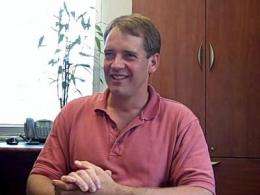
Douglas N. Robinson, Ph.D., is an associate professor of Cell Biology, Pharmacology and Molecular Sciences, Johns Hopkins University School of Medicine. Credit: Johns Hopkins Medicine

Every moment, millions of a body's cells flawlessly divvy up their genes and pinch perfectly in half to form two identical progeny for the replenishment of tissues and organs -- even as they collide, get stuck, and squeeze through infinitesimally small spaces that distort their shapes.

Now Johns Hopkins scientists, working with the simplest of organisms, have discovered the molecular sensor that lets cells not only "feel" changes to their neat shapes, but also to remodel themselves back into ready-to-split symmetry. In a study published September 15 in , the researchers show that two force-sensitive proteins accumulate at the sites of cell-shape disturbances and cooperate first to sense the changes and then to resculpt the cells. The proteins — II and cortexillin I — monitor and correct shape changes in order to ensure smooth division.

This video is not supported by your browser at this time.

Watch dividing cells "feel" their way out of warp. Credit: Johns Hopkins Medicine

"What we found is an exquisitely tuned mechanosensory system that keeps the cells shipshape so they can divide properly," says Douglas N. Robinson, Ph.D., an associate professor of , Pharmacology and Molecular Sciences, Johns Hopkins University School of Medicine.

Faulty cell division can put organisms, including people, on the pathway to diseases such as cancer, Robinson notes, and a better understanding of how cells respond to mechanical stress on their shapes could present new targets for both diagnosing and treating such diseases.

Working with hardy, single-celled protozoa that move and divide similarly to human cells, the scientists watched through microscopes while they deformed the cells' shapes with a tiny instrument that, like a soda straw, sucks in on the cell surface and creates distorted shapes.

"This particular method, based on a very old principle that dates back to Archimedes, enables us to deform cells without killing them, much in the same way that natural processes in the body constantly assault them, Robinson says."

Once the cells were warped, the scientists monitored the movements of fluorescent-tagged myosin II and cortexillin I. Myosin, which normally accumulates in the middles of cells during division to help power that process, collected instead at the sites of disturbances made by the micropipette. Also amassing with myosin was cortexillin I, a so-called actin-crosslinking protein that, like glue, holds the toothpick-like filaments of a cell's housing together.

In the experiments, as soon as the two proteins accumulated to a certain level, the cells contracted, escaping the pipettes and assuming their original shapes. After the cells righted themselves, the proteins realigned along the cells' midlines and pinched to divide symmetrically into two daughter cells.

The researchers repeated the experiment using cells engineered to lack myosin II and then again with cells lacking cortexillin I. They discovered that cortexillin I responded to deformations except when myosin II was removed, and myosin II responded to deformations except when cortexillin I was removed.

"It's clear that the two need each other to operate as a cellular mechanosensor," Robinson says.

Source: Johns Hopkins Medical Institutions


Rank not rated yet
Related Stories
Relevant PhysicsForums posts
  • Stem cell question.
    createdFeb 10, 2012
  • Protease cleavage
    createdFeb 10, 2012
  • Pertubance in a model
    createdFeb 10, 2012
  • Cancer drugs and Alzheimer's, Oh my!
    createdFeb 09, 2012
  • Squishing cells
    createdFeb 09, 2012
  • Any books/articles for evolutionary stable strategy models in humans?
    createdFeb 09, 2012
  • More from Physics Forums - Biology

More news stories

Entire genome of extinct human decoded from fossil

(PhysOrg.com) -- In 2010, Svante Pääbo and his colleagues presented a draft version of the genome from a small fragment of a human finger bone discovered in Denisova Cave in southern Siberia. The ...

Biology / Biotechnology

created Feb 07, 2012 | popularity 4.7 / 5 (58) | comments 44 | with audio podcast

Why are there so few fish in the Earth's oceans?

(PhysOrg.com) -- A Stony Brook University researcher has found that, contrary to popular belief, there are not plenty of fish in the sea.

Biology / Plants & Animals

created Feb 08, 2012 | popularity 4.3 / 5 (17) | comments 26 | with audio podcast

Miami battling invasion of giant African snails

No one knows how they got there. But an invasion of African giant snails has southern Florida in a panic over potential crop damage, disease and general yuckiness surrounding the slimy gastropods.

Biology / Ecology

created Feb 10, 2012 | popularity 4.5 / 5 (2) | comments 5

The power of estrogen -- male snakes attract other males

A new study has shown that boosting the estrogen levels of male garter snakes causes them to secrete the same pheromones that females use to attract suitors, and turned the males into just about the sexiest ...

Biology / Plants & Animals

created Feb 10, 2012 | popularity 4.8 / 5 (6) | comments 2 | with audio podcast

Deciding to go left or right: Researchers use device to determine that lower animals can navigate too

For decades, scientists have associated binary decision making — opting to go left or right — with higher-ranking animals, including humans. A team of Harvard researchers, however, is rewriting that ...

Biology / Plants & Animals

created Feb 09, 2012 | popularity 4 / 5 (1) | comments 4 | with audio podcast


Walney offshore wind farm is world's biggest (for now)

(PhysOrg.com) -- The Walney wind farm on the Irish Sea--characterized by high tides, waves and windy weather--officially opened this week. The farm is treated in the press as a very big deal as the Walney ...

GPS court ruling leaves US phone tracking unclear

A US Supreme Court decision requiring a warrant to place a GPS device on the car of a criminal suspect leaves unresolved the bigger issue of police tracking using mobile phones, legal experts say.

Europeans protest controversial Internet pact

Tens of thousands of people marched in protests in more than a dozen European cities Saturday against a controversial anti-online piracy pact that critics say could curtail Internet freedom.

Europe stakes billion-dollar bet on new rocket

A pencil-slim rocket is scheduled to lift into space from South America on Monday, carrying a billion-dollar bet that Europe can grab a juicy slice of the market to place satellites in low orbit.

Study finds that anti-diabetic medication can prevent the long-term effects of maternal obesity

In a study to be presented today at the Society for Maternal-Fetal Medicine's annual meeting, The Pregnancy Meeting, in Dallas, Texas, researchers will report findings that show that short therapy with the anti-diabetic medication ...

Netflix settlement trims 14 pct off 4Q earnings

(AP) -- Netflix pressed the rewind button on its fourth-quarter earnings after settling allegations that the video subscription service violated a consumer-privacy law.