New hyperspectral imager launched to International Space Station
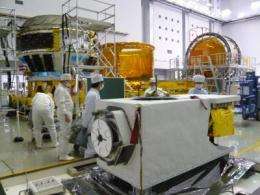
Following a fast-paced 16 month design and development process, NRL's Remote Sensing and Space Science Divisions and the Naval Center for Space Technology provide the first-ever high quality and real-time monitoring of space weather and coastal ocean environment directly from the new Japanese Experiment Module-Exposed Facility (JEM-EF) on the International Space Station (ISS).
Designed and built by NRL, the Hyperspectral Imager for the Coastal Ocean (HICO) and Remote Atmospheric and Ionospheric Detection System (RAIDS) Experiment Payload (HREP) launched September 10, 2009, on-board the Japanese Aerospace Exploration Agency (JAXA) H-II Transfer Vehicle. The Aerospace Corporation provided HREP structure analysis and the thermal design and analysis.
A complex series of maneuvers, involving both the ISS and the JEM-EF manipulator arms, will transfer HREP from the vehicle to its deployment station on the JEM-EF. HICO is the first space-borne sensor specifically designed for coastal maritime hyperspectral imaging, and RAIDS is a hyperspectral imaging sensor suite for innovative measurement of the Earth's thermosphere and ionosphere.
"Never has the ISS been utilized as a platform to conduct scientific Earth observations of this nature," said Dr. Mike Corson, NRL Remote Sensing Division and HICO Principal Investigator. "This collaboration of a diverse international and interagency consortium opens exciting opportunities for future basic and applied space-based research."
The ISS offers a challenging, and novel research platform for oceanic and atmospheric observations. Because it is not in a Sun-synchronous orbit, the ISS offers a wide range of illumination angles and ample opportunity to study local time variations of the upper atmosphere. The ISS provides power to the HICO and RAIDS instruments and offers a high-availability communication link, streaming data to NRL's Washington, D.C., campus for processing, analyses, archiving and distribution.
Hyperspectral imaging is a powerful remote sensing technique for environmental characterization of the Earth. HICO is a down-looking hyperspectral imager that includes a high quantum efficiency focal plane array to achieve high signal-to-noise ratios at water-penetrating wavelengths (380-1000 nanometers). It is the first space-borne sensor optimized for scientific investigation of the coastal ocean and nearby land regions. HICO will demonstrate coastal products critical for governmental and scientific applications including water clarity, bottom-types, bathymetry and on-shore vegetation maps.
Initial calibration and processing of the HICO data is performed at the NRL Remote Sensing Division. The data is then sent to NRL's Oceanography Division at Stennis Space Center, Miss., for further processing, archiving, and distribution to government users. Data will also be archived at Oregon State University, which is the primary repository for distribution of HICO data products to civilian users. The Office of Naval Research (ONR) as part of their "Space Innovative Naval Prototype" program funded HICO instrument design and fabrication.
RAIDS, built collaboratively by NRL and The Aerospace Corporation, combines a suite of eight optical instruments to study the Earth's thermosphere and ionosphere using hyperspectral limb scanning techniques. RAIDS includes two spectrographs, three spectrometers and three photometers that collectively span the extreme-ultraviolet to near-infrared passband (55-874 nanometers). The science team will use the measurements to explore the effects of lower-atmospheric tides on the ionosphere-thermosphere system, demonstrate advanced dayside ionospheric remote sensing, and study upper atmosphere chemical and thermal processes. By filling existing measurement gaps, these data will not only expose fundamental physics of the upper atmosphere, but also provide a testbed for state-of-the-art global assimilative models that specify and forecast ionospheric weather relevant to civilian and military space-based systems.
"The thermosphere and ionosphere comprise the rarefied atmospheric region where many space assets orbit," said Dr. Scott Budzien, NRL Space Science Division and RAIDS Principal Investigator. "RAIDS gathers data continuously and transmits this data in real-time, allowing live monitoring of the upper atmospheric environment for more accurate space weather forecasting."
The HICO and RAIDS sensors are mounted inside the HREP enclosure along with a computer for communication, instrument control and data storage, and a star camera to provide precise attitude determination. Attitude information from the star camera is used to improve the knowledge of the HICO and RAIDS line-of-sight pointing directions. Costs for the design, assembly, and testing of the HREP instrument enclosure were provided by ONR and the DoD Space Test Program (STP). STP provided launch and integration costs. Supported by NASA, STP selected HREP to be the first US science payload to be deployed on the Japanese Experiment Module-Exposed Facility.
Source: Naval Research Laboratory


