Archaeologists discover oldest-known fiber materials used by early humans
September 10, 2009 Oldest-known fibers to be used by humans discovered

Enlarge

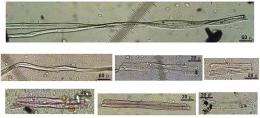
A team of archaeologists and paleobiologists has discovered flax fibers in these microscopic soil samples. The flax, which would have been collected from the wild and not farmed, is believed to be more than 34,000 years old, making these fibers the oldest known to have been used by humans. Image: Science/AAAS

(PhysOrg.com) -- A team of archaeologists and paleobiologists has discovered flax fibers that are more than 34,000 years old, making them the oldest fibers known to have been used by humans. The fibers, discovered during systematic excavations in a cave in the Republic of Georgia, are described in this week's issue of Science.

The flax, which would have been collected from the wild and not farmed, could have been used to make linen and thread, the researchers say. The cloth and thread would then have been used to fashion garments for warmth, sew leather pieces, make cloths, or tie together packs that might have aided the mobility of our ancient from one camp to another.

The excavation was jointly led by Ofer Bar-Yosef, George Grant MacCurdy and Janet G. B. MacCurdy Professor of Prehistoric in the Faculty of Arts and Sciences at Harvard University, with Tengiz Meshveliani from the Georgian State Museum and Anna Belfer-Cohen from the Hebrew University. The microscopic research of the soil samples in which numerous flax fibers were discovered was done by Eliso Kvavadze of the Institute of Paleobiology, part of the National Museum of Georgia.

"This was a critical invention for early humans. They might have used this fiber to create parts of clothing, ropes, or baskets—for items that were mainly used for domestic activities," says Bar-Yosef. "We know that this is wild flax that grew in the vicinity of the cave and was exploited intensively or extensively by modern humans."

The items created with these fibers increased early humans chances of survival and mobility in the harsh conditions of this hilly region. The flax fibers could have been used to sew hides together for clothing and shoes, to create the warmth necessary to endure cold weather. They might have also been used to make packs for carrying essentials, which would have increased and eased mobility, offering a great advantage to a hunter-gatherer society.

Some of the fibers were twisted, indicating they were used to make ropes or strings. Others had been dyed. Early humans used the plants in the area to color the fabric or threads made from the flax.

Today, these fibers are not visible to the eye, because the garments and items sewed together with the flax have long ago disintegrated. Bar-Yosef, Kvavadze and colleagues discovered the fibers by examining samples of clay retrieved from different layers of the cave under a microscope.

The discovery of such ancient fibers was a surprise to the scientists. Previously, the oldest known were imprints of fibers in small clay objects found in Dolni Vestonice, a famous site in the Czech Republic some 28,000 years old.

The scientists' original goal was to analyze tree pollen samples found inside the cave, part of a study of environmental and temperature fluctuations over the course of thousands of years that would have affected the lives of these . However, while looking for this pollen, Kvavadze, who led the analysis of the pollen, also discovered non-pollen polymorphs - these flax fibers.

Bar-Yosef and his team used radiocarbon dating to date the layers of the cave as they dug the site, revealing the age of the clay samples in which the fibers were found. Flax fibers were also found in the layers that dated to about 21,000 and 13,000 years ago.

Bar-Yosef's team began the excavations of this cave in 1996, and has returned to the site each year to complete this work.

"We were looking to find when the cave was occupied, what was the nature of the occupation by those early hunter-gatherers, where did they go hunting and gathering food, what kind of stone tools they used, what types of bone and antler tools they made and how they used them, whether they made beads and pendants for body decoration, and so on," says Bar-Yosef. "This was a wonderful surprise, to discover these ancient flax fibers at the end of this excavation project."

Source: Harvard University (news : web)


Rate this story - 4.5 /5 (11 votes)

Rank Filter

Move the slider to adjust rank threshold, so that you can hide some of the comments.


Display comments: newest first

  • docknowledge - Sep 10, 2009
    • Rank: 1 / 5 (1)
    What's annoying about these stories is that even professionals will now start thinking of "the beginning" of human use of fibers as being 34,000 years ago. Ignoring that there's a strong chance the date will be pushed even further back.

    Now a decade of school texts will be written quoting "34,000". A generation of archaeologists and professors will grow up implicitly believing that "that's the way it started".

    Archeologists should spend more effort recognizing and assessing the limits of their state of knowledge.
  • eachus - Sep 10, 2009
    • Rank: 1 / 5 (2)
    I can't believe the stupidity of the article. Not the science, the implications. It seems obvious to me that the ascendancy of the human race started with fishing, either with hooks or nets. Obviously once you have enough food--and any tribe that first discovered fishing would have plenty of food--then you can concentrate on clothing and other things.

    Of course, the other implication here, which I am waiting to see confirmed, is that reeds, flax, and other materials useful in fishing (or baskets for fish ;-) would be the first agricultural products. No early tribe could afford to start farming without an abundant supply of food. And if you have enough food, why grow food? (Well, maybe for variety.)

    But in a community that got most of its food from fishing, growing crops to replace leather and furs in clothing makes sense. Remember that every fisherman in the community would see the wisdom of cultivating flax and other crops that could be used to make nets or fishing line.
  • RBurr - Sep 10, 2009
    • Rank: 5 / 5 (1)
    Based on genetic evidence involving human lice, we had evidence for humans wearing clothes going back 75-80,000 years ago. This fills in some detail on what sort of clothing materials were in use for a smidgeon of that prehistoric time period in one portion of the world. As such, it's an interesting data point.

September 10, 2009 all stories

Comments: 3

4.5 /5 (11 votes)

  • hide
  • Related Stories

  • Earliest evidence of our cave-dwelling human ancestors
    created Dec 19, 2008 | popularity not rated yet | comments 0
  • Ancient figs may be first cultivated crop
    created Jun 02, 2006 | popularity not rated yet | comments 0
  • Ancient Buddhist murals found in Nepal
    created May 05, 2007 | popularity not rated yet | comments 0
  • Low-cost fibers remove trace atrazine from drinking water
    created Aug 23, 2004 | popularity not rated yet | comments 0
  • Illinois cave reveals ancient pine
    created May 12, 2007 | popularity not rated yet | comments 0


  • hide
  • Relevant PhysicsForums posts

  • Sleeping habits and the risk of cancer
    created Feb 08, 2010
  • Pressure in chambers of the heart
    created Feb 07, 2010
  • Primordial soup canned?
    created Feb 07, 2010
  • Where on the r/K selection theory scale do social insects like ants and bees fall?
    created Feb 06, 2010
  • Testosterone levels and Fighting
    created Feb 05, 2010
  • Evolution Simulator
    created Feb 04, 2010
  • More from Physics Forums - Biology

Other News

Study challenges bird-from-dinosaur theory of evolution - was it the other way around?

Study challenges bird-from-dinosaur theory of evolution - was it the other way around?

Other Sciences / Archaeology & Fossils

created 10 hours ago | popularity 4.1 / 5 (9) | comments 4 | with audio podcast

(PhysOrg.com) -- A new study just published in the Proceedings of the National Academy of Sciences provides yet more evidence that birds did not descend from ground-dwelling theropod dinosaurs, experts say, a ...


'Counterfactual' thinkers are more motivated and analytical, study suggests

Other Sciences / Social Sciences

created 13 hours ago | popularity 4.4 / 5 (5) | comments 5 | with audio podcast

(PhysOrg.com) -- "If only I had..." Almost everyone has said those four words at some time. Rather than intensifying regret, '"what if" reflection about pivotal moments in the past helps people to weave a coherent life story, ...


The Glass Cliff: Female representation in politics and business

Other Sciences / Social Sciences

created 4 hours ago | popularity not rated yet | comments 0

Leadership positions in business have proven to be precarious for women. Female business leaders are more likely to be appointed to powerful leadership positions when an organization is in crisis or high-risk circumstances. ...


Office romance? Not a problem most of time: study

Office romance? Not a problem most of time: study

Other Sciences / Social Sciences

created 11 hours ago | popularity not rated yet | comments 1

(PhysOrg.com) -- Pam and Jim on The Office. Meredith and McDreamy on Grey's Anatomy. Television shows depict many workplace romances, but in the real world how do co-workers view love on the job? According ...


Women on board: Does forced diversity hurt firm performance?

Other Sciences / Social Sciences

created 11 hours ago | popularity 1 / 5 (1) | comments 1

(PhysOrg.com) -- New SEC rules will require public firms to disclose what role, if any, diversity plays in appointing members to their corporate boards, but University of Michigan researchers say any forced restructuring ...