Carbon nanotubes could make efficient solar cells
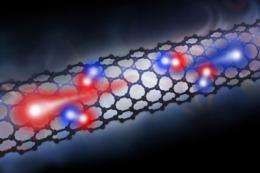
(PhysOrg.com) -- Cornell researchers fabricated, tested and measured a simple solar cell called a photodiode, formed from an individual carbon nanotube.
Using a carbon nanotube instead of traditional silicon, Cornell researchers have created the basic elements of a solar cell that hopefully will lead to much more efficient ways of converting light to electricity than now used in calculators and on rooftops.
The researchers fabricated, tested and measured a simple solar cell called a photodiode, formed from an individual carbon nanotube. Reported online Sept. 11 in the journal Science, the researchers -- led by Paul McEuen, the Goldwin Smith Professor of Physics, and Jiwoong Park, assistant professor of chemistry and chemical biology -- describe how their device converts light to electricity in an extremely efficient process that multiplies the amount of electrical current that flows. This process could prove important for next-generation high efficiency solar cells, the researchers say.
"We are not only looking at a new material, but we actually put it into an application -- a true solar cell device," said first author Nathan Gabor, a graduate student in McEuen's lab.
The researchers used a single-walled carbon nanotube, which is essentially a rolled-up sheet of graphene, to create their solar cell. About the size of a DNA molecule, the nanotube was wired between two electrical contacts and close to two electrical gates, one negatively and one positively charged. Their work was inspired in part by previous research in which scientists created a diode, which is a simple transistor that allows current to flow in only one direction, using a single-walled nanotube. The Cornell team wanted to see what would happen if they built something similar, but this time shined light on it.
Shining lasers of different colors onto different areas of the nanotube, they found that higher levels of photon energy had a multiplying effect on how much electrical current was produced.
Further study revealed that the narrow, cylindrical structure of the carbon nanotube caused the electrons to be neatly squeezed through one by one. The electrons moving through the nanotube became excited and created new electrons that continued to flow. The nanotube, they discovered, may be a nearly ideal photovoltaic cell because it allowed electrons to create more electrons by utilizing the spare energy from the light.
This is unlike today's solar cells, in which extra energy is lost in the form of heat, and the cells require constant external cooling.
Though they have made a device, scaling it up to be inexpensive and reliable would be a serious challenge for engineers, Gabor said.
"What we've observed is that the physics is there," he said.
Provided by Cornell University (news : web)


