Extremophile Yields a Key Cog in Life's Protein Factory
September 10, 2009 Extremophile Yields a Key Cog in Life's Protein Factory

Enlarge

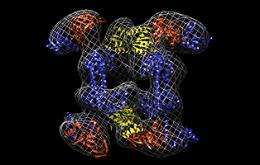
Artist rendering of a small ribonucleoprotein.

(PhysOrg.com) -- Peering at single molecules within an organism that makes its home near thermal vents, Yale University scientists have discovered the structure of a key player in the creation of protein-making factories in humans.

In the Sept. 11 issue of the journal Science, Susan Baserga, professor of molecular biophysics and biochemistry, genetics, and therapeutic radiology and her colleagues describe the elusive structure of an RNA and protein essential to making ribosomes, which churn out the proteins that carry out most of life’s functions. Malfunctions of this process have been implicated in cancer and as well as in rare genetic disorders that cause infertility and childhood cirrhosis.

Ribosomes carry out the essential business of translating the information encoded in DNA into proteins. The makeup of one of the key players in the process of making ribosomes, the RNA-protein enzymes called box C/D small ribonucleoproteins, had been unknown. Scientists were eager to describe the complex, which is so important to life it is conserved in organisms as diverse as yeast and humans, and even in extremophiles in the domain Archaea.

Baserga’s team decided to look at the archeon, Methanocaldococcus jannaschii, a microbe so hardy it survives in Antarctic ice and boiling thermal vents at the bottom of the ocean. Using single-particle , the research team was able to see that the RNA and enzyme was unexpectedly composed of two RNAs and 4 sets of proteins.

“It looks like a wheat thin with feet,” she said. “When you can discern structure, you can often figure out function.”

The structure of this RNA-protein enzyme is just one piece of the puzzle for understanding how the many factors that contribute to making human ribosomes come together at the right time and place. Mutations in other factors that make ribosomes can disrupt sperm production in men or lead to a rare form of . Also, because production is central to cell growth and division, it is routinely used as a marker to stage cancer progression.

“If you are a cancer cell, you need as many ribosomes as you can get,’’ Baserga said.

Baserga said her lab is already using the findings of this study to further understand how this enzyme is essential to the creation of ribosomal .

Lead researcher on the Science paper was Franziska Bleichert of Yale. Vinzenz M. Unger was the other Yale author of the paper, which included contributors from North Carolina State and Harvard.

Provided by Yale University (news : web)


print this article email this article download pdf blog this article bookmark this article     Stumble it Digg this share on Facebook retweet share on Reddit add to delicious
Rate this story - 4.5 /5 (2 votes)


September 10, 2009 all stories

Comments: 0

4.5 /5 (2 votes)
  • Stumble this up

  • Digg this

  • share this

  • hide
  • Related Stories

  • In Ocean's Depths, Heat-Loving 'Extremophile' Evolves a Strange Molecular Trick
    created Apr 30, 2009 | popularity not rated yet | comments 0
  • Bacteria are models of efficiency
    created Feb 04, 2009 | popularity not rated yet | comments 0
  • New Mathematical Model Evaluates Efficiency of E. Coli
    created Feb 04, 2009 | popularity not rated yet | comments 0
  • Molecular sleuths track evolution through the ribosome
    created Aug 18, 2008 | popularity not rated yet | comments 0
  • Biologists probe the machinery of cellular protein factories
    created Sep 13, 2006 | popularity not rated yet | comments 0


  • hide
  • Relevant PhysicsForums posts

  • Putting every element in a box
    created 3 hours ago
  • a question in Lewis structure???
    created 10 hours ago
  • Paint Technology
    created Nov 24, 2009
  • About pH, Metallic electrodes
    created Nov 24, 2009
  • More from Physics Forums - Chemistry

Other News

Blocking biofilms: Alzheimer's research sheds light on potential treatments for urinary tract infections

Chemistry / Biochemistry

created 7 hours ago | popularity 5 / 5 (1) | comments 0

(PhysOrg.com) -- Research into Alzheimer's disease seems an unlikely approach to yield a better way to fight urinary tract infections (UTIs), but that's what scientists at Washington University School of Medicine in St. Louis ...


Chemists get custom-designed microscopic particles to self-assemble in liquid crystal

Chemists get custom-designed microscopic particles to self-assemble in liquid crystal

Chemistry / Materials Science

created 8 hours ago | popularity 5 / 5 (5) | comments 0

(PhysOrg.com) -- The scientists anticipate their "LithoParticles" will have significant applications in photonics, optical communications and other areas.


Study shows flavanol antioxidant content of US chocolate and cocoa-containing products

Chemistry / Other

created 9 hours ago | popularity 1 / 5 (1) | comments 0

A recent study confirms that the antioxidants and other plant-based nutrients in chocolate and cocoa products are highly associated with the amount of non-fat cocoa-derived ingredients in the product. The study expands on ...


Sandia CR5

Machine Converts CO2 into Gasoline, Diesel, and Jet Fuel

Chemistry / Biochemistry

created Nov 23, 2009 | popularity 4.6 / 5 (30) | comments 19

(PhysOrg.com) -- Researchers at Sandia National Laboratories have built a machine that uses the sun's energy to convert carbon dioxide waste from power plants into transportation fuels such as gasoline, diesel, ...


New hydrogen-storage method discovered

New hydrogen-storage method discovered

Chemistry / Materials Science

created Nov 22, 2009 | popularity 4.3 / 5 (41) | comments 15

Scientists at the Carnegie Institution have found for the first time that high pressure can be used to make a unique hydrogen-storage material. The discovery paves the way for an entirely new way to approach ...