Oil and wildlife don't mix in Ecuador's Eden
September 10, 2009
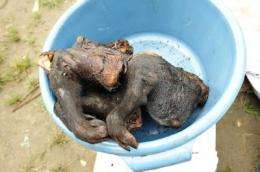
Large mammals such as peccaries are targeted by commercial hunters, who use an oil company road to bring their meat to a nearby wild market. Credit: Julie Larsen Maher (c) WCS
What harm can a simple road do in a pristine place such as Ecuador's Yasuni National Park, home to peccaries, tapirs, monkeys and myriad other wildlife species? A great deal, it turns out. Specifically, it can turn subsistence communities into commercial hunting camps that empty rainforests of their wildlife, researchers from the Wildlife Conservation Society and the IDEAS-Universidad San Francisco de Quito in Ecuador have found.
A study by WCS field scientists in the park found that the presence of a single road in a protected area and the subsidies provided by oil companies to local people can fundamentally change how indigenous communities use their resources by providing both access to deeper parts of the forest and a cheap means of getting meat to nearby wildlife markets.
The study appears in the most recent issue of the journal Animal Conservation.
"We've found that a road in a forest can bring huge social changes to local groups and the ways in which they utilize wildlife resources," said WCS and USFQ researcher Esteban Suárez, lead author of the study. "Communities existing inside and around the park are changing their customs to a lifestyle of commercial hunting, the first stage in a potential overexploitation of wildlife."
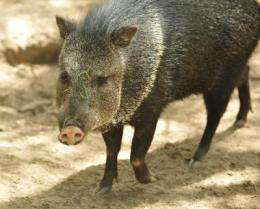
Yasuni National Park contains a wealth of biodiversity, including large mammals such as the collared peccary. Peccaries are also targeted by commercial hunters. Credit: Julie Larsen Maher (c) WCS
"A simple, seemingly inoffensive road can have far-reaching effects on a landscape and its people," said Dr. Avecita Chicchón, Director of WCS's Latin America and Caribbean Program. "It provides hunters with more access to a wider range of forest while providing a low-cost transportation route to markets. More importantly, it plugs communities more easily into the larger economic world while creating increased demand for numerous species of animals. It is the road to unsustainability."In the study, WCS scientists measured the levels of wild meat sold in a market in Pompeya, located about 5 kilometers (3.1 miles) outside Yasuni National Park, between the years 2005-2007. The study also examined the effects of a road constructed in 1992 by oil company Maxus Ecuador Inc. that traverses more than 149 kilometers (92 miles) into the protected area.
The wild meat market emerged shortly after the construction of the road. Although road access was strictly controlled, the oil companies operating this concession provided free travel along the road for hunters from local Waorani communities, according to the study. The availability of cheap transportation is the biggest factor in determining the large amount of wild meat making it to market from Waorani communities. In fact, the road's very existence prompted many Waorani to abandon their semi-nomadic lifestyle; three Waorani communities now live along the road.
The company also hired members of both the Waorani and Kichwa indigenous groups at wages much higher than local salaries, and compensated communities for use of indigenous lands both inside and outside the park. Further, firearms became more widely available to hunters who then abandoned blowguns and other traditional weapons.
Between the years of 2005 and 2007, the researchers recorded more than 11,000 kilograms (24,000 pounds) of wild meat moving through the Pompeya market each year. While the amount of wild meat recorded in the study is still small with respect to other markets, the levels of recorded wild meat sold in Pompeya increased significantly over the study period, rising to over 300 kilograms (661 pounds) of meat per market day in 2007 from approximately 150 kilograms (330 pounds) per market day in 2005.
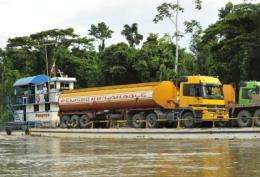
Oil development near Yasuni National Park (including a road through the park) has led to an increase of commercial hunting. This barge carries an oil truck on the nearby Napo River. Credit: Julie Larsen Maher (c) WCS
The majority of animals brought in by hunters were pacas (mid-sized Amazonian rodents), white-lipped peccaries, collared peccaries, and woolly monkeys comprising some 80 percent of the total biomass monitored.Of the totals recorded at the market, more than 69 percent of the wild meat purchased in Pompeya was bound for restaurants and other markets in other towns, one of which was 234 kilometers (145 miles) away from the first market. Middlemen consistently increased the price of wild meat by up to 60 percent of the original cost paid to hunters. Secondary markets sell wild meat at prices up to two times the average prices of domestic animal meat.
Suarez and his co-authors warn that extractive initiatives in protected areas and wild lands require new governance systems with an emphasis on local participation and increased sensitivity on how development affects the social dynamics of indigenous groups.
Source: Wildlife Conservation Society
-
Big cats, wild pigs and short-eared dogs -- oh, my!
Jan 27, 2009 |
not rated yet |
0
-
New national survey says public reveres bison
Nov 18, 2008 |
not rated yet |
0
-
Blanket ban on bushmeat could be disastrous for forest dwellers in Central Africa, says new report
Sep 16, 2008 |
not rated yet |
0
-
Tibetan antelope slowly recovering, WCS says
Feb 01, 2007 |
not rated yet |
0
-
Camera-shy deer caught for first time
Jul 24, 2007 |
not rated yet |
0
-
Engineers build first sub-10-nm carbon nanotube transistor
Feb 01, 2012 |
4.9 / 5 (31) |
30
-
Something old, something new: Evolution and the structural divergence of duplicate genes
Jan 31, 2012 |
4.6 / 5 (7) |
1
-
The hidden nanoworld of ice crystals: Revealing the dynamic behavior of quasi-liquid layers
Jan 30, 2012 |
5 / 5 (3) |
1
-
Stock market network reveals investor clustering
Jan 27, 2012 |
3.9 / 5 (23) |
8
-
Of microchemistry and molecules: Electronic microfluidic device synthesizes biocompatible probes
Jan 26, 2012 |
5 / 5 (1) |
0
-
Stem cell question.
1 hour ago
-
Protease cleavage
7 hours ago
-
Pertubance in a model
14 hours ago
-
Cancer drugs and Alzheimer's, Oh my!
22 hours ago
-
Squishing cells
22 hours ago
-
Any books/articles for evolutionary stable strategy models in humans?
Feb 09, 2012
- More from Physics Forums - Biology
More news stories
The power of estrogen -- male snakes attract other males
A new study has shown that boosting the estrogen levels of male garter snakes causes them to secrete the same pheromones that females use to attract suitors, and turned the males into just about the sexiest ...
12 hours ago |
4.8 / 5 (5) |
0
|
Grass to gas: Researchers' genome map speeds biofuel development
Researchers at the University of Georgia have taken a major step in the ongoing effort to find sources of cleaner, renewable energy by mapping the genomes of two originator cells of Miscanthus x giganteus, a large perenn ...
9 hours ago |
3.8 / 5 (5) |
0
|
Experts reveal how plants don't get sunburn
(PhysOrg.com) -- Experts at the University of Glasgow have discovered how plants survive the harmful rays of the sun.
12 hours ago |
4.7 / 5 (3) |
0
|
Miami battling invasion of giant African snails
No one knows how they got there. But an invasion of African giant snails has southern Florida in a panic over potential crop damage, disease and general yuckiness surrounding the slimy gastropods.
16 hours ago |
4 / 5 (1) |
4
Protein libraries in a snap
(PhysOrg.com) -- A Rice University undergraduate will depart with not only a degree but also a possible patent for his invention of an efficient way to create protein libraries, an important component of biomolecular ...
15 hours ago |
4.8 / 5 (4) |
0
|
Google users warned of threat to smartphone wallets
Users of Google smartphone wallets were being warned on Friday that there is a way to crack pass codes intended to thwart thieves from going on illicit shopping sprees.
Anonymous knocks CIA website offline (Update)
The website of the Central Intelligence Agency was inaccessible on Friday after the hacker group Anonymous claimed to have knocked it offline.
Complex wiring of the nervous system may rely on a just a handful of genes and proteins
Researchers at the Salk Institute have discovered a startling feature of early brain development that helps to explain how complex neuron wiring patterns are programmed using just a handful of critical genes. ...
New error-correcting codes guarantee the fastest possible rate of data transmission
Error-correcting codes are one of the triumphs of the digital age. Theyre a way of encoding information so that it can be transmitted across a communication channel such as an optical fiber o ...
Humans may have helped the decline of African rainforests 3000 years ago
(PhysOrg.com) -- Large areas of rainforests in Central Africa mysteriously disappeared over three thousand years ago, to be replaced by savannas. The prevailing theory has been that the cause was a change ...
Putting the squeeze on planets outside our solar system
(PhysOrg.com) -- Using high-powered lasers, scientists at Lawrence Livermore National Laboratory and collaborators discovered that molten magnesium silicate undergoes a phase change in the liquid state, abruptly ...

