CU-Boulder Unmanned Aircraft Buzz Over Gigantic Holes in Antarctic Sea Ice
September 10, 2009
CU-Boulder Unmanned Aircraft Buzz Over Gigantic Holes in Antarctic Sea Ice

Enlarge

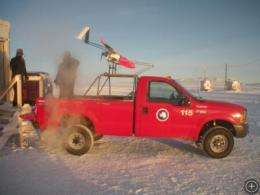
Aerosonde on launch vehicle at Pegasus runway (5 September 2009).

A series of record-setting unmanned research flights are providing University of Colorado at Boulder researchers with some of the first 3-D observations of gaping holes in the Antarctic sea ice known as polynyas and the blasting winds that help form them.

Using unmanned planes roughly 9 feet across, CU-Boulder faculty members John Cassano and James Maslanik are gaining a unique glimpse into the Terra Nova Bay polynya, a yawning stretch of open water that at times reaches 2,000 square miles in area, nearly twice the size of Rhode Island. The CU-Boulder team made its first flight Sept. 7, believed to be the southernmost flight ever of any unmanned aircraft.

"These will be some of the longest flights on record for science applications, and certainly the longest in Antarctica," said Maslanik, a research professor in the aerospace engineering sciences department and an affiliate of the university's Cooperative Institute for Research in Environmental Sciences, or CIRES.

Earlier this year, Maslanik led a NASA-funded project known as the Characterization of Arctic Experiment, or CASIE, which made some of the most extensive unmanned aerial measurements to date of sea ice in the . Together, the two CU-Boulder-led field campaigns will include some of the highest latitude research flights ever conducted with unmanned planes in both the Northern and Southern hemispheres, he said.

The goal of the mission is to measure moisture and heat exchanges between the ocean and atmosphere and to eventually unravel the effect of polynyas on global climate, said Cassano.

"In polar regions, sea ice often reduces interactions between the ocean and atmosphere, but in polynyas, open water persists even in the heart of winter," said Cassano, an assistant professor in the atmospheric and oceanic sciences department and CIRES Fellow. "It's in these areas that large amounts of heat and moisture are lost from the ocean to the atmosphere. Instruments aboard the unmanned planes will provide some of the first direct measurements of this heat loss in winter."

Sea ice formation in polynyas also leaves cold and salty water behind, he said. Because the cold and salty water is denser, it sinks, affecting global currents like the thermohaline circulation, said Cassano. The thermohaline circulation works much like an oceanic conveyer belt, moving seawater around the globe through changes in salinity and water temperature. In places where the thermohaline circulation emerges at the ocean surface, it substantially influences weather and climate, said Cassano.

The planes will also measure airflow above Terra Nova Bay -- which lies between West Antarctica and East Antarctica in the southern part of the continent -- to help researchers understand the interaction between the polynya and the severe winds that whip over the Antarctic continent.

The winds, called katabatic winds, form as air slides down from the high plateau of Antarctica's interior and funnels into small drainages near the coast. During the month of September, near the end of the austral winter, these winds can exceed hurricane strength.

The constant blasting of the katabatic winds helps keep the Terra Nova Bay polynya free of new sea ice and open throughout the winter, said Cassano. He said he suspects the polynya influences local wind patterns by creating a low pressure area that can spin off small but intense cyclones.

"There have been a lot of models and theory-based studies describing polynyas and their climate feedbacks, but we can't fully understand them until we measure them," said Cassano.

Provided by University of Colorado


Rank 2 /5 (2 votes)
Relevant PhysicsForums posts
  • Do some geologists actually act a lot like Randy Marsh?
    createdFeb 11, 2012
  • Discrepancy between oxygen and carbon-dioxide levels
    createdFeb 09, 2012
  • where gems are found in the world
    createdFeb 09, 2012
  • Wind Waves in Reservoir ~ Wind run-up and Wind set-up
    createdFeb 08, 2012
  • Balance of oxygen in the atmosphere
    createdFeb 01, 2012
  • The case for a methanol-based economy
    createdJan 30, 2012
  • More from Physics Forums - Earth

More news stories

Latin America mining boom clashes with conservation

Latin America is experiencing a mining boom as prices rise fuelled by a hike in global demand, but the region is also being hit by a wave of violent protests, strikes and rallies by environmentalists.

Space & Earth / Environment

created 7 hours ago | popularity not rated yet | comments 0

Political leaders play key role in how worried Americans are by climate change: study

More than extreme weather events and the work of scientists, it is national political leaders who influence how much Americans worry about the threat of climate change, new research finds.

Space & Earth / Environment

created Feb 06, 2012 | popularity 5 / 5 (6) | comments 73

NASA budget will axe Mars deal with Europe: scientists

US President Barack Obama's budget proposal to be submitted next week for 2013 will cut NASA's budget by 20 percent and eliminate a major partnership with Europe on Mars exploration, scientists said Thursday.

Space & Earth / Space Exploration

created Feb 10, 2012 | popularity 5 / 5 (3) | comments 55

Humans may have helped the decline of African rainforests 3000 years ago

(PhysOrg.com) -- Large areas of rainforests in Central Africa mysteriously disappeared over three thousand years ago, to be replaced by savannas. The prevailing theory has been that the cause was a change ...

Space & Earth / Environment

created Feb 10, 2012 | popularity 4.1 / 5 (14) | comments 20 | with audio podcast report

Study shows global glaciers, ice caps, shedding billions of tons of mass annually

Earth's glaciers and ice caps outside of the regions of Greenland and Antarctica are shedding roughly 150 billion tons of ice annually, according to a new study led by the University of Colorado Boulder.

Space & Earth / Earth Sciences

created Feb 08, 2012 | popularity 4.4 / 5 (9) | comments 14 | with audio podcast


Injured boomers beware: Know when to see doctor

(AP) -- It happened to nurse Jane Byron years after an in-line skating fall, business owner Haralee Weintraub while doing "men's" push-ups, and avid cyclist Gene Wilberg while lifting a heavy box.

Google might launch Drive for cloud storage soon

(PhysOrg.com) -- Google's next big move, according to the Wall Street Journal, is a cloud storage service called Drive. Hardly first to the plate, Google is simply catching up to introducing its cloud reposi ...

Love a click away in Indonesia's Twitter Republic

He was a geeky kid from Yogyakarta, she a glamorous city girl in Jakarta. In a country with one of the world's most vibrant social networking scenes they fell in love on Twitter.

Europeans protest controversial Internet pact

Tens of thousands of people marched in protests in more than a dozen European cities Saturday against a controversial anti-online piracy pact that critics say could curtail Internet freedom.

Walney offshore wind farm is world's biggest (for now)

(PhysOrg.com) -- The Walney wind farm on the Irish Sea--characterized by high tides, waves and windy weather--officially opened this week. The farm is treated in the press as a very big deal as the Walney ...

Navy to begin tests on electromagnetic railgun prototype launcher

The Office of Naval Research (ONR)'s Electromagnetic (EM) Railgun program will take an important step forward in the coming weeks when the first industry railgun prototype launcher is tested at a facility ...