Bees Throw Out Mites
September 11, 2009 By Alfredo Flores
Bees Throw Out Mites

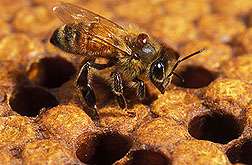
ARS researchers have developed honey bees that more aggressively deal with varroa mites, a parasite that is one of the major problems damaging honey bees today.

Honey bees are now fighting back aggressively against Varroa mites, thanks to Agricultural Research Service (ARS) efforts to develop bees with a genetic trait that allows them to more easily find the mites and toss them out of the broodnest.

The parasitic Varroa mite attacks the honey bee, Apis mellifera L., by feeding on its hemolymph, which is the combination of blood and fluid inside a bee. Colonies can be weakened or killed, depending on the severity of the infestation. Most colonies eventually die from varroa infestation if left untreated.

Varroa-sensitive hygiene (VSH) is a genetic trait of the honey bee that allows it to remove mite-infested pupae from the capped brood—developing that are sealed inside cells of the comb with a protective layer of wax. The mites are sometimes difficult for the bees to locate, since they attack the bee brood while these developing bees are inside the capped cells.

This video is not supported by your browser at this time.

Audio Podcast: The Mitey Bee Bouncers

ARS scientists at the agency’s Breeding, Genetics and Physiology Research Unit in Baton Rouge, La., have developed honey bees with high expression of the VSH trait. Honey bees are naturally hygienic, and they often remove diseased brood from their nests. VSH is a specific form of nest cleaning focused on removing varroa-infested pupae. The VSH honey bees are quite aggressive in their pursuit of the mites. The bees gang up, chew and cut through the cap, lift out the infected brood and their mites, and discard them from the broodnest.

This hygiene kills the frail mite offspring, which greatly reduces the lifetime reproductive output of the mother mite. The mother mite may survive the ordeal and try to reproduce in brood again, only to undergo similar treatment by the bees.

To test the varroa resistance of VSH bees, the Baton Rouge team conducted field trials using 40 colonies with varying levels of VSH. Mite population growth was significantly lower in VSH and hybrid colonies than in bee colonies without VSH. Hybrid colonies had half the VSH genes normally found in pure VSH bees, but they still retained significant varroa resistance. Simpler ways for bee breeders to measure VSH behavior in colonies were also developed in this study.

This research was published in the Journal of Apicultural Research and Bee World.

Provided by Agricultural Research Service

4.8 /5 (10 votes)  

Filter


Move the slider to adjust rank threshold, so that you can hide some of the comments.


Display comments: newest first

gmurphy
Sep 12, 2009

Rank: not rated yet
good work, but evolution doesn't stand still, some mites will survive due to some genetic trait and the whole situation will be back to square one within a few decades
Swarmcatcher
Sep 12, 2009

Rank: 5 / 5 (1)
good work, but evolution doesn't stand still, some mites will survive due to some genetic trait and the whole situation will be back to square one within a few decades

Don't forget that evolution doesn't stand still for the honeybees, either. Mites were thrust on these bee populations over the course of a few years. Researchers have sped up the clock on the evolution of VSH behavior, we didn't teach the bees anything. Future mutations in mite behavior will naturally select for better honeybees. It is the catastrophic environmental changes that merit intervention by researchers.
codesuidae
Sep 13, 2009

Rank: not rated yet
Will the genetic modifications be patented? How will this bee technology be licensed?
Rank 4.8 /5 (10 votes)
Related Stories
Relevant PhysicsForums posts
  • Mitosis
    created1 hour ago
  • Stem cell question.
    created3 hours ago
  • Protease cleavage
    created9 hours ago
  • Pertubance in a model
    created16 hours ago
  • Cancer drugs and Alzheimer's, Oh my!
    createdFeb 09, 2012
  • Squishing cells
    createdFeb 09, 2012
  • More from Physics Forums - Biology

More news stories

The power of estrogen -- male snakes attract other males

A new study has shown that boosting the estrogen levels of male garter snakes causes them to secrete the same pheromones that females use to attract suitors, and turned the males into just about the sexiest ...

Biology / Plants & Animals

created 14 hours ago | popularity 4.8 / 5 (6) | comments 1 | with audio podcast

Grass to gas: Researchers' genome map speeds biofuel development

Researchers at the University of Georgia have taken a major step in the ongoing effort to find sources of cleaner, renewable energy by mapping the genomes of two originator cells of Miscanthus x giganteus, a large perenn ...

Biology / Biotechnology

created 11 hours ago | popularity 3.8 / 5 (5) | comments 0 | with audio podcast

Experts reveal how plants don't get sunburn

(PhysOrg.com) -- Experts at the University of Glasgow have discovered how plants survive the harmful rays of the sun.

Biology / Cell & Microbiology

created 14 hours ago | popularity 4.8 / 5 (5) | comments 0 | with audio podcast

Miami battling invasion of giant African snails

No one knows how they got there. But an invasion of African giant snails has southern Florida in a panic over potential crop damage, disease and general yuckiness surrounding the slimy gastropods.

Biology / Ecology

created 18 hours ago | popularity 4 / 5 (1) | comments 4

Protein libraries in a snap

(PhysOrg.com) -- A Rice University undergraduate will depart with not only a degree but also a possible patent for his invention of an efficient way to create protein libraries, an important component of biomolecular ...

Biology / Cell & Microbiology

created 17 hours ago | popularity 4.8 / 5 (4) | comments 0 | with audio podcast


Google users warned of threat to smartphone wallets

Users of Google smartphone wallets were being warned on Friday that there is a way to crack pass codes intended to thwart thieves from going on illicit shopping sprees.

Anonymous knocks CIA website offline (Update)

The website of the Central Intelligence Agency was inaccessible on Friday after the hacker group Anonymous claimed to have knocked it offline.

New error-correcting codes guarantee the fastest possible rate of data transmission

Error-correcting codes are one of the triumphs of the digital age. They’re a way of encoding information so that it can be transmitted across a communication channel — such as an optical fiber o ...

Complex wiring of the nervous system may rely on a just a handful of genes and proteins

Researchers at the Salk Institute have discovered a startling feature of early brain development that helps to explain how complex neuron wiring patterns are programmed using just a handful of critical genes. ...

Humans may have helped the decline of African rainforests 3000 years ago

(PhysOrg.com) -- Large areas of rainforests in Central Africa mysteriously disappeared over three thousand years ago, to be replaced by savannas. The prevailing theory has been that the cause was a change ...

New power source discovered

(PhysOrg.com) -- Researchers at the Massachusetts Institute of Technology (MIT) and RMIT University have made a breakthrough in energy storage and power generation.