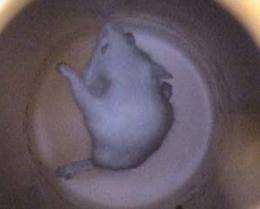
Mice Levitated for Space Research
September 11, 2009 by Lin Edwards
Image credit: Da-Ming Zhu
(PhysOrg.com) -- Scientists have managed to levitate young mice in research carried out for NASA. Levitated mice may help research on bone density loss during long exposures to low gravity, such as in space travel and missions to other planets.
The researchers worked from a number of laboratories around the U.S., including the Jet Propulsion Laboratory in Pasadena, California and the University of Missouri. The research was done on behalf of NASA, and was published in the online journal Advances in Space Research on 6 September 2009.
The scientists built a variable gravity simulator consisting of a superconducting magnet that could generate a magnetic field strong enough to levitate the water inside every cell in the mouse's body. Water is weakly diamagnetic, which means that in the presence of a strong magnetic field the electrons in water rearrange orbit slightly, creating tiny currents in opposition to the external magnetic field. If the external magnet is strong enough, the diamagnetic repulsion of the water in the mouse tissue is enough to exactly balance the force of gravity on the body.
Scientists have previously levitated live grasshoppers and frogs, but this is the first time a mammal has been levitated. The mice were confined to a plastic cage, which had a base with holes to allow waste to be removed, and an open top to allow in air, food, water, and to allow the proceedings to be filmed. The cage was not necessary for the levitation, but it did allow the scientists to compare the levitated mice with non-levitated subjects in identical cages.
The first subject to be levitated was just three weeks old. The tiny mouse was disturbed and disoriented and began to spin when it kicked out as though trying to find something to hold on to. With no friction to stop the spinning, the mouse became even more disoriented, according to Jet Propulsion Lab physicist Yuanming Liu.
The next young mouse was mildly sedated before being levitated, and it was less agitated by the experience. The levitation experiments were repeated a number of times, and showed that the mice quickly adjusted to the conditions, even eating and drinking normally after a few hours of levitation. Even without sedation, the mice became quite comfortable floating in zero gravity.
The powerful magnetic field seemed to have no short term effects on the mice, and earlier studies on rats showed there were no ill effects even after 10 weeks' exposure to strong magnetic fields.
The researchers are now applying for research funding that will allow them to study the physiological effects of prolonged exposure to microgravity, and to try to develop countermeasures that astronauts could adopt.
More information: Magnetic levitation of large water droplets and mice; Yuanming Liua, Da-Ming Zhub, Donald M. Strayera and Ulf E. Israelssona, Advances in Space Research, http://dx.doi.org/10.1016/j.asr.2009.08.033
© 2009 PhysOrg.com


The levitation part is very cool.
In this experiment you have gravity still pulling down and the magnetic field pushing up (on mostly the water) so there is still force interactions on the body. Since the bones are still having forces act on them (both pushing up and pulling down) won't there be negligble mass-loss?
Or I am wildly wrong, insight anyone?
In earth orbit microgravity, you're also still in gravitational field. It's weaker than it is on earth surface, nevertheless, it's there.
The difference is that when you're on the ground, the force of gravity on your body is opposed by electrical repulsion of electrons orbiting atoms that make up the ground below your feet. This force (or pressure as typically done when discussing forces acting inside solid bodies) is propagated throughout your body, mostly by your skeleton. Therefore, bones that make up the skeleton feel compressive pressure arising from repulsion from ground below, and gravitaitonal pull of body mass above it.
With magnetic levitation, pull of gravity is cancelled by magnetic force at cellular level, ie., each cell in the body is lifted by magnetic field. Therefore, there will be no mechanical stress imposed on bones in the skeleton.
Therefore, if you want to study the effect of absence of mechanical stress loading on bones, this may be the way.
or am i being silly?
The water is so close to being evenly distributed in the small mice that the simulation of a micro-gravity environment should be very good. Even in a fully grown human, the simulation would be much better than floating in a neutral buoyancy tank, as astronauts are trained now. But of course, the power and magnetic field strength to accomplish this with a grown human would be off the charts.
This is why you can work with high base magnetic fields in an MR without inducing currents (though you use variable fields to read the spatial information, but these are of a much lower intensity)
A constant magnetic field only leads to a certain amount of the spins of polarized atoms to be oriented in a certain way (IIRC in an MR this means that the spin axis of less than 1 in 1000 protons is not oriented in a random direction - but those are the ones that generate the signal)
I tried to give you a zero and I'd love to give you a negative 5, as that is just SO wrong. Even if it is sarcasm, which I don't think it is, it is just plain bad news to even insinuate that the such things are as you have said. We don't let profit drive corporations create such 'research' for a reason. this aspect of American science and it's fundamental aspects of 'responsibility' is just way off the charts wrong, in many cases. You never let the fox do scientific studies on the henhouse. For example, the first thing you should be aware of in the world of medicine---is that the AMA is a private organization and is a profit driven company.
Right, I know about microgravity, it's just the biological aspects and the play of forces I was not sure about. Still, I think there would be more stress on the bones in the experiment than in true microgravity. That stress would keep bones from getting weaker as quick as they would in microgravity.
Of course, my doubt is probably shared by many scientists, which is another good reason for this experiment.
I don't care if I am right or wrong, so long as the experiment can prove it either way.
http://en.wikiped...cylinder
The forces between various parts of levitating mice's body have origin in different amount of water and other diamagnetic substances, so in certain sense, these mices would really experience microgravity in terresterial conditions.
Just the presence of a strong field is not inducing current - only the changes in it do.
Motion of the conductor through non-homogeneous magnetic fields is the same as changing the field. In this case I guess the field can be considered approximately homogeneous though.
Rotation even in a homogeneous field leads to induction though. So you are right that in some circumstances this might have some bad effects.
http://en.wikiped...ral_line
Neural system of higher organism isn't very sensitive to DC current.