Biologists discover 'death stench' is a universal ancient warning signal
September 11, 2009
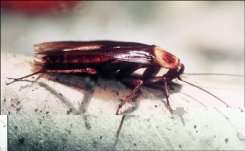
A cockroach

One of the most reviled species in the book of life, the cockroach is also one of the most successful. Its design, honed by 300 million years of evolution, enables it to exploit a huge range of habitat niches, and its locomotion is notoriously fast and versatile.

The smell of recent death or injury that repels living relatives of insects has been identified as a truly ancient signal that functions to avoid disease or predators, biologists have discovered.

David Rollo, professor of biology at McMaster University, found that corpses of animals, from insects to crustaceans, all emit the same death stench produced by a blend of specific .

The findings have been published in the journal .

Rollo and his team made the discovery while they were studying the of cockroaches. When a finds a good place to live it marks the site with pheromone odours that attract others. In trying to identify the precise chemicals involved, Rollo extracted body juices from dead cockroaches.

"It was amazing to find that the cockroaches avoided places treated with these extracts like the plague," says Rollo. "Naturally, we wanted to identify what chemical was making them all go away."

The team eventually identified the specific chemicals that signaled death. Furthermore, they found that the same fatty acids not only signaled death in ants, , and cockroaches, they were equally effective in terrestrial woodlice and pill bugs that are actually not insects but crustaceans related to crayfish and lobsters.

Because and crustaceans diverged more than 400-million years ago it is likely that most subsequent species recognize their dead in a similar way, that the origin of such signals was likely even older, and that such behaviour initially occurred in aquatic environments (few crustaceans are terrestrial).

"Recognizing and avoiding the dead could reduce the chances of catching the disease, or allow you to get away with just enough exposure to activate your immunity," says Rollo. Likewise, he adds, release of fatty acids from dismembered body parts could provide a strong warning that a nasty predator was nearby.

"As explained in our study, fatty acids—oleic or linoleic acids—are reliably and quickly released from the cells following death. Evolution appears to have favoured such clues because they were reliably associated with demise, and avoiding contagion and predation are rather critical to survival."

The generality and strength of the phenomenon, coupled with the fact that the fatty acids are essential nutrients rather than pesticides, holds real promise for applications such as plant and stored product protection or exclusion of household pests.

Source: McMaster University (news : web)

4.8 /5 (6 votes)  

Filter


Move the slider to adjust rank threshold, so that you can hide some of the comments.


Display comments: newest first

zevkirsh
Sep 11, 2009

Rank: not rated yet
instead of the roach motel, roach coffin. cofffin smell keeps away the bugs?
Mandan
Sep 12, 2009

Rank: 4.3 / 5 (3)
I guess this bolsters the apparent efficacy of that clever tactic used by old gardeners of smashing the bodies of insect pests on the leaves and branches of the plants they are attacking to drive off other freeloaders seeking a meal.
Ulg
Sep 12, 2009

Rank: not rated yet
Does sound like a nice alternative to pesticides
cybrbeast
Sep 12, 2009

Rank: not rated yet
This could be a great bug repellent. The only big question is, how does this compound smell to humans? If it's disgusting I wouldn't want to use it.
Rank 4.8 /5 (6 votes)
Related Stories
Relevant PhysicsForums posts
  • Factors affecting beet root cell membrane
    created10 hours ago
  • Stem cell question.
    createdFeb 10, 2012
  • Protease cleavage
    createdFeb 10, 2012
  • Pertubance in a model
    createdFeb 10, 2012
  • Cancer drugs and Alzheimer's, Oh my!
    createdFeb 09, 2012
  • Squishing cells
    createdFeb 09, 2012
  • More from Physics Forums - Biology

More news stories

A mitosis mystery solved: How chromosomes align perfectly in a dividing cell

Although the process of mitotic cell division has been studied intensely for more than 50 years, Whitehead Institute researchers have only now solved the mystery of how cells correctly align their chromosomes during symmetric ...

Biology / Cell & Microbiology

created 6 hours ago | popularity 4.4 / 5 (10) | comments 0 | with audio podcast

Researchers find extensive RNA editing in human transcriptome

In a new study published online in Nature Biotechnology, researchers from BGI, the world's largest genomics organization, reported the evidence of extensive RNA editing in a human cell line by analysis of RNA-seq data, demons ...

Biology / Biotechnology

created 6 hours ago | popularity 5 / 5 (4) | comments 0 | with audio podcast

The proteins ensuring genome protection

Researchers from the University of Geneva (UNIGE), Switzerland, have discovered the crucial role of two proteins in developing a cell 'anti-enzyme shield'. This protection system, which operates at the level of molecular ...

Biology / Cell & Microbiology

created 6 hours ago | popularity 5 / 5 (3) | comments 0 | with audio podcast

Entire genome of extinct human decoded from fossil

(PhysOrg.com) -- In 2010, Svante Pääbo and his colleagues presented a draft version of the genome from a small fragment of a human finger bone discovered in Denisova Cave in southern Siberia. The ...

Biology / Biotechnology

created Feb 07, 2012 | popularity 4.7 / 5 (59) | comments 48 | with audio podcast

Why are there so few fish in the Earth's oceans?

(PhysOrg.com) -- A Stony Brook University researcher has found that, contrary to popular belief, there are not plenty of fish in the sea.

Biology / Plants & Animals

created Feb 08, 2012 | popularity 4.2 / 5 (18) | comments 27 | with audio podcast


Declining health-care productivity in England: Who says so?

Reports that the National Health Service in England has been declining in productivity in the last decade appear to have been accepted as fact. However, a Viewpoint published Online First by The Lancet disputes this. The Vi ...

Scientists discover molecular secrets of 2,000-year-old Chinese herbal remedy

For roughly two thousand years, Chinese herbalists have treated Malaria using a root extract, commonly known as Chang Shan, from a type of hydrangea that grows in Tibet and Nepal. More recent studies suggest that halofuginone, ...

New method to examine batteries -- MRI from the inside

There is an ever-increasing need for advanced batteries for portable electronics, such as phones, cameras, and music players, but also to power electric vehicles and to facilitate the distribution and storage of energy derived ...

Overeating may double risk of memory loss

New research suggests that consuming between 2,100 and 6,000 calories per day may double the risk of memory loss, or mild cognitive impairment (MCI), among people age 70 and older. The study was released today and will be ...

Lab study raises questions over nano-particle impact

Tests involving chickens have raised questions about the impact on health from engineered nano-particles, the ultra-fine grains commonly used in drugs and processed foods, scientists said on Sunday.

Google might launch Drive for cloud storage soon

(PhysOrg.com) -- Google's next big move, according to the Wall Street Journal, is a cloud storage service called Drive. Hardly first to the plate, Google is simply catching up to introducing its cloud reposi ...