Students To Participate In NASA's Lunar Field Test Activities
September 11, 2009
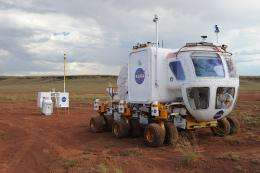
The Lunar Electric Rover with the Portable Utility Pallet.
(PhysOrg.com) -- To prepare for human exploration of the moon and other destinations in our solar system, NASA is conducting a field test of rovers and equipment at an Earthly site in the Arizona desert. Hundreds of students are invited to experience it.
NASA's annual Desert RATS -- or Research and Technology Studies -- field test is underway. The agency has planned a variety of activities to engage students in the practical application of the science, technology, math and engineering skills critical to space exploration.
Dozens of students from Flagstaff and surrounding areas have been invited to visit the test site at Black Point Lava Flow on Sept. 16. They will be introduced to the work NASA engineers and researchers conducted during the field test. In addition, college teams that ranked highest in NASA's 2009 Moon Work Engineering Contest will present their projects to members of the NASA field test team. The winning teams are from the University of Maryland, College Park; the University of Akron, Ohio; and Texas A&M University, College Station.
As part of the day's activities, hundreds of elementary and middle school students participating in "Education Alley" at the American Institute of Aeronautics and Astronautics' Space 2009 Conference in Pasadena, Calif., will observe field test activities and chat live with the NASA engineers and researchers via satellite at 1 p.m. EDT. Heather Paul and Kimberly Land of NASA's Exploration Technology Development Program will host the event, which will include NASA experts explaining how the agency plans to use similar rovers on the moon; video clips of field test demonstrations; and questions from students. Students everywhere can view the event and learn more about the Desert RATS activities at: http://www.nasa.go … tion/analogs .
The 2009 Desert RATS tests focus on a simulated 14-day mission. Two crew members -- an astronaut and a geologist -- will live for 14 days inside NASA's prototype Lunar Electric Rover, searching the area for features of geologic interest and conducting simulated moonwalks to collect samples. NASA's K10 scout robot examined the location in August to identify areas of interest. NASA's heavy-lift rover Tri-ATHLETE -- or All-Terrain Hex-Limbed Extra-Terrestrial Explorer -- will carry a habitat mockup to which the rover will dock.
The Desert RATS tests have taken place for more than a decade, as engineers from NASA centers have worked together with representatives from both industry and academia to determine what will be needed when NASA makes trips to other worlds. Future Desert RATS analog test activities could involve international partners in the quest toward human planetary exploration. This year's work will build on the investigations of previous years, increasing the scope and length of the tests.
NASA centers involved are Johnson Space Center in Houston; Langley Research Center, in Hampton, Va.; Jet Propulsion Laboratory in Pasadena, Calif.; Ames Research Center in Moffett Field, Calif.; Kennedy Space Center in Florida.; Goddard Space Flight Center in Greenbelt, Md.; Glenn Research Center in Cleveland; Marshall Space Flight Center in Huntsville, Ala.; and NASA Headquarters in Washington.
Desert RATS participants from outside of NASA include the Smithsonian Institution in Washington; the United States Geological Survey in Flagstaff, Ariz.; Arizona State University in Tempe; University of Texas at El Paso; University of Colorado at Denver; Brown University in Providence, R.I.; and the Mars Institute at Moffett Field, Calif.
For more information about NASA's "Moon Work" contest, visit: http://moontasks.larc.nasa.gov
-
STUDENTS IN SOUTHFIELD EXPERIENCE SPACE IN THE DESERT
Sep 14, 2004 |
not rated yet |
0
-
Space Droids In The Desert
Sep 15, 2006 |
not rated yet |
0
-
NASA Tests Rover Concepts in Arizona
Oct 27, 2008 |
not rated yet |
0
-
NASA plans 'moonbuggy' design competition
Dec 16, 2006 |
not rated yet |
0
-
NASA Tests Lunar Robots and Spacesuits on Earthly Moonscape
Jun 16, 2008 |
not rated yet |
0
-
Engineers build first sub-10-nm carbon nanotube transistor
Feb 01, 2012 |
4.9 / 5 (31) |
30
-
Something old, something new: Evolution and the structural divergence of duplicate genes
Jan 31, 2012 |
4.6 / 5 (7) |
1
-
The hidden nanoworld of ice crystals: Revealing the dynamic behavior of quasi-liquid layers
Jan 30, 2012 |
5 / 5 (3) |
1
-
Stock market network reveals investor clustering
Jan 27, 2012 |
3.9 / 5 (23) |
8
-
Of microchemistry and molecules: Electronic microfluidic device synthesizes biocompatible probes
Jan 26, 2012 |
5 / 5 (1) |
0
-
Never ending outer space.....
11 hours ago
-
Neutron Star fragments?
13 hours ago
-
stationary or not?
17 hours ago
-
Scale of the Universe
Feb 10, 2012
-
Titan's lack of impact craters
Feb 09, 2012
-
Real pictures of black hole eating a star?
Feb 08, 2012
- More from Physics Forums - General Astronomy
More news stories
Latin America mining boom clashes with conservation
Latin America is experiencing a mining boom as prices rise fuelled by a hike in global demand, but the region is also being hit by a wave of violent protests, strikes and rallies by environmentalists.
4 hours ago |
not rated yet |
0
Political leaders play key role in how worried Americans are by climate change: study
More than extreme weather events and the work of scientists, it is national political leaders who influence how much Americans worry about the threat of climate change, new research finds.
Feb 06, 2012 |
5 / 5 (6) |
72
NASA budget will axe Mars deal with Europe: scientists
US President Barack Obama's budget proposal to be submitted next week for 2013 will cut NASA's budget by 20 percent and eliminate a major partnership with Europe on Mars exploration, scientists said Thursday.
Space & Earth / Space Exploration
Feb 10, 2012 |
5 / 5 (3) |
55
Humans may have helped the decline of African rainforests 3000 years ago
(PhysOrg.com) -- Large areas of rainforests in Central Africa mysteriously disappeared over three thousand years ago, to be replaced by savannas. The prevailing theory has been that the cause was a change ...
High planetary tilt lowers odds for life?
Highly-tilted worlds would have extreme seasons, subjecting life to alternating periods of scorching and subzero temperatures. This could make the development of all but hardiest, simplest creatures a long ...
Space & Earth / Space Exploration
Feb 06, 2012 |
4.8 / 5 (12) |
14
|
Google might launch Drive for cloud storage soon
(PhysOrg.com) -- Google's next big move, according to the Wall Street Journal, is a cloud storage service called Drive. Hardly first to the plate, Google is simply catching up to introducing its cloud reposi ...
Walney offshore wind farm is world's biggest (for now)
(PhysOrg.com) -- The Walney wind farm on the Irish Sea--characterized by high tides, waves and windy weather--officially opened this week. The farm is treated in the press as a very big deal as the Walney ...
Love a click away in Indonesia's Twitter Republic
He was a geeky kid from Yogyakarta, she a glamorous city girl in Jakarta. In a country with one of the world's most vibrant social networking scenes they fell in love on Twitter.
Europeans protest controversial Internet pact
Tens of thousands of people marched in protests in more than a dozen European cities Saturday against a controversial anti-online piracy pact that critics say could curtail Internet freedom.
Navy to begin tests on electromagnetic railgun prototype launcher
The Office of Naval Research (ONR)'s Electromagnetic (EM) Railgun program will take an important step forward in the coming weeks when the first industry railgun prototype launcher is tested at a facility ...
Explained: Sigma
It's a question that arises with virtually every major new finding in science or medicine: What makes a result reliable enough to be taken seriously? The answer has to do with statistical significance -- but ...