Going With the Flow: Using Star Power to Better Understand Fusion
September 11, 2009 Plasma Power: Turning Fusion Into a Renewable Energy Source

Enlarge

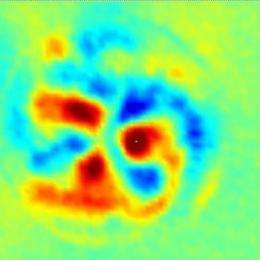
Above is a false color image taken from a fast imaging camera that shows the “plasma weather patterns” that form and propagate in Controlled Shear Decorrelation Experiments (CSDX). The motion and dynamics of these types of structures will be studied as part of the work in the new Center for Momentum Transport and Flow Organization in Plasmas and Magnetofluids at UC San Diego.

(PhysOrg.com) -- UC San Diego researchers are using “star” power to help ignite the field of fusion, which is being looked at as a future reliable green energy source. Under a new $5.8 million five-year grant from the U.S. Department of Energy, UCSD will host and lead the new Center for Momentum Transport and Flow Organization in Plasmas and Magnetofluids, which will bring together astrophysical and magnetic fusion theorists, experimentalists and computationalists from multiple institutions.

The Center, led by George Tynan, a UCSD Mechanical and Aerospace Engineering professor and researcher for the UCSD Center for Energy Research, will also include collaborators from Princeton University, University of Wisconsin at Madison, the University of Colorado at Boulder, UC Irvine, Massachusetts Institute of Technology, UC Santa Cruz, University of Leeds and New York University.

Center researchers will focus on fundamental studies of turbulent transport and organization in and astrophysical plasmas. In doing this, they will directly examine the link between turbulent momentum transport and large scale flow self-organization using newly developed diagnostic and data analysis techniques to investigate and critically test emerging theoretical and computational models. The new Center will also host an annual winter school for graduate students, postdoctoral researchers and scientists interested in this research topic. Web-based seminars and presentations will be provided and archived for future reference.

Studying how large-scale flows are generated and dissipated in natural systems like stars may help unlock some of the mysteries behind how fusion works, Tynan said.

“We are interested in identifying and understanding the common elements between fusion experiments, rotating stars and accretion disks. How do these systems develop organized flows and how do they dissipate or get rid of the energy associated with the flows?” he said. “Answering these questions can allow us to gain a better understanding of the overall behavior of these systems. For example, in order for stars and planets to for the disk has to get rid of some of the rotational energy.”

The recognition of this commonality between flow generation and organization astrophysical and fusion systems came from Pat Diamond, a UCSD physics professor and member of the Center for Astrophysics and Space Science and Co-PI for this new Center. Currently, the leading candidate for producing controlled thermonuclear fusion power is a device called the tokomak, a magnetic confinement device that produces a toroidal magnetic field for confining plasma.

“One of the interesting about a tokomak is the plasma spins continuously, converting thermal energy to rotational energy,” Diamond said. “The spin of a tokomak is good for energy confinement. It inhibits the plasma from locking on to the wall and causing unpleasant stabilities. By understanding these momentum transport processes through this new Center we may be able to optimize and control this spontaneous rotation.”

One of the ultimate goals of the new Center is to help design better, smaller and cheaper fusion systems, Tynan said. He said this research could also contribute to the development of ITER, the world’s first experimental fusion reactor being built in France.

“It’s important that the plasma in the ITER device spins at a rapid enough rate— because this spinning increases the thermal insulation of the plasma, so you can get a hotter reaction in the center, and also allows you to raise the maximum pressure at which the plasma can operate before you have instability.” Tynan said. “Achieving an adequate amount of this rotation in ITER is therefore important. Right now we don’t really understand what causes the rotation in the first place so it’s very difficult to predict with enough confidence what’s going to happen in this new experiment. By working together in this new Center, we hope to be able to understand that problem enough so we can make an estimate of what might happen in this new experiment. We may then better know what the fusion power production in ITER will be.

“Over the last 10 years or more, we have been focused in this field on how to keep heat in a fusion system, largely ignoring the role that flow and flow organization plays,” Tynan added. “Now we have realized that the heat transport problem is intimately coupled to the flow organization problem. We saw that there was an opportunity to study this problem that has been neglected.”

Provided by University of California - San Diego (news : web)


print this article email this article download pdf blog this article bookmark this article     Stumble it Digg this share on Facebook retweet share on Reddit add to delicious
Rate this story - 3.8 /5 (4 votes)

Rank Filter

Move the slider to adjust rank threshold, so that you can hide some of the comments.


Display comments: newest first

  • Atomsview - Sep 11, 2009
    • Rank: 1 / 5 (2)
    The temperature within stars yields the ionization of atoms. Stars utilize the laws of electromagnetism (Maxwell's equations) to fuse nuclei. The correct process is not used in our laboratories.
  • PPihkala - Sep 12, 2009
    • Rank: 1 / 5 (2)
    I also wonder how the fusion would look like it if was viewed in light of all 20 equations of Maxwell's instead of current, century old, truncated version of only 4.
  • omatumr - Sep 12, 2009
    • Rank: 1 / 5 (3)
    FIRST STUDY DATA ON THE SUN AND NUCEAR REST MASSES

    Star power is based on an ILLUSION that the Sun and other ordinary stars are giant balls of Hydrogen heated by Hydrogen fusion. They are not.

    Solar luminosity, solar neutrinos, and solar wind Hydrogen pouring from the surface of the Sun arise from repulsive interactions between neutrons in the solar core that trigger this series of nuclear reactions:

    a) Neutron-emission generates 60% of solar luminosity:
    ---- => n + 12 Mev

    b) Neutron-decay generates 5% of solar luminosity:
    ---- n => proton + electron + 1 MeV

    c) Protons fuse to He-4 as they are accelerated upward by deep-seated magnetic fields, generating 35% of solar luminosity:
    ---- p => 0.25 He-4 + 7 MeV

    d) Protons surviving the upward journey depart in the solar wind, generating 100% of SW Hydrogen:
    ---- 3 x 10^43 protons => depart annually in the solar wind.

    With kind regards,
    Oliver K. Manuel
    http://www.omatumr.com
    http://myprofile....anuelo09
  • Alizee - Sep 13, 2009
    • Rank: 1.5 / 5 (2)
  • omatumr - Sep 29, 2009
    • Rank: 1 / 5 (1)
    If the Sun were in a bottle and nothing escaped through the walls,

    a.) Pouring from the top of the bottle would be heat, light, SW (solar-wind) H that had been produced in the bottle, and enough solar neutrinos to account for ~35% of the heat and light if generated by Hydrogen-fusion alone.

    b.) A tiny, dense speck emitting neutrons would be at the bottom of the bottle.

    c.) Near the speck, neutrons would decay to Hydrogen ions and electrons.

    d.) Strong magnetic fields would carry the Hydrogen upward.

    e.) Most of the Hydrogen would fuse into Helium during this upward journey.

    f.) The upward flow of Hydrogen would maintain mass separation in the bottle selectively carrying lightweight elements and lightweight isotopes of each element to the top of the bottle and away in the solar-wind.

    See: The Sun is a plasma diffuser that sorts atoms by mass, Physics of Atomic Nuclei 69 (2006) 1847-1856

    Oliver K. Manuel

September 11, 2009 all stories

Comments: 5

3.8 /5 (4 votes)
  • Stumble this up

  • Digg this

  • share this

  • hide
  • Related Stories

  • Fusion technology: from ANU to the world
    created Jun 30, 2005 | popularity not rated yet | comments 0
  • Taming 900 vortices gives plasma energy insight
    created Jan 05, 2007 | popularity not rated yet | comments 0
  • ORNL, Princeton partners in five-year fusion project
    created Sep 14, 2005 | popularity not rated yet | comments 0
  • U.S. ITER Project Office Is Relocating to ORNL
    created Feb 01, 2006 | popularity not rated yet | comments 0
  • Controls engineer wins NSF CAREER Award to advance the viability of nuclear fusion
    created Mar 21, 2007 | popularity not rated yet | comments 0


  • hide
  • Relevant PhysicsForums posts

  • Noether's Theorem
    created 49 minutes ago
  • moment of inertia and friction
    created 11 hours ago
  • two-dimensional collision
    created 14 hours ago
  • The acceleration of mass using light
    created 16 hours ago
  • Badminton
    created 17 hours ago
  • Galileos law of free fall
    created 19 hours ago
  • More from Physics Forums - General Physics

Other News

In the Brain, Seven Is A Magic Number

In the Brain, Seven Is A Magic Number

Physics / General Physics

created 20 hours ago | popularity 4.4 / 5 (28) | comments 8

Having a tough time recalling a phone number someone spoke a few minutes ago or forgetting items from a mental grocery list is not a sign of mental decline; in fact, it's natural.


Scientists react as they stand in front of a screen at CERN

First atoms reported smashed in Large Hadron Collider (Update)

Physics / General Physics

created 22 hours ago | popularity 4.7 / 5 (25) | comments 14

Two circulating beams on Monday produced the first particle collisions in the world's biggest atom smasher, the Large Hadron Collider (LHC), three days after its restart, scientists announced.


New tool for helping pediatric heart surgery

Physics / General Physics

created 7 hours ago | popularity not rated yet | comments 0

A team of researchers at the University of California, San Diego and Stanford University has developed a way to simulate blood flow on the computer to optimize surgical designs. It is the basis of a new tool that may help ...


Straightening messy correlations with a quantum comb

Straightening messy correlations with a quantum comb

Physics / Quantum Physics

created 22 hours ago | popularity 4.8 / 5 (8) | comments 0

Quantum computing promises ultra-fast communication, computation and more powerful ways to encrypt sensitive information. But trying to use quantum states as carriers of information is an extremely delicate ...


Visual assistance for cosmic blind spots

Visual assistance for cosmic blind spots

Physics / General Physics

created 23 hours ago | popularity 4.3 / 5 (3) | comments 0

A bit of imagination on the part of a measuring instrument wouldn't be a bad thing. It could help to add data from areas where the instrument is unable to measure. However, it must do so constructively. In ...