First complete image created of Himalayan fault, subduction zone
September 11, 2009 First complete image created of Himalayan fault, subduction zone

Enlarge

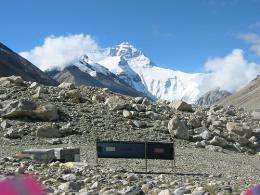
The Hi-CLIMB (Himalayan-Tibetan Continental Lithosphere during Mountain Building) seismic station at the Mt. Everest base camp in Tibet. (photo courtesy of OSU's John Nabelek)

An international team of researchers has created the most complete seismic image of the Earth's crust and upper mantle beneath the rugged Himalaya Mountains, in the process discovering some unusual geologic features that may explain how the region has evolved.

Their findings, published this week in the journal Science, help explain the formation of the world's largest mountain range, which is still growing.

The researchers discovered that as the Indian and Eurasian tectonic plates collide, the Indian lower crust slides under the Tibetan crust, while the upper mantle peels away from the crust and drops down in a diffuse manner.

"The building of Tibet is not a simple process," said John Nabelek, an Oregon State University geophysicist and lead author on the Science study. "In part, the mountain building is similar to pushing dirt with a bulldozer except in this case, the Indian sediments pile up into a wedge that is the lesser Himalayan mountains.

"However, an important component of the from the upper crust of India to the Himalayas also occurs at depth through viscous processes, while the lower crust continues sliding intact farther north under the Tibet plateau," Nabelek added.

The findings are important because there has been clear scientific consensus on the boundaries and processes for that region's . In fact, the piecemeal images gathered by previous research have led to a series of conflicting models of the lithospheric structure and plate movement.

In this study, the international research team - called Hi-CLIMB (Himalayan-Tibetan Continental Lithosphere during Mountain Building) - was able to create new in-depth images of the Earth's structure beneath the Himalayas.

The interface between the subducting Indian plate and the upper Himalayan and Tibetan crust is the Main Himalayan thrust fault, which reaches the surface in southern Nepal, Nabelek said. The new images show it extends from the surface to mid-crustal depths in central Tibet, but the shallow part of the fault sticks, leading to historically devastating mega-thrust earthquakes.

"The deep part is ductile," Nabelek said, "and slips in a continuous fashion. Knowing the depth and geometry of this interface will advance research on a variety of fronts, including the interpretation of strain accumulation from GPS measurements prior to large earthquakes."
First complete image created of Himalayan fault, subduction zone
Enlarge

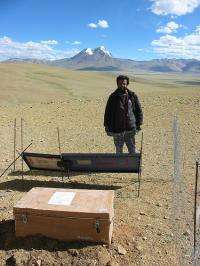
Soma Sapkota, of Nepal's Department of Mines and Geology, at a seismic station in barren, wind-swept central Tibet. (photo courtesy of OSU's John Nabelek)

Nabelek, an associate professor in OSU's College of Oceanic and Atmospheric Sciences, said the lower part of the Indian crust slides about 450 kilometers under the southern Tibetan plate and the mantle appears to shear off and break into sub-parallel segments.

The researchers found evidence that subduction in the fault zone has been occurring from both the north and south sides - likely at different times in its geologic history.

In this project, funded primarily by the National Science Foundation, the researchers deployed and monitored about 230 seismic stations for a period of three years, cutting across 800 kilometers of some of the most remote terrain in the world. The lowest-elevation station was at 12 meters above sea level in Nepal; the highest, nearly 5,500 meters in Tibet. In fact, 30 of the stations were higher than 5,000 meters, or 16,400 feet.

"The research took us from the jungles of Nepal, with its elephants, crocodiles and rhinos, to the barren, wind-swept heights of Tibet in areas where nothing grew for hundreds of miles and there were absolutely no humans around," Nabelek said. "That remoteness is one reason this region had never previously been completely profiled."

Source: Oregon State University (news : web)


print this article email this article download pdf blog this article bookmark this article     Stumble it Digg this share on Facebook retweet share on Reddit add to delicious
Rate this story - 4.3 /5 (7 votes)

Rank Filter

Move the slider to adjust rank threshold, so that you can hide some of the comments.


Display comments: newest first

  • Nartoon - Sep 12, 2009
    • Rank: not rated yet
    Shouldn't the fault line travel east-west along a line much wider than India since the entire Indian sub-continent is pushing north into Eurasia?

September 11, 2009 all stories

Comments: 1

4.3 /5 (7 votes)
  • Stumble this up

  • Digg this

  • share this

  • hide
  • Related Stories

  • Scientists use seismic waves to locate missing rock under Tibet
    created Feb 07, 2007 | popularity not rated yet | comments 0
  • Geophysicists image rock layers under Himalaya
    created Jun 29, 2005 | popularity not rated yet | comments 0
  • China quake rare and unexpected, new study says
    created Jun 30, 2008 | popularity not rated yet | comments 0
  • New analysis of earthquake zone raises questions
    created Aug 26, 2008 | popularity not rated yet | comments 0
  • Journey to the center of the Earth -- Scientists explain tectonic plate motions
    created Feb 21, 2008 | popularity not rated yet | comments 0


  • hide
  • Relevant PhysicsForums posts

Other News

Astronauts finish another spacewalk, still no baby (AP)

Astronauts finish another spacewalk, still no baby

Space & Earth / Space Exploration

created 8 hours ago | popularity 3 / 5 (2) | comments 0

(AP) -- A spacewalking astronaut put aside the impending birth of his daughter and blazed through his first-ever venture outside the International Space Station on Saturday.


Unseasonably hot and dry weather combined with strong winds to fan scores of blazes in the country's southeastern states

Australia issues 'catastrophic' alerts as fires rage

Space & Earth / Environment

created 14 hours ago | popularity 4.5 / 5 (2) | comments 0

Australia has issued "catastrophic" alerts after record-breaking temperatures and wild lightning storms sparked more than 100 fires across the country, officials said Saturday.


Commuters wait on the platform shrouded by fog in London

Climate change not man-made, say majority of Britons: poll

Space & Earth / Environment

created Nov 15, 2009 | popularity 3.3 / 5 (15) | comments 46

Less than half of Britons believes that human activity is to blame for global warming, according to a poll carried out for The Times newspaper and published on Saturday.


Mysteriously warm times in Antarctica

Mysteriously warm times in Antarctica

Space & Earth / Earth Sciences

created Nov 18, 2009 | popularity 4.2 / 5 (21) | comments 28

(PhysOrg.com) -- A new study of Antarctica's past climate reveals that temperatures during the warm periods between ice ages (interglacials) may have been higher than previously thought. The latest analysis ...


UN: Fight climate change with free condoms (AP)

UN: Fight climate change with free condoms

Space & Earth / Environment

created Nov 18, 2009 | popularity 3.1 / 5 (11) | comments 24

(AP) -- The battle against global warming could be helped if the world slowed population growth by making free condoms and family planning advice more widely available, the U.N. Population Fund said Wednesday.