Master gene that switches on disease-fighting cells identified by scientists
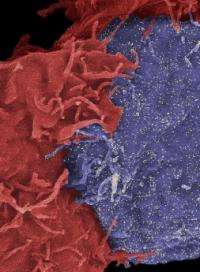
(PhysOrg.com) -- The master gene that causes blood stem cells to turn into disease-fighting 'Natural Killer' (NK) immune cells has been identified by scientists, in a study published in Nature Immunology today. The discovery could one day help scientists boost the body's production of these frontline tumour-killing cells, creating new ways to treat cancer.
The researchers have 'knocked out' the gene in question, known as E4bp4, in a mouse model, creating the world's first animal model entirely lacking NK cells, but with all other blood cells and immune cells intact. This breakthrough model should help solve the mystery of the role that Natural Killer cells play in autoimmune diseases, such as diabetes and multiple sclerosis. Some scientists think that these diseases are caused by malfunctioning NK cells that turn on the body and attack healthy cells, causing disease instead of fighting it. Clarifying NK cells' role could lead to new ways of treating these conditions.
The study was carried out by researchers at Imperial College London, UCL and the Medical Research Council's National Institute for Medical Research.
Natural Killer cells - a type of white blood cell - are a major component of the human body's innate, quick-response immune system. They provide a fast frontline defence against tumours, viruses and bacterial infections, by scanning the human body for cells that are cancerous or infected with a virus or a bacterial pathogen, and killing them.
NK cells - along with all other types of blood cell, both white and red - are continuously generated from blood stem cells in the bone marrow over the course of a person's lifetime. The gene E4bp4 identified in today's study is the 'master gene' for NK cell production, which means it is the primary driver that causes blood stem cells to differentiate into NK cells.
The researchers behind today's study, led by Dr Hugh Brady from the Department of Life Sciences at Imperial College London, are hoping to progress with a drug treatment for cancer patients which reacts with the protein expressed by their E4bp4 gene, causing their bodies to produce a higher number of NK cells than normal, to increase the chances of successfully destroying tumours.
Currently, NK cells isolated from donated blood are sometimes used to treat cancer patients, but the effectiveness of donated cells is limited because NK cells can be slightly different from person to person. Dr Brady explains: "If increased numbers of the patient's own blood stem cells could be coerced into differentiating into NK cells, via drug treatment, we would be able to bolster the body's cancer-fighting force, without having to deal with the problems of donor incompatibility."
Dr Brady and his colleagues at the MRC National Institute for Medical Research proved the pivotal role E4bp4 plays in NK production when they knocked the gene out in a mouse model. Without E4bp4 the mouse produced no NK cells whatsoever but other types of blood cell were unaffected. As well as proving their hypothesis about the function of the E4bp4 gene, this animal model will allow medical researchers, for the first time, to discover if NK cell malfunction is behind a wide range of medical conditions, including autoimmune disorders, inflammatory conditions, persistent viral infections, female infertility and graft rejection.
Dr Brady explains: "Since shortly after they were discovered in the 1970s some scientists have suspected that the vital disease-fighting NK cells could themselves be behind a number of serious medical conditions, when they malfunction. Now finally, with our discovery of the NK cell master gene and subsequent creation of our mouse model, we will be able to find out if the progression of these diseases is impeded or aided by the removal of NK cells from the equation. This will solve the often-debated question of whether NK cells are always the 'good guys', or if in certain circumstances they cause more harm than good."
The researchers were initially studying the effect of E4bp4 in a very rare but fatal form of childhood leukaemia when they discovered its importance for NK cells.
Source: Imperial College London (news : web)


