Nobel Peace Prize winner Norman Borlaug dies at 95
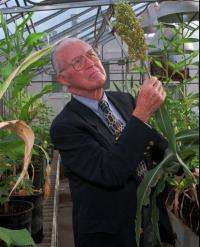
(AP) -- Agricultural scientist Norman Borlaug, the father of the "green revolution" who won the Nobel Peace Prize for his role in combating world hunger and saving hundreds of millions of lives, died Saturday in Texas, a Texas A&M University spokeswoman said. He was 95.
Borlaug died Saturday night at his home in Dallas from complications of cancer, school spokeswoman Kathleen Phillips said. Phillips said Borlaug's granddaughter told her about his death. Borlaug was a distinguished professor at the university in College Station.
The Nobel committee honored Borlaug in 1970 for his contributions to high-yield crop varieties and bringing other agricultural innovations to the developing world. Many experts credit the green revolution with averting global famine during the second half of the 20th century and saving perhaps 1 billion lives.
Thanks to the green revolution, world food production more than doubled between 1960 and 1990. In Pakistan and India, two of the nations that benefited most from the new crop varieties, grain yields more than quadrupled over the period.
"Norman E. Borlaug saved more lives than any man in human history," said Josette Sheeran, executive director of the U.N. World Food Program. "His heart was as big as his brilliant mind, but it was his passion and compassion that moved the world."
Equal parts scientist and humanitarian, the Iowa-born Borlaug realized improved crop varieties were just part of the answer, and pressed governments for farmer-friendly economic policies and improved infrastructure to make markets accessible. A 2006 book about Borlaug is titled "The Man Who Fed the World."
"He has probably done more and is known by fewer people than anybody that has done that much," said Dr. Ed Runge, retired head of Texas A&M University's Department of Soil and Crop Sciences and a close friend who persuaded Borlaug teach at the school. "He made the world a better place - a much better place. He had people helping him, but he was the driving force."
Borlaug began the work that led to his Nobel in Mexico at the end of World War II. There he used innovative breeding techniques to produce disease-resistant varieties of wheat that produced much more grain than traditional strains.
He and others later took those varieties and similarly improved strains of rice and corn to Asia, the Middle East, South America and Africa.
"More than any other single person of his age, he has helped to provide bread for a hungry world," Nobel Peace Prize committee chairman Aase Lionaes said in presenting the award to Borlaug. "We have made this choice in the hope that providing bread will also give the world peace."
During the 1950s and 1960s, public health improvements fueled a population boom in underdeveloped nations, leading to concerns that agricultural systems could not keep up with growing food demand. Borlaug's work often is credited with expanding agriculture at just the moment such an increase in production was most needed.
"We got this thing going quite rapidly," Borlaug told The Associated Press in a 2000 interview. "It came as a surprise that something from a Third World country like Mexico could have such an impact."
His successes in the 1960s came just as books like "The Population Bomb" were warning readers that mass starvation was inevitable.
"Three or four decades ago, when we were trying to move technology into India, Pakistan and China, they said nothing could be done to save these people, that the population had to die off," he said in 2004.
Borlaug often said wheat was only a vehicle for his real interest, which was to improve people's lives.
"We must recognize the fact that adequate food is only the first requisite for life," he said in his Nobel acceptance speech. "For a decent and humane life we must also provide an opportunity for good education, remunerative employment, comfortable housing, good clothing and effective and compassionate medical care."
In Mexico, Borlaug was known both for his skill in breeding plants and for his eagerness to labor in the fields himself, rather than to let assistants do all the hard work.
He remained active well into his 90s, campaigning for the use of biotechnology to fight hunger and working on a project to fight poverty and starvation in Africa by teaching new drought-resistant farming methods.
"We still have a large number of miserable, hungry people and this contributes to world instability," Borlaug said in May 2006 at an Asian Development Bank forum in the Philippines. "Human misery is explosive, and you better not forget that."
Norman Ernest Borlaug was born March 25, 1914, on a farm near Cresco, Iowa, and educated through the eighth grade in a one-room schoolhouse.
He left home during the Great Depression to study forestry at the University of Minnesota. While there he earned himself a place in the university's wrestling hall of fame and met his future wife, whom he married in 1937. Margaret Borlaug died in 2007 at the age of 95.
After a brief stint with the U.S. Forest Service, Norman Borlaug returned to the University of Minnesota for a doctoral degree in plant pathology. He then worked as a microbiologist for DuPont, but soon left for a job with the Rockefeller Foundation. Between 1944 and 1960, Borlaug dedicated himself to increasing Mexico's wheat production.
In 1963, Borlaug was named head of the newly formed International Maize and Wheat Improvement Center, where he trained thousands of young scientists.
Borlaug retired as head of the center in 1979 and turned to university teaching, first at Cornell University and then at Texas A&M, which presented him with an honorary doctorate in December 2007.
"You really felt really very privileged to be with him, and it wasn't that he was so overpowering, but he was always on, intellectually always engaged," said Dr. Ed Price, director of A&M's Norman Borlaug Institute for International Agriculture. "He was always onto the issues and wanting to engage and wanting your opinions and thoughts."
In 1986, Borlaug established the Des Moines, Iowa-based World Food Prize, a $250,000 award given each year to a person whose work improves the world's food supply. He also helped found and served as president of the Sasakawa Africa Foundation, an organization funded by Japanese billionaire Ryoichi Sasakawa to introduce the green revolution to sub-Saharan Africa.
In July 2007, Borlaug received the Congressional Gold Medal, the highest civilian honor given by Congress.
He is survived by daughter Jeanie Borlaug Laube and her husband Rex; son William Gibson Borlaug and his wife Barbie; five grandchildren and six great-grandchildren.
"We would like his life to be a model for making a difference in the lives of others and to bring about efforts to end human misery for all mankind," his children said in a statement. "One of his favorite quotes was, 'Reach for the stars. Although you will never touch them, if you reach hard enough, you will find that you get a little 'star dust' on you in the process.'"
©2009 The Associated Press. All rights reserved. This material may not be published, broadcast, rewritten or redistributed.


