Sex life may hold key to honeybee survival
September 14, 2009 Honeybees

Enlarge

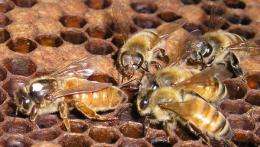
Honeybees (queen marked). Image: Dr Bill Hughes

The number and diversity of male partners a queen honeybee has could help to protect her children from disease, say University of Leeds scientists, who are investigating possible causes of the widespread increase in bee deaths seen around the world.

The researchers are working on the theory that the reason some colonies are wiped out while others remain healthy could be down the genetic diversities of the hives.

Dr Bill Hughes, from the Faculty of Biological Sciences at the University of Leeds, says: “By making sure queens mate with enough genetically variable males, we may be able to boost resistance levels and so protect our populations from disease attacks like the ones we have seen hitting the US.”

One possibility is that the loss of honeybees means that the number and variety of potential mates for a queen is becoming too low to maintain and therefore disease resistant populations.

Says Dr Hughes: “Given the choice, queen honeybees will typically mate with up to 12 different male partners in a matter of minutes and some with over 20.   The record is the giant Asian honeybee whose queens normally mate with well over 40 males - and in one case was found to have mated with over a hundred.”

The Leeds scientists will be examining the question of genetic resistance by studying honeybee reactions to a common fungus parasite called Chalkbrood, under carefully controlled laboratory conditions.

The , already found in the majority of UK hives, infects and ‘eats’ larvae, giving them a chalky appearance. Individual larvae die but the parasite rarely kills the whole colony.

In 2008, US average losses of honeybee colonies were 35%, with some beekeepers losing 90% of their colonies.  A contributing factor to these high levels of honeybee deaths may have been a virus. However the same virus has been found in other countries yet does not seem to cause the same problems.

Dr Hughes and his team think infections by hidden in genetically susceptible bees may be combining with other factors to produce a lethal ‘perfect storm’ which overwhelms their defences.

Honeybee survival is vital to the protection of our food supplies because they pollinate up to a third of the food we grow in the UK.

The project, which has received just under £500,000 in funding from the Natural Environment Research Council, is due last for three years. Collaborators include the UK Government’s National Bee Unit based near York and the University of Copenhagen.

Source: University of Leeds (news : web)


print this article email this article download pdf blog this article bookmark this article     Stumble it Digg this share on Facebook retweet share on Reddit add to delicious
Rate this story - 5 /5 (1 vote)


September 14, 2009 all stories

Comments: 0

5 /5 (1 vote)
  • Stumble this up

  • Digg this

  • share this

  • hide
  • Related Stories

  • Genetic diversity in honeybee colonies boosts productivity
    created Jul 20, 2007 | popularity not rated yet | comments 0
  • Queen bee promiscuity boosts hive health
    created Dec 11, 2006 | popularity not rated yet | comments 0
  • Royal corruption is rife in the ant world
    created Mar 11, 2008 | popularity not rated yet | comments 0
  • Survey finds slower decline of honeybee colonies
    created May 20, 2009 | popularity not rated yet | comments 0
  • Honeybee genome to enable genetic study of social behaviour
    created Nov 20, 2006 | popularity not rated yet | comments 0


  • hide
  • Relevant PhysicsForums posts

  • Questions about diffusion
    created 4 hours ago
  • Human Leukocyte Antigen (HLA) typing
    created 11 hours ago
  • Breeding program
    created Nov 20, 2009
  • How does a concentration gradient provide energy?
    created Nov 20, 2009
  • More from Physics Forums - Biology

Other News

The Monarchs' annual migration ritual has yet to be scientifically explained

Tree-eating bugs threaten Monarch butterfly in Mexico

Biology / Ecology

created 12 hours ago | popularity 4 / 5 (1) | comments 0

The mysterious Monarch butterfly, which migrates en masse annually between Canada and Mexico, is now facing a new peril: another insect thriving in Western Mexican forests.


Bigger not necessarily better, when it comes to brains

Bigger not necessarily better, when it comes to brains

Biology / Plants & Animals

created Nov 17, 2009 | popularity 4.5 / 5 (17) | comments 11

(PhysOrg.com) -- Tiny insects could be as intelligent as much bigger animals, despite only having a brain the size of a pinhead, say scientists at Queen Mary, University of London.


Extinct goat Myotragus balearicus

Extinct goat was cold-blooded

Biology / Plants & Animals

created Nov 18, 2009 | popularity 4.9 / 5 (33) | comments 10

(PhysOrg.com) -- An extinct goat that lived on a barren Mediterranean island survived for millions of years by reducing in size and by becoming cold-blooded, which has never before been discovered in mammals.


Right-handed chimpanzees provide clues to the origin of human language

Biology / Plants & Animals

created Nov 16, 2009 | popularity 3 / 5 (1) | comments 7

Most of the linguistic functions in humans are controlled by the left cerebral hemisphere. A study of captive chimpanzees at the Yerkes National Primate Research Center (Atlanta, Georgia), reported in the January 2010 issue ...


The creature was found at a depth of 161 metres

Japanese researchers film rare baby fish 'fossil'

Biology / Plants & Animals

created Nov 17, 2009 | popularity 4.7 / 5 (7) | comments 4

Japanese marine researchers said Tuesday they had found and successfully filmed a young coelacanth -- a rare type of fish known as "a living fossil" -- in deep water off Indonesia.