Astronomers unveil an amazing, interactive, 360-degree panoramic view of the entire night sky
September 14, 2009 Astronomers unveil an amazing, interactive, 360-degree panoramic view of the entire night sky

Enlarge

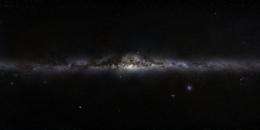
This magnificent 360-degree panoramic image, covering the entire southern and northern celestial sphere, reveals the cosmic landscape that surrounds our tiny blue planet. This gorgeous starscape serves as the first of three extremely high-resolution images featured in the GigaGalaxy Zoom project, launched by ESO within the framework of the International Year of Astronomy 2009 (IYA2009). The plane of our Milky Way Galaxy, which we see edge-on from our perspective on Earth, cuts a luminous swath across the image. The projection used in GigaGalaxy Zoom place the viewer in front of our Galaxy with the Galactic Plane running horizontally through the image — almost as if we were looking at the Milky Way from the outside. From this vantage point, the general components of our spiral galaxy come clearly into view, including its disc, marbled with both dark and glowing nebulae, which harbours bright, young stars, as well as the Galaxy’s central bulge and its satellite galaxies. As filming extended over several months, objects from the Solar System came and went through the star fields, with bright planets such as Venus and Jupiter. For copyright reasons, we cannot provide here the full 800-million-pixel original image. The high resolution image provided here contains 18 million pixels. Credit: ESO

(PhysOrg.com) -- The first of three images of ESO's GigaGalaxy Zoom project — a new magnificent 800-million-pixel panorama of the entire sky as seen from ESO's observing sites in Chile — has just been released online. The project allows stargazers to explore and experience the Universe as it is seen with the unaided eye from the darkest and best viewing locations in the world.

This 360-degree panoramic image, covering the entire celestial sphere, reveals the cosmic landscape that surrounds our tiny blue planet. This gorgeous starscape serves as the first of three extremely high-resolution images featured in the GigaGalaxy Zoom project, launched by ESO within the framework of the International Year of Astronomy 2009 (IYA2009).

GigaGalaxy Zoom features a web tool that allows users to take a breathtaking dive into our Milky Way. With this tool users can learn more about many different and exciting objects in the image, such as multicoloured nebulae and exploding stars, just by clicking on them. In this way, the project seeks to link the sky we can all see with the deep, "hidden" cosmos that astronomers study on a daily basis. The wonderful quality of the images is a testament to the splendour of the night sky at ESO's sites in Chile, which are the most productive astronomical observatories in the world.

The plane of our , which we see edge-on from our perspective on Earth, cuts a luminous swath across the image. The projection used in GigaGalaxy Zoom place the viewer in front of our Galaxy with the Galactic Plane running horizontally through the image — almost as if we were looking at the Milky Way from the outside. From this vantage point, the general components of our come clearly into view, including its disc, marbled with both dark and glowing nebulae, which harbours bright, young stars, as well as the Galaxy's central bulge and its satellite galaxies.

The painstaking production of this image came about as a collaboration between ESO, the renowned French writer and astrophotographer Serge Brunier and his fellow Frenchman Frédéric Tapissier. Brunier spent several weeks during the period between August 2008 and February 2009 capturing the sky, mostly from ESO observatories at La Silla and Paranal in Chile. In order to cover the full Milky Way, Brunier also made a week-long trip to La Palma, one of the Canary Islands, to photograph the northern skies. Once the raw photographs were in hand, image processing by Tapissier and ESO experts helped to convey accurately the night sky as our eyes behold it. The resulting image is composed of almost 300 fields each individually captured by Brunier four times, adding up to nearly 1200 photos that encompass the entire night sky.

"I wanted to show a sky that everyone can relate to — with its constellations, its thousands of stars, with names familiar since childhood, its myths shared by all civilisations since Homo became Sapiens," says Brunier. "The image was therefore made as man sees it, with a regular digital camera under the dark skies in the Atacama Desert and on La Palma."

As photographing extended over several months, objects from the Solar System came and went through the star fields, with bright planets such as Venus and Jupiter. A brilliant, emerald-green comet also flew by, although spotting it among a background of tens of millions of stars will be difficult (but rewarding).

Overall, the creators of the GigaGalaxy Zoom project hope that these tremendous efforts in bringing the as observed under the best conditions on the planet to stargazers everywhere will inspire awe for the beautiful, immense Universe that we live in.

"The vision of the IYA2009 is to help people rediscover their place in the Universe through the day- and night-time sky, and this is exactly what the GigaGalaxy Zoom project is all about," says project coordinator Henri Boffin.

The second dramatic GigaGalaxy Zoom image will be revealed next week, on 21 September 2009.

More information:

The GigaGalaxy Zoom web site is at http://www.gigagalaxyzoom.org
Serge Brunier's Web site: http://www.sergebrunier.com/gallerie/pleinciel/index-eng.html

Source: ESO (news : web)


print this article email this article download pdf blog this article bookmark this article     Stumble it Digg this share on Facebook retweet share on Reddit add to delicious
Rate this story - 4.9 /5 (14 votes)

Rank Filter

Move the slider to adjust rank threshold, so that you can hide some of the comments.


Display comments: newest first

  • omatumr - Sep 14, 2009
    • Rank: 4 / 5 (1)
    GREAT PHOTOGRAPH!

    Thanks to ESO's GigaGalaxy Zoom project.

    With kind regards,
    Oliver K. Manuel
  • RayCherry - Sep 15, 2009
    • Rank: 4 / 5 (1)
    Never thought I would say this, but I guess Oliver just said it all.

    Congratulations to ESO, GigaGalaxy (and Oliver)

September 14, 2009 all stories

Comments: 2

4.9 /5 (14 votes)
  • Stumble this up

  • Digg this

  • share this

  • hide
  • Related Stories

  • The Planet, the Galaxy and the Laser
    created Aug 03, 2007 | popularity not rated yet | comments 0
  • A pool of distant galaxies -- the deepest ultraviolet image of the universe yet
    created Nov 07, 2008 | popularity not rated yet | comments 0
  • The great Easter egg hunt: The void's incredible richness
    created Apr 13, 2006 | popularity not rated yet | comments 0
  • The thousand-ruby galaxy
    created Sep 02, 2008 | popularity not rated yet | comments 0
  • Google Sky Turns Computer Into Telescope
    created Aug 22, 2007 | popularity not rated yet | comments 0


  • hide
  • Relevant PhysicsForums posts

  • Sideral question
    created 19 hours ago
  • Doppler shifted blackbody spectrum
    created 21 hours ago
  • Earth v. Moon
    created 23 hours ago
  • help me with coordinates and orbits
    created Nov 21, 2009
  • basic 'our universe' question..
    created Nov 20, 2009
  • deriving keplers law
    created Nov 19, 2009
  • More from Physics Forums - General Astronomy

Other News

Astronauts finish another spacewalk, still no baby (AP)

Astronauts finish another spacewalk, still no baby

Space & Earth / Space Exploration

created 10 hours ago | popularity 3 / 5 (2) | comments 0

(AP) -- A spacewalking astronaut put aside the impending birth of his daughter and blazed through his first-ever venture outside the International Space Station on Saturday.


Unseasonably hot and dry weather combined with strong winds to fan scores of blazes in the country's southeastern states

Australia issues 'catastrophic' alerts as fires rage

Space & Earth / Environment

created 16 hours ago | popularity 4 / 5 (3) | comments 0

Australia has issued "catastrophic" alerts after record-breaking temperatures and wild lightning storms sparked more than 100 fires across the country, officials said Saturday.


Commuters wait on the platform shrouded by fog in London

Climate change not man-made, say majority of Britons: poll

Space & Earth / Environment

created Nov 15, 2009 | popularity 3.3 / 5 (15) | comments 46

Less than half of Britons believes that human activity is to blame for global warming, according to a poll carried out for The Times newspaper and published on Saturday.


Mysteriously warm times in Antarctica

Mysteriously warm times in Antarctica

Space & Earth / Earth Sciences

created Nov 18, 2009 | popularity 4.2 / 5 (21) | comments 28

(PhysOrg.com) -- A new study of Antarctica's past climate reveals that temperatures during the warm periods between ice ages (interglacials) may have been higher than previously thought. The latest analysis ...


UN: Fight climate change with free condoms (AP)

UN: Fight climate change with free condoms

Space & Earth / Environment

created Nov 18, 2009 | popularity 3.1 / 5 (11) | comments 24

(AP) -- The battle against global warming could be helped if the world slowed population growth by making free condoms and family planning advice more widely available, the U.N. Population Fund said Wednesday.