February launch for ESA's CryoSat ice mission
September 14, 2009 February launch for ESA's CryoSat ice mission

Enlarge

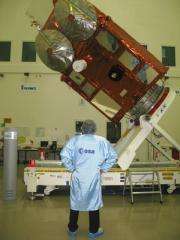
ESA’s CryoSat Project Manager, Richard Francis, standing in front of the satellite at IABG’s spacecraft test centre in Germany. Credits: ESA

(PhysOrg.com) -- As members of the media visit IABG’s spacecraft test centre in Germany to learn more about ESA’s CryoSat mission and view the satellite, a new target launch date of 28 February 2010 has been announced.

The slip, from the planned launch date of December this year, is due to the limited availability of facilities at the Baikonur launch site in Kazakhstan, which is particularly busy at the moment.

Richard Francis, ESA’s Project Manager for CryoSat, commented that, “Naturally we are disappointed at this further delay. The satellite has already spent over six months in storage waiting for a launch opportunity. We restarted test activities in April hoping to have a clear run, but unfortunately we will now have to put the satellite back into its container for another few months. Now we’re replanning to make sure that the whole team is fully trained and at peak performance on the day. After the disappointment of losing the original CryoSat, before we even had the chance to contact it, we are eagerly awaiting this launch. We just have to wait longer.”

CryoSat will be the third of ESA’s Earth Explorer missions in orbit, following on from the GOCE gravity mission in March, and the SMOS water mission, which is being shipped to the in Russia this week for launch on 2 November.

Developed in direct response to the needs of the scientific community, Earth Explorer missions form the science and research element of ESA’s Programme. Their main aim is to improve our understanding of how the Earth system works and the effect that human activity is having on natural Earth processes, while demonstrating breakthrough technology in observation techniques.
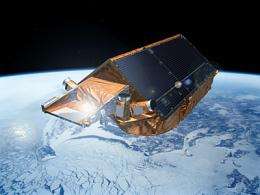
CryoSat
Enlarge

CryoSat will provide data to determine the precise rate of change in the thickness of the polar ice sheets and floating sea ice. It is capable of detecting changes as little as 1 cm per year. The information from the CryoSat will lead to a better understanding of how the volume of ice on Earth is changing and, in turn, a better appreciation of how ice and climate are linked. Credits: ESA - P. Carril

As the effects of climate change are becoming apparent in polar regions, it is increasingly important to understand exactly how Earth’s fields are changing. For some years, satellites such as Envisat have been mapping the extent of ice cover. However, in order to understand how climate change is affecting these sensitive regions, there is an urgent need to determine how the thickness of the ice is changing.

Volker Liebig, ESA’s Director for Earth Observation Programmes commented that, “Ice thickness and mass monitoring is crucial for assessing . CryoSat will be our next Earth Explorer mission in space and I am proud that it took only four months for ESA and its Member States to agree on rebuilding ESA’s ice mission after the loss of the original satellite in 2005.”

Over its lifetime of at least three years, CryoSat will deliver the data that scientists need to determine exactly how the thickness of the huge ice sheets on land and the ice floating in the oceans is changing. Being able to detect changes in these two different types of ice sets the CryoSat mission apart - ice on land can up to 5 km thick and ice floating in the sea just up to a couple of metres thick.

The satellite carries the first all-weather microwave radar altimeter optimised for detecting changes in the elevation of both types of ice. The core instrument is called SIRAL, short for SAR Interferometric Radar Altimeter it has two radar antennas and exploits synthetic aperture processing.

The media are currently enjoying a private viewing of the CryoSat satellite in the cleanroom at IABG’s test centre in Ottobrunn, Germany. It has recently completed a series of tests to demonstrate that the 720 kg , built by Astrium GmbH, is ready for launching into orbit.

CryoSat will soon be packed up in readiness for shipment to the Baikonur Cosmodrome in December, where it will be prepared for launch at the end of February.

Provided by European Space Agency (news : web)


print this article email this article download pdf blog this article bookmark this article     Stumble it Digg this share on Facebook retweet share on Reddit add to delicious
Rate this story - 5 /5 (1 vote)


September 14, 2009 all stories

Comments: 0

5 /5 (1 vote)
  • Stumble this up

  • Digg this

  • share this

  • hide
  • Related Stories

  • Ground segment declared ready for CryoSat-2 launch
    created Aug 07, 2009 | popularity not rated yet | comments 0
  • ESA confirms CryoSat recovery mission
    created Feb 24, 2006 | popularity not rated yet | comments 0
  • ESA's director comments on the loss of CryoSat
    created Oct 10, 2005 | popularity not rated yet | comments 0
  • CryoSat set for launch
    created Oct 08, 2005 | popularity not rated yet | comments 0
  • CryoSat preparations for shipment to launch site to begin
    created Jul 22, 2005 | popularity not rated yet | comments 0


  • hide
  • Relevant PhysicsForums posts

  • Sideral question
    created Nov 21, 2009
  • Doppler shifted blackbody spectrum
    created Nov 21, 2009
  • Earth v. Moon
    created Nov 21, 2009
  • help me with coordinates and orbits
    created Nov 21, 2009
  • basic 'our universe' question..
    created Nov 20, 2009
  • deriving keplers law
    created Nov 19, 2009
  • More from Physics Forums - General Astronomy

Other News

Baby can wait as expectant dad finishes spacewalk (AP)

Baby can wait as expectant dad finishes spacewalk

Space & Earth / Space Exploration

created 17 hours ago | popularity 3 / 5 (2) | comments 0

(AP) -- A spacewalking astronaut put aside the impending birth of his daughter and blazed through his first-ever venture outside the International Space Station on Saturday.


Unseasonably hot and dry weather combined with strong winds to fan scores of blazes in the country's southeastern states

Australia issues 'catastrophic' alerts as fires rage

Space & Earth / Environment

created 23 hours ago | popularity 4 / 5 (3) | comments 0

Australia has issued "catastrophic" alerts after record-breaking temperatures and wild lightning storms sparked more than 100 fires across the country, officials said Saturday.


Commuters wait on the platform shrouded by fog in London

Climate change not man-made, say majority of Britons: poll

Space & Earth / Environment

created Nov 15, 2009 | popularity 3.3 / 5 (15) | comments 46

Less than half of Britons believes that human activity is to blame for global warming, according to a poll carried out for The Times newspaper and published on Saturday.


Mysteriously warm times in Antarctica

Mysteriously warm times in Antarctica

Space & Earth / Earth Sciences

created Nov 18, 2009 | popularity 4.2 / 5 (21) | comments 28

(PhysOrg.com) -- A new study of Antarctica's past climate reveals that temperatures during the warm periods between ice ages (interglacials) may have been higher than previously thought. The latest analysis ...


UN: Fight climate change with free condoms (AP)

UN: Fight climate change with free condoms

Space & Earth / Environment

created Nov 18, 2009 | popularity 3.1 / 5 (11) | comments 27

(AP) -- The battle against global warming could be helped if the world slowed population growth by making free condoms and family planning advice more widely available, the U.N. Population Fund said Wednesday.