Eye Movements May Help Detect Autism

September 14, 2009 Eye Movements May Help Detect Autism

Enlarge

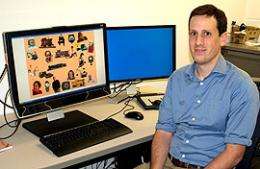
Image arrays used in Sasson’s test might include people, faces, trains, cars, computers, clothes and furniture.

(PhysOrg.com) -- Most parents will attest that infants convey their needs and interests in a variety of ways, many times without ever making a sound. For researchers in the School of Behavioral and Brain Sciences, it is what babies communicate with their eyes that could be key to understanding the development of certain disabilities, including autism.

Dr. Noah Sasson, an assistant professor in the school, and his colleagues at the UT Dallas Center for Children and Families, are currently tracking and measuring the eye movements of infants. technology is nothing new to Sasson — he has used it in previous research to investigate how children and adults perceive social and non-social information.

“By tracking eye movements, we can infer information about an infant based on what he or she views and for how long,” said Sasson. “Although this information alone is not diagnostic, certain patterns of eye movements may signify an abnormality that could reflect potential developmental difficulties.”

Researchers collect the data by having infants sit on their parent’s lap and face a computer monitor. An array of images is projected on the monitor, and a Tobii eye tracker — a standalone unit designed for just such studies — instantly measures the .

Included in the array are social images, such as people and faces, and objects that are often of high interest to children with , such as trains, cars and computers, as well as objects that may be less appealing to children with autism, such as clothes and furniture.
Eye Movements May Help Detect Autism
Enlarge

“The goal of our research is to detect a problem as soon as possible so that parents can then proceed with early intervention programs,” Dr. Noah Sasson says.

Previous research has shown that with autism are more likely to view high interest objects more frequently and for longer periods of time than social or low interest objects. More research is needed before the results can help determine whether a child might be at greater risk for developing autism.

“We know from experience that early intervention can lessen the effects of autism traits in both childhood and adulthood,” said Sasson. “The goal of our research is to detect a problem as soon as possible so that parents can then proceed with early intervention programs.”

Sasson is conducting the study in conjunction with the Infant Development Program. It is designed for infants up to 30 months of age and includes both clinical screenings and research. All activities take place at the Callier Center for Communication Disorders.

Provided by UT Dallas


print this article email this article download pdf blog this article bookmark this article     Stumble it Digg this share on Facebook retweet share on Reddit add to delicious
Rate this story - 4.5 /5 (2 votes)


September 14, 2009 all stories

Comments: 0

4.5 /5 (2 votes)
  • Stumble this up

  • Digg this

  • share this

  • hide
  • Related Stories


  • hide
  • Relevant PhysicsForums posts

Other News

Multitasking may be Achilles heel for hepatitis C

Medicine & Health / Research

created 5 hours ago | popularity 5 / 5 (1) | comments 0

(PhysOrg.com) -- Hepatitis C, a formidable virus that affects 130 million people worldwide, is nursing some pretty impressive bruises. By knocking out sections and subsections of one of its proteins, scientists reveal weak ...


Gene therapy improves vision

Gene therapy improves vision

Medicine & Health / Research

created 6 hours ago | popularity 5 / 5 (2) | comments 0

German scientist Paul Ehrlich found what he coined the "magic bullet" in the early 20th century upon developing the world’s first effective treatment of syphilis.


Tissue tension regulates tumor progression

Medicine & Health / Cancer

created 6 hours ago | popularity not rated yet | comments 0

(PhysOrg.com) -- UCSF scientists have shown for the first time that the rigidity of a tissue can induce cancer. The research team identified an enzyme that is crucial for regulating tissue stiffness and demonstrated that ...


Measured -- The time it takes us to find the words we need

Medicine & Health / Psychology & Psychiatry

created 8 hours ago | popularity 3.3 / 5 (3) | comments 0

(PhysOrg.com) -- The time it takes for our brains to search for and retrieve the word we want to say has been measured for the first time. The discovery is reported in a paper published in the Proceedings of the National Ac ...


Multiple health concerns surface as winter, vitamin D deficiences arrive

Medicine & Health / Health

created 11 hours ago | popularity 3.7 / 5 (3) | comments 3

A string of recent discoveries about the multiple health benefits of vitamin D has renewed interest in this multi-purpose nutrient, increased awareness of the huge numbers of people who are deficient in it, spurred research ...