Evidence Points to Conscious 'Metacognition' in Some Nonhuman Animals
September 14, 2009
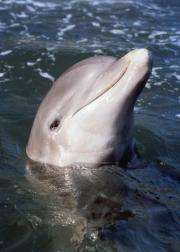
Dolphins like Natua, pictured here, may share with humans the ability reflect upon their states of mind, says UB researcher David Smith.
(PhysOrg.com) -- J. David Smith, Ph.D., a comparative psychologist at the University at Buffalo who has conducted extensive studies in animal cognition, says there is growing evidence that animals share functional parallels with human conscious metacognition -- that is, they may share humans' ability to reflect upon, monitor or regulate their states of mind.
Smith makes this conclusion in an article published the September issue of the journal Trends in Cognitive Science (Volume 13, Issue 9). He reviews this new and rapidly developing area of comparative inquiry, describing its milestones and its prospects for continued progress.
He says "comparative psychologists have studied the question of whether or not non-human animals have knowledge of their own cognitive states by testing a dolphin, pigeons, rats, monkeys and apes using perception, memory and food-concealment paradigms.
"The field offers growing evidence that some animals have functional parallels to humans' consciousness and to humans' cognitive self-awareness," he says. Among these species are dolphins and macaque monkeys (an Old World monkey species).
Smith recounts the original animal-metacognition experiment with Natua the dolphin. "When uncertain, the dolphin clearly hesitated and wavered between his two possible responses," he says, "but when certain, he swam toward his chosen response so fast that his bow wave would soak the researchers' electronic switches.
"In sharp contrast," he says, "pigeons in several studies have so far not expressed any capacity for metacognition. In addition, several converging studies now show that capuchin monkeys barely express a capacity for metacognition.
"This last result," Smith says, "raises important questions about the emergence of reflective or extended mind in the primate order.
"This research area opens a new window on reflective mind in animals, illuminating its phylogenetic emergence and allowing researchers to trace the antecedents of human consciousness."
Smith, a professor in the UB Department of Psychology and Center for Cognitive Sciences, is recognized for his research and publications in the field of animal cognition.
He and his colleagues pioneered the study of metacognition in nonhuman animals, and they have contributed some of the principal results in this area, including many results that involve the participation of Old World and New World monkeys who have been trained to use joysticks to participate in computer tasks.
Their research is supported by the National Institute of Child Health and Development and the National Science Foundation.
Smith explains that metacognition is a sophisticated human capacity linked to hierarchical structure in the mind (because the metacognitive executive control processes oversee lower-level cognition), to self-awareness (because uncertainty and doubt feel so personal and subjective) and to declarative consciousness (because humans are conscious of their states of knowing and can declare them to others).
Therefore, Smith says, "it is a crucial goal of comparative psychology to establish firmly whether animals share humans' metacognitive capacity. If they do, it could bear on their consciousness and self-awareness, too."
In fact, he concludes, "Metacognition rivals language and tool use in its potential to establish important continuities or discontinuities between human and animal minds."
Source: University at Buffalo (news : web)


...
I don't understand this kind of reasoning.
Here we have two observations: One time the dolphin waits for a certain time before he starts to move. The other time the dolphin moves at once.
How can one conclude that the cause for the first observed type of activity is "hesitation" and the cause for the second observed type of activity is "certainty"?
This seems to be anthropocentrism.
Please don't get me wrong - I'm convinced that there are more similarities than differences between the human and the other animals. But the above example is not very convincing.
You've just pointed out one of the great problems with the methodology of psychology. Upon what basis does one conclude, by virtue of the observation of certain behavior, what is the corresponding internal mental state of the agent?
I believe the intention was to illustrate that the dolphin is actually considering its options before acting. The idea is that a purely instinctual animal will quickly act without pausing to think about its choice, whereas an animal with metacognition will ponder first before acting.
I think frajo's point was that there is no way to know that that is the case. The method is inference may be reasonable (which it seems to me). Yet the problem remains that there really is no way, based on behavior, to know the thoughts and intentions of another creature. This is certainly true of humans.
I think Smith has had misconceived metacogniton: with which only humans are capable of; by the power of our mind so as to manipulate the repertoires of our memory, and to create and communicate our intelligence and culture among ourselves. Animals are incapable of doing all those abstract cognition, or creation; let alone metacognition.
The power of our mind is one theory or our memory mechanisms that I just discussed here: http://www.physor...699.html "Memories exist even when forgotten, study suggests -- RE: Memories recalled or manipulated or misinterpreted, etc!?" (PhysOrgEU; September 10).
[to be continued in next post]
That's not necessarily true. They've already determined that Dolphins use "names" to refer to each other, and those names are distinct from individual to individual. In any eventy, without preconception, this research should yield interesting results.
The accurate conception and definition of metacognition is key here, did your assertion mean this:
[to be continued in next post]
[continued from last post -- links in signature removed]
Metacognition is a 'unique' human mental mechanisms: the power of our mind that only humans are capable of learning, so as to 'introspect' and 'understand' ourselves, especially through our dynamic and cumulative cognition and creation in our culture, and in nature; the evolutionary cognitive and creative processes that have had indeed given rise to our 'science' and 'philosophy' today. No other animals on Earth could do those mental feats, real or imagined -- or practical or anthropomorphized feats!?
Best wishes, Mong 9/18/9usct2:40p; practical science-philosophy critic; author "Decoding Scientism" and "Consciousness & the Subconscious" (works in progress since July 2007), "Gods, Genes, Conscience" (iUniverse; 2006) and "Gods, Genes, Conscience: Global Dialogues Now" (blogging avidly since 2006).
Now, here's the most interesting question to ponder:
If dolphins in-fact had sufficient manipulative appendages, as we do, and lived on land, as we do, whose to say they would not be more intelligent than we are?
No, there has been recent research that has shown that dolphins will "announce" themselves upon entering an unfamiliar group with a distinct sonic pattern. The other dolphins will refer to that individual by that same sonic pattern when calling for assitance or expressing displeasure, pleasure, etc. I was rather shocked but on further reading intrigued by the development.
That is intra-species communication, not metacognition as Smith tries to anthropomorphize in dolphins.
Each species of organisms has their own ways of communicating their intelligence through their unique sensory-response-memory mechanisms; only humans have the unlimited capacity to manipulate and recreate our memory repertoires, through metacognition and learning, as explained in RE: Metacognition misconceived!? above.
[to be continued in next post]
There are no continuities or discontinuities between human and animal minds, as Smith has mistakenly tried to detect above.
Humans and animals have evolved and adapted their respective mental capacities -- so as to communicate their respective survival intelligence -- as they appeared at different geological times, especially since the Cambrian explosion of life-species over 500 million years ago! The Quantum Mechanics of life intelligence is discussed here: http://www.physor...500.html RE: What sources of our human 'Superpowers' -- More illusions than resolutions!? (PhysOrgEU; July 3).
Best wishes, Mong 9/19/9usct12:21p; practical science-philosophy critic; author "Decoding Scientism" and "Consciousness & the Subconscious" (works in progress since July 2007), "Gods, Genes, Conscience" (iUniverse; 2006) and "Gods, Genes, Conscience: Global Dialogues Now" (blogging avidly since 2006).
Dolphins although not proven to fit meta-cognition entirely, do show strong signs of meta-cognitive practice.