Plasma power: Turning fusion into a renewable energy source
September 14, 2009
Plasma power: Turning fusion into a renewable energy source

Enlarge

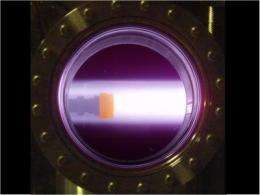
A hot (1,000C) tungsten sample is exposed to high-power deuterium plasma in the PISCES-B device to investigate plasma-surface interactions. Such research and experiments are conducted at the UCSD Center for Energy Research's PISCES lab, which is used to perform fundamental and experimental research in the field of boundary plasma science for fusion applications. Credit: UC San Diego

Fusion is best known for powering the sun and stars. But researchers have long been studying ways to transform that power source into future "green" energy that can be used on Earth. A team of researchers from UC San Diego, MIT and UC Berkeley have received a $7 million research grant from the U.S. Department of Energy (DOE) that could lead us one step closer to making that a reality. The researchers will use the five-year grant for fundamental multiscale studies of plasma-material interactions.

It's well known in the scientific community that plasma-surface interactions (PSI) pose an immense scientific challenge in magnetic confinement fusion; present understanding of PSI in confinement environments is highly inadequate. Under the DOE grant, the three universities will establish science co-centers that will focus on an innovative approach to PSI sciences.

"Right now we're not really making sufficient scientific progress in this field," said Russ Doerner, a research scientist in the UCSD's Jacobs School of Engineering's Center for Energy Research and co-PI on the DOE contract. "There's no deep understanding of this interaction between the and its 'wall' and the other materials in a confined environment. If you can build these 'walls', or layers, to be more effective it will save time, money and energy in the long run."

The 'wall' Doerner is talking about is basically the first surface, or layer, between the plasma (or super hot gas) and the container it is active in. He and his team hope this research will lead to a better understanding of a way to engineer plasma "walls" to survive in the environment necessary to generate fusion power.

"Our aim is to provide power from fusion in a controlled environment," he said. "From a DOE and energy perspective, fusion energy is important for the future because most everything we're using these days is eventually going to be exhausted. Renewable energies like wind and solar are good, but they don't provide the necessary power concentration you need for something like large industrial or population centers."

Doerner said a couple short pulse magnetic confinement machines (called TFTR and JET) have proven the scientific feasibility by measuring fusion happening in their plasma, but have not generated as much power as they have consumed.

At the heart of the sun, fusion takes place at a temperature of 15 million degrees. However, since it impossible to reproduce these conditions on Earth, terrestrial fusion reactors must operate at lower pressures and higher temperatures -- at about 100 million degrees. The best way to control the plasma is to "bottle" it, enclosing the electrically charged gas in powerful magnetic fields. So far, the most successful magnetic "bottle" is a doughnut-shaped device called a tokamak, where a helical magnetic field is used to confine the plasma.

"With magnetic fusion you are basically trying to build a sun on earth," Doerner explained. "But you have to put the sun inside of something. The sun tries to melt the walls. We try to study how the walls behave in that environment. We are trying to understand the plasma interaction with the surfaces around it so we can keep the plasma pure and the walls intact. …If you want to be effective in producing sufficient energy you have to have the walls intact and you have to keep the plasma clean. How the plasma interacts with the walls is one of the issues that determines how well these fusion reactors will generate energy and how cost effective they will be."

Doerner and his group hope their research will help aid the building and operation of large projects like ITER (originally the International Thermonuclear Experimental Reactor), an international tokamak (magnetic confinement fusion) being built in France that could help to make the transition from today's studies of plasma physics to future electricity-producing fusion power plants by making a fusion plasma that produces more power than it consumes. Construction of ITER is expected to be completed by 2018.

According to the ITER consortium, fusion power offers the potential of "environmentally benign, widely applicable and essentially inexhaustible" electricity, properties that the organization believes will be needed as world energy demands increase.

"If we look at what's been happening in fusion research, in particular with the advent of ITER, we are waking up to the challenges of the interactions of materials in confinement devices," said Dennis Whyte, Associate Professor of Nuclear Science and Engineering at MIT and the lead PI on the DOE research project. "We have to integrate the [PSI] science into this field now. Otherwise you'll delay the real development of fusion for another 20 years."

Whyte said the team's goal is to also apply their future research findings for other large fusion energy and electricity-driven plants and facilities. Under the DOE contract, The 'science centers' at UC San Diego, MIT and UC Berkley will focus on research for surface and film dynamics, synergistic effects of radiation and plasma damage, plasma fuel retention, sheath physics and material erosion and transport.

"Fusion should be looked upon on as an attractive nuclear energy source. In the end you need baseline electrical power to run an industrial society, and fusion could provide that," Whyte said. "But when you engineer these materials and environments you have to know how they all will work together and interact. Our vision is to make this ( source) carbon free and very safe. "


Join PhysOrg.com on Facebook!
Follow PhysOrg.com on Twitter!
Source: University of California - San Diego (news : web)

4.6 /5 (13 votes)  

Filter


Move the slider to adjust rank threshold, so that you can hide some of the comments.


Display comments: newest first

Alexa
Sep 14, 2009

Rank: not rated yet
Why tungsten? It should be some deuteride..
Alexa
Sep 14, 2009

Rank: not rated yet
Heating a pyroelectric crystal in a deuterated atmosphere can generate fusion under desktop conditions. The electrostatic field of the crystal is used to generate and accelerate a deuteron beam (> 100 keV and > 4 nA), which, upon striking a deuterated target, produces a neutron flux over 400 times the background level. The presence of neutrons from the reaction D + D --> 3He (820 keV) + n (2.45 MeV)

I can't understand, why plasma treatment of solid deuterides isn't studied more systematically, if plasma fusors provide apparently much less advantageous collision geometry. For example lanthanum immobilizes deuterium well.
PPihkala
Sep 14, 2009

Rank: not rated yet
I think tungsten is used because it's having such a high temperature abilities. One of the reasons it's used in electrical bulbs too. You don't want to use something that will melt at low temperatures. Assuming that this plasma containment idea is sound. I would rather steer funds to something more easily attainable like Cold Fusion.
sender
Sep 15, 2009

Rank: not rated yet
Laser confinement has already been accomplished also, suppose electrode interaction studies would be nice.
Alexa
Sep 15, 2009

Rank: not rated yet
Laser confinement has already been accomplished also

Will NIF Work?
http://arxiv.org/abs/0908.4229
kasen
Sep 15, 2009

Rank: not rated yet
Question: do all fusion power alternatives present economy of scale, or otherwise require large reactors to work? Plasma, laser, wishful thinking, whatever, are they more efficient as the facility gets bigger? Or is it as the article says, just the need for concentrated power for cities and industry? Because I don't think it's just electrical power that's the issue here.
eachus
Sep 15, 2009

Rank: not rated yet
Laser confinement has already been accomplished also

Will NIF Work?
http://arxiv.org/abs/0908.4229


Interesting argument, but one I first heard 20 years ago. The solution is use a homogeneous target. The original proposal was to use frozen pellets of a deuterium-tritium mixture. The problem with that was poor coupling from the lasers to the surface. Thus began the research using (literally) gold-plated targets. But gold was way to high-Z to allow anywhere near a DT plasma. Targets then switched to hydrocarbon (plastic) capsules.

I have always assumed that when the playing around is over, the final choice of targets will be Lithium 6 deuteride with perhaps some tritium mixed in. Technically the reaction Li6 + d ---> 2 He occurs at a much higher temperature than DT fusion. But Li6 + n ---> He4 + t has a very high cross section, so the neutrons from dt fusion (d + t ---> He4 + n) become, in effect a catalyst in the overall reaction.
david_42
Sep 19, 2009

Rank: not rated yet
When was the first functional fusion reactor built?

1959

Commercial neutron sources based on the Fusor approach have been on sale for years.

Not saying they are break-even, but there is a very good chance that the US Navy's WB 8 project will do that within a few years. They are planning on using the proton-Boron reaction: no radioactive fuels, no neutrons and only Helium as a waste product.
sender
Sep 20, 2009

Rank: not rated yet
Laser confinement has already been accomplished also

Will NIF Work?
http://arxiv.org/abs/0908.4229


Interesting argument, but one I first heard 20 years ago. The problem with that was poor coupling from the lasers to the surface.


Maybe the answer is utilizing both magnetic and laser confinement simultaneously which has not been done to date, then using highly ionized particle streams of lithium ferrogas to move turbines. The background radiation can be absorbed by lithium hydride chambers in the walls.
Rank 4.6 /5 (13 votes)
Related Stories
Relevant PhysicsForums posts

More news stories

Explained: Sigma

It's a question that arises with virtually every major new finding in science or medicine: What makes a result reliable enough to be taken seriously? The answer has to do with statistical significance -- but ...

Physics / General Physics

created Feb 09, 2012 | popularity 5 / 5 (20) | comments 76

Quantum physicist explains $100K offer for proof scaled-up quantum computing is impossible

(PhysOrg.com) -- MIT researcher Scott Aaronson has certainly riled the physics community with his offer this past Friday, of $100,000 to anyone who can prove that scaled-up quantum computing is impossible. ...

Physics / Quantum Physics

created Feb 08, 2012 | popularity 4.3 / 5 (14) | comments 36 | with audio podcast weblog

Diamond light, brighter than the sun

It’s the size of five football pitches and generates light 10 billion times brighter than the sun. As the Diamond Light Source celebrates its tenth anniversary this year, Penny Bailey visits one of the ...

Physics / General Physics

created Feb 07, 2012 | popularity 4.4 / 5 (9) | comments 18 | with audio podcast

Physicists 'record' magnetic breakthrough

An international team of scientists has demonstrated a revolutionary new way of magnetic recording which will allow information to be processed hundreds of times faster than by current hard drive technology.

Physics / General Physics

created Feb 07, 2012 | popularity 4.6 / 5 (43) | comments 14 | with audio podcast

Hints of the Higgs - papers are submitted

Back in December 2011, the ATLAS and CMS experiments at CERN presented some exciting results that provided tantalising hints of the Higgs boson.

Physics / General Physics

created Feb 08, 2012 | popularity 4.3 / 5 (8) | comments 10


Scientists discover molecular secrets of 2,000-year-old Chinese herbal remedy

For roughly two thousand years, Chinese herbalists have treated Malaria using a root extract, commonly known as Chang Shan, from a type of hydrangea that grows in Tibet and Nepal. More recent studies suggest that halofuginone, ...

New method to examine batteries -- MRI from the inside

There is an ever-increasing need for advanced batteries for portable electronics, such as phones, cameras, and music players, but also to power electric vehicles and to facilitate the distribution and storage of energy derived ...

Google might launch Drive for cloud storage soon

(PhysOrg.com) -- Google's next big move, according to the Wall Street Journal, is a cloud storage service called Drive. Hardly first to the plate, Google is simply catching up to introducing its cloud reposi ...

Lab study raises questions over nano-particle impact

Tests involving chickens have raised questions about the impact on health from engineered nano-particles, the ultra-fine grains commonly used in drugs and processed foods, scientists said on Sunday.

A mitosis mystery solved: How chromosomes align perfectly in a dividing cell

Although the process of mitotic cell division has been studied intensely for more than 50 years, Whitehead Institute researchers have only now solved the mystery of how cells correctly align their chromosomes during symmetric ...

Starve a virus, feed a cure? Findings show how some cells protect themselves against HIV

A protein that protects some of our immune cells from the most common and virulent form of HIV works by starving the virus of the molecular building blocks that it needs to replicate, according to research published online ...