Will China's Planned Solar Field Lower the Cost of Alternative Energy?
September 14, 2009 by Miranda Marquit
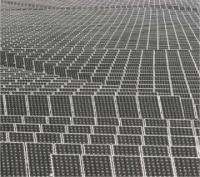
Panels from a solar farm in Spain. This solar farm will not be the largest when China's solar field opens. Image source: Treehugger.com
(PhysOrg.com) -- One of the biggest complaints that some have about solar power (and other forms of alternative energy) is that it is so much more expensive than the fossil fuels that are more commonly used today. However, this might change with China's ambitious plans to build a 2-gigawatt solar field in Inner Mogolia.
The solar field will be built by the U.S. company First Solar, and it is not scheduled to be completed for another 10 years, in 2019. The massive undertaking, though, could help make solar power more competitive in terms of energy pricing. MarketWatch reports on the project, and its possible implications:
The project "represents an encouraging step forward toward the mass-scale deployment of solar power worldwide to help mitigate climate-change concerns," First Solar Chief Executive Mike Ahearn said in a statement.
The project will depend upon a "feed-in-tariff" supplied by the Chinese government, which will guarantee the pricing of the electricity it produces over a certain period, First Solar said.
"This type of forward-looking government policy is necessary to create a strong solar market ... which in turn continues to drive the cost of solar electricity closer to 'grid parity' -- where it is competitive with traditional energy sources," Ahearn said.
While many are not as impressed with the idea of climate change concerns, the idea of more affordable solar power appeals on another level. Being able to develop energy sources beyond fossil fuels, which will eventually run out and are located to large extent in countries of questionable stability, would contribute to energy security. China also recognizes that it will need more energy as it moves forward in its efforts to become the next economic superpower. Fossil fuels will probably prove inadequate, so China is taking the time now to develop energy source for the future.
In the end, much of what is lacking in terms of alternative energy development and mass use is the political and financial will to front the money needed to give it a start. China is hoping that by providing political and financial capital it will be able to jump start a move toward increasingly affordable solar power.
© 2009 PhysOrg.com


it is beyond me why the u.s.a. doesn't start finding a way to substitute for oil purchases via their massive coal, natural gas, wind and solar resources. oil contributes almost half a trillion annually to outflows, and that number is steadily climbing to a trillion as the dollar weakens and oil supply/demand balance tips over as developing nations mature.
Never mind the world socioeconomic concerns this type of technology could help alleviate, let's see what we can do to fix something that's not broken.
It pleases me to read this article,as earlier today I read an inverview to a recent nobelprice winning physicist (no clue about his name,sorry) who pointed out that under the chinese government live 1/5 of the world population,making it impossible to plan a global energyshift without them.
Come on governments!Why not make this an engineering contest a la space race?Looks like the commies are going fast!
I kinda doubt your 50% reduction as it is a even and commonly used guess figure.
Oh and don't forget the 3 gorges dams that produce electricity in China. Destroyed countless historical sites and displaced thousands from their homes.
It is most often cheaper to import oil than to produce and use our own on a larger scale. It is often cheaper to import other materials than to mine them here. This is an unfortunate situation but that is what exists.
I know in California they are opposing stuff like this because their plans to install such things in the desert will break up the under-soil lichens and cause huge amounts of dust to be thrown up into the air.
This dust would be laden with bacteria and virii which will harm many people when they inhale it.
If efficiency is about 70% or more then you can start thinking about doing that.
-personally i am all for destroying 2% of the desert, I know its important, to have a gain of no more coal fired power plants --- And I also am for the development of a energy grid based on superconducting fiber to transport the energy produced. In the long run the superconducting fiber replacing long distance lines will be the greater boon.
It's already happening--Environmentalists are fighing over being more environmental. Two neighbors, both prius driving. One plants redwoods. The other installs solar on their house. The trees eventually grow to shade the solar. Who wins? The solar panels--the redwood owners had to cut their trees:
http://www.nytime...675.html
Pave the desert and use solar thermal. Done and done. Amirite?
...and increase the level of ambient heat radiating into the atmosphere, as well as throw the dut into the atmosphere during the contruction phase...
Sigh... People do not learn...
That might not be necessary. Large solar farms are only popular right now because few individuals can afford the large up-front costs of solar (and the maintenance costs, and panel inefficiency.) But this will not always be the case. I suspect that, in the end, the cost of maintaining a power distribution grid will make grid electricity more expensive than home solar panels (or wind turbines or whatever), and the grid will gradually disappear. The average rooftop receives 10 times the solar energy needed to power everything under it. So imagine if you could buy $100 of solar panels and batteries, and have ample free electricity for life. Sound unlikely? Well, I just bought a $20 wrist watch that has a more powerful computer chip in it than a $10 million supercomputer from 50 years ago. Better, smaller, cheaper. That's just what technology does. All it needs is money -- which solar now has (finally!)
You HAVE to be kidding me right? Dust control isn't a technical challenge and, as it turns out, gravity will eventually settle the dust that you miss. The solar radiation incident on that patch of desert will heat the ambient air anyway by conduction from the warmed ground. Sure the area will have a higher effective absorptivity but aren't most of the viable alternatives adding energy to the system anyway?
Yes, it will eventually settle out, but not before people breathe a lot of it in. The proof in principle can be seen in all the lung illnesses that occur in regions hit with large earthquakes. These illnesses are caused by airborne virii and bacteria in the dust raised.
The heating effect on desert ground is lower than the same effect from blacktop in the desert. And, the heat radiates off the blacktop in the desert into the atmosphere for some time longer than from the natural ground.
Maybe not as far off as you think. Solar panels have been hovering below 15% efficiency for decades, but now that research dollars are finally coming in, labs are suddenly boasting efficiencies well over 30%. Analysts expect these to hit stores in a decade or two.
Yep, and I'm already accounting for that. The average solar insolation in Alaska is around 250 watts per square meter (and 400 at the equator) -- and that already includes nights, winters, and clouds. That comes out to 46,000 watts of sunlight hitting a typical 2000 sq ft roof in Alaska. Maybe not all of the roof faces the right way; but even using 10% of this power would be more than enough for virtually all households. Nowadays, of course, covering a roof with solar panels would break the bank.
Today, no one would be able to afford such a monstrosity except the rich. And heaven forbid you should have to replace these in a few years for any reason. I have seen even professional quality PV cells break under the stress of extreme temperature variations.
In some place like Alaska I would think that you would have to find a way to keep temperatures from varying in the panels so as to prevent such breakage from occurring, increasing cost and decreasing efficiency.
Out of curiosity, would you have an approximate figure for how many people in Alaska actually use solar?
Exactly my point. Large-scale solar fields are only popular now because individuals can't afford solar. Yet.
The point I was trying to make was: once the cost of individual energy installations falls below the nominal maintenance cost of "the grid" (the power distribution networks), I suspect that "the grid" will gradually disappear. Power will become a commodity, not a service. And it will be a commodity you buy once (more or less) for free electricity thereafter. Should be a huge and interesting paradigm shift!
A 2000 sq ft roof covered in 10% efficient panels could generate over 4000 watts (including nights, winters, and clouds). But the cost is prohibitive -- for now.
While these may be "trivial" now, each of these is more than 17,000 times the GHG that CO2 is. So, a little goes a long way.
Are you saying that they are going to start using pure flourine gas (F2) instead of nitrogen triflouride??? That's just nuts! I had not heard that...
My understanding is that NF3 and SF6 are used only as cleaning agents, even during solar panel manufacture.
Well, they break the gas into fluorine ions first, and only 2% of the gas survives. But, yeah, that's the direction:
From http://www.solar-...sted.php :
"fluorine gas (F2) has been identified as an effective alternative, having zero Global Warming Potential... this proven technology has been installed at more than 20 semiconductor, LCD and solar cell production sites..."
Concentrated F2 is highly corrosive, but not enough is produced to raise atmospheric levels.
Plus you are "banking" your own reserves.
production of solar cells
or
solar cells per se
"environmentally friendly"?
To avoid being mocked please do not refer to the 'carbon credit' shell game scam or wik*edia.
Agreed. And, in fact, F2 technology has been around since the 90's! The main reason it hasn't been widely adopted yet is because there are more urgent problems to work on. Due to its ultralow concentration in the atmosphere, NF3 still has only 0.1% of the global warming impact of CO2 -- and that number will likely stay under 1% for many years. I haven't checked into SF6 specifically, but I would expect similar numbers for it. By the time these numbers creep up to the point where they matter, there may well be a more cost-effective alternative than F2, and so many businesses are just taking a "wait and see" approach. Given that it's just a cleaner, swapping it out shouldn't be too hard on a technical level. Even so, many forward-thinking plants have already made the switch (and thus worked out any technical kinks.)
Yes, that's confusing to me, too. I was always taught that increasing the demand will *increase* prices. But perhaps they're assuming this will trigger larger investments in R&D and/or supply capacities, which will drive down prices in the long run. This is suggested by the Ahearn quote, and may have been mentioned in one of the "..." parts.