Study shows common pain cream could protect heart during attack
September 14, 2009
Study shows common pain cream could protect heart during attack

Enlarge

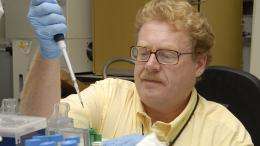
Keith Jones

(PhysOrg.com) -- New research from the University of Cincinnati (UC) shows that a common, over-the-counter pain salve rubbed on the skin during a heart attack could serve as a cardiac-protectant, preventing or reducing damage to the heart while interventions are administered.

These findings are published in the Sept. 14 edition of the journal Circulation.

Keith Jones, PhD, a researcher in the department of pharmacology and cell biophysics, and scientists in his lab have found that applying capsaicin to specific skin locations in mice caused in the skin to trigger signals in the nervous system. These signals activate cellular "pro-survival" pathways in the heart which protect the muscle.

Capsaicin is the main component of chili peppers and produces a hot sensation. It is also the active ingredient in several topical medications used for temporary pain relief.

Capsaicin is approved for use by the U.S. Food and Drug Administration.

Jones is working with Neal Weintraub, MD, a UC Health cardiologist and director of UC's cardiovascular diseases division, and other clinicians to construct a translational plan to test capsaicin in a human population.

"Topical capsaicin has no known serious adverse effects and could be easily applied in an ambulance or emergency room setting well in advance of coronary tissue death," Jones says. "If proven effective in humans, this therapy has the potential to reduce injury and/or death in the event of a coronary blockage, thereby reducing the extent and consequences of ."

Researchers observed an 85 percent reduction in cardiac cell death when capsaicin was used.

They also found that a small incision made on the abdomen triggered an 81 percent reduction.

"Both this and the capsaicin effect are shown to work through similar neurological mechanisms," Jones says. "These are the most powerful cardioprotective effects recorded to date.

"This is a form of remote cardioprotection, using a skin stimulus that activates cardioprotection long before the blocked coronary artery is opened."

Weintraub adds that this finding offers an important distinction between existing therapies.

"All of the current interventions require the vessel to be opened before doctors can act, and since it takes time to elicit protection, tissue dies," he says. "This treatment will protect the heart before the vessel is opened while producing a strong protective effect that is already active when we open the vessel."

Jones and Weintraub think that skin—the main sensor and largest human body organ—has evolved to protect animals, including humans, in a variety of ways.

"By activating these sensors in the nervous system, via skin, we think that a response to preserve and protect the heart is triggered," Weintraub says.

"We think that this technique is fooling the body into sending out protective signals," Jones adds. "This may be similar to the way certain acupuncture treatments work; there may be a neurological basis. In a broad sense, this work may provide a 'Rosetta stone' for translating alternative medicine techniques—like acupuncture—to Western medicine. Perhaps we can understand the biological mechanisms of how alternative treatments may be successful for patients."

Now, researchers will further explore this concept by investigating which sensors are associated with certain aspects of organ protection—and how much of specific stimuli are needed to produce the desired responses.

"This could help create favorable outcomes for those who are experiencing stroke, shock or are in need of an organ transplant, and the best part is that it is done non-invasively and is relatively inexpensive," Jones says.

But he warns against rubbing capsaicin on your belly if you feel like you are having a heart attack.

"We don't know if it will work for all indications, for all patients, and we don't know if it will work over an extended amount of time," he says. "A major goal is testing this therapy in clinical trials, but we still need to study more about dosage and application—where we put it on the body for the best results. However, this has tremendous clinical potential and could eventually save lives."

Source: University of Cincinnati

Filter


Move the slider to adjust rank threshold, so that you can hide some of the comments.


Display comments: newest first

deatopmg
Sep 15, 2009

Rank: not rated yet
"But he warns against rubbing capsaicin on your belly if you feel like you are having a heart attack. "

Why not, since capsaicin has such a low order of toxicity??? (oh I get it, it a disclaimer required by UC lawyers)
Rank 5 /5 (5 votes)
Related Stories
Relevant PhysicsForums posts
  • Is Everyday Technology Killing Us?
    createdFeb 08, 2012
  • Exercise and weight loss
    createdFeb 08, 2012
  • Why do we have head aches? Our brains can't feel anything.
    createdFeb 07, 2012
  • "The end of diseases" by David Agus, interview from Daily Show with Jon Stewart
    createdFeb 04, 2012
  • Oncolytic adenovirus
    createdFeb 04, 2012
  • Nutrition label stuffs and diets
    createdFeb 02, 2012
  • More from Physics Forums - Medical Sciences

More news stories

Starve a virus, feed a cure? Findings show how some cells protect themselves against HIV

A protein that protects some of our immune cells from the most common and virulent form of HIV works by starving the virus of the molecular building blocks that it needs to replicate, according to research published online ...

Medicine & Health / Research

created 10 hours ago | popularity 5 / 5 (2) | comments 0 | with audio podcast

Overeating may double risk of memory loss

New research suggests that consuming between 2,100 and 6,000 calories per day may double the risk of memory loss, or mild cognitive impairment (MCI), among people age 70 and older. The study was released today and will be ...

Medicine & Health / Neuroscience

created 7 hours ago | popularity 5 / 5 (2) | comments 0 | with audio podcast

Injured boomers beware: Know when to see doctor

(AP) -- It happened to nurse Jane Byron years after an in-line skating fall, business owner Haralee Weintraub while doing "men's" push-ups, and avid cyclist Gene Wilberg while lifting a heavy box.

Medicine & Health / Health

created 12 hours ago | popularity 5 / 5 (1) | comments 0

Declining health-care productivity in England: Who says so?

Reports that the National Health Service in England has been declining in productivity in the last decade appear to have been accepted as fact. However, a Viewpoint published Online First by The Lancet disputes this. The Vi ...

Medicine & Health / Health

created 5 hours ago | popularity not rated yet | comments 0

FDA-approved drug rapidly clears amyloid from the brain, reverses Alzheimer's symptoms in mice

Neuroscientists at Case Western Reserve University School of Medicine have made a dramatic breakthrough in their efforts to find a cure for Alzheimer's disease. The researchers' findings, published in the journal Science, show t ...

Medicine & Health / Neuroscience

created Feb 09, 2012 | popularity 4.9 / 5 (58) | comments 17 | with audio podcast


Scientists discover molecular secrets of 2,000-year-old Chinese herbal remedy

For roughly two thousand years, Chinese herbalists have treated Malaria using a root extract, commonly known as Chang Shan, from a type of hydrangea that grows in Tibet and Nepal. More recent studies suggest that halofuginone, ...

New method to examine batteries -- MRI from the inside

There is an ever-increasing need for advanced batteries for portable electronics, such as phones, cameras, and music players, but also to power electric vehicles and to facilitate the distribution and storage of energy derived ...

Google might launch Drive for cloud storage soon

(PhysOrg.com) -- Google's next big move, according to the Wall Street Journal, is a cloud storage service called Drive. Hardly first to the plate, Google is simply catching up to introducing its cloud reposi ...

A mitosis mystery solved: How chromosomes align perfectly in a dividing cell

Although the process of mitotic cell division has been studied intensely for more than 50 years, Whitehead Institute researchers have only now solved the mystery of how cells correctly align their chromosomes during symmetric ...

Lab study raises questions over nano-particle impact

Tests involving chickens have raised questions about the impact on health from engineered nano-particles, the ultra-fine grains commonly used in drugs and processed foods, scientists said on Sunday.

Researchers find extensive RNA editing in human transcriptome

In a new study published online in Nature Biotechnology, researchers from BGI, the world's largest genomics organization, reported the evidence of extensive RNA editing in a human cell line by analysis of RNA-seq data, demons ...