Government Web sites kept alive at Cyber Cemetery
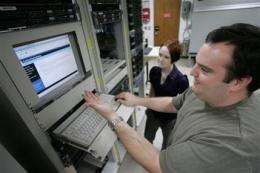
(AP) -- It was a historian's nightmare. During the change from the Clinton to the Bush administration, Web sites affiliated with the Clinton White House went dark, and an unknown number of online documents and files were forever lost.
Such Internet deaths inspired the Cyber Cemetery at the University of North Texas, which preserves government Web sites in their final form. The Cyber Cemetery archives sites when commissions or panels expire, allowing the online work of defunct government bodies to live on and remain accessible to the public.
The virtual graveyard was born in the late 1990s when a group of university librarians noticed that Web sites affiliated with the Clinton administration were disappearing.
"It was very early in the Web-publishing era for governments ... and these Web sites were just going away," said Cathy Hartman, an assistant dean of libraries at North Texas. "I began conversations with folks about recapturing the sites and keeping them available for public access."
Hartman's concern coincided with those of the federal Government Printing Office, which issued a 1995 report emphasizing the need to preserve electronic publications. North Texas and the printing office eventually joined forces, and early users of the system christened the depository as the Cyber Cemetery.
"It started as a joke. You know, `Oh, all these dead Web sites,'" said Starr Hoffman, who oversees the project as the librarian for digital collections at North Texas. "But it stuck, and nobody thought of a better name."
In an increasingly digitized world, the cyber cemetery has become the main publicly accessible depository for government records that don't exist on paper.
Other entities, such as the Internet Archive, take periodic snapshots of Web sites to preserve information. But the Cyber Cemetery, which also has partnered with the National Archives and Records Administration, focuses exclusively on government Web sites and captures them in their final and complete form, Hoffman said.
"Someone needs to take the responsibility of capturing the material for future researchers," Hartman said. "This is government by the people, and we need access to see what our taxes are paying for."
The archived sites include the understandable - the Child Online Protection Act Commission of 2000 - and the unintelligible. (Check out the 2005 Commission on Systemic Interoperability or the 2000 International Competition Policy Advisory Committee Research Collection.) The work is varied, from commissions to help people have more access to health care information to panels that study 20th century antitrust problems.
But even obscure commissions deserve to have their work saved, Hartman said.
There are 48 archived sites for visitors to view and another nine are coming soon, Hoffman said. A pair of Web sites from the Office of Laura Bush - USA Freedom Corps and Helping America's Youth - will be on the cemetery site in February.
The cemetery preserves only the work of commissions and panels, so not every document from the Bush or Clinton administrations can be found there. Bush-era sites with plots in the Cyber Cemetery include the 2005 Commission on the Intelligence Capabilities of the United States Regarding Weapons of Mass Destruction and a bipartisan committee that investigated the administration's preparation for and response to Hurricane Katrina.
The Cyber Cemetery receives nearly 5,000 daily visits and its most popular site is the 9/11 Commission. Its final report is the most frequently downloaded file on the whole site.
The archived Web sites include fascinating nuggets. On the Columbia Accident Investigation Board site, devoted to the 2003 shuttle explosion, there is a recording of a scientist discussing the scattering of debris.
"The big brown tank you see over there is about a 575-pound stainless steel tank," the scientist says in the recording. "It landed about 50 yards from a farmer's house here in Texas. He was not pleased."
The cemetery is also like an Internet time machine, transporting users to a period when going online involved high-pitched electronic screeches. Photos are rare, and audio and video components are almost nonexistent. The Web sites aren't always easy on the eyes. For instance, the main graphic on the 1998 Advisory Committee on Public Interest Obligations of Digital Television Broadcasters site is largely a mess of colorful, squiggly lines.
Not everything on a government site is considered a historical record worth preserving, said Susan Cummings, a deputy director at the National Archives and Records Administration. Sometimes other Web sites duplicate the information, or there is a hardcopy of the report that's permanently archived.
The National Archives determines whether a site is of historical value through a complex process in which sites have to meet several requirements. If a site meets the criteria, the agency archives it. But only the Cyber Cemetery makes the same Web site easily accessible online.
"Our mission is to permanently preserve public access to government documents," Hoffman said. "We're maintaining the historical record."
---
On The Net:
Cyber Cemetery: http://govinfo.library.unt.edu/default.htm
©2009 The Associated Press. All rights reserved. This material may not be published, broadcast, rewritten or redistributed.


