Longest lightning storm on Saturn breaks Solar System record
September 15, 2009 Longest lightning storm on Saturn breaks Solar System record

Enlarge

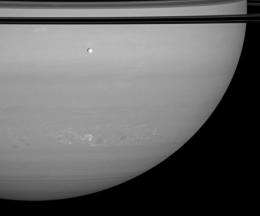
Image of a lightning storm on Saturn. Credit: NASA/JPL/Space Science Institute

A powerful lightning storm in Saturn’s atmosphere that began in mid-January 2009 has become the Solar System’s longest continuously observed thunderstorm.  It broke the record duration of 7.5 months set by another thunderstorm observed on Saturn by NASA’s Cassini spacecraft between November 2007 and July 2008.

The observations of the thunderstorm will be presented by Dr Georg Fischer of the Austrian Academy of Sciences at the European Planetary Science Congress in Potsdam, Germany, on Tuesday 15 September.

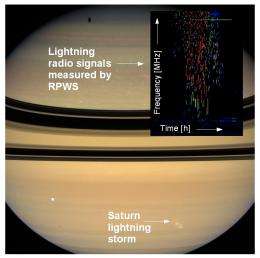
The current thunderstorm on Saturn is the ninth that has been measured since Cassini swung into orbit around Saturn in July 2004. Lightning discharges in Saturn's atmosphere emit very powerful radio waves, which are measured by the antennas and receivers of the Cassini Radio and Plasma Wave Science (RPWS) instrument. The radio waves are about 10 000 times stronger than their terrestrial counterparts and originate from huge thunderstorms in Saturn's atmosphere with diameters around 3000 km.

Dr Fischer said, “These lightning storms are not only astonishing for their power and longevity, the radio waves that they emit are also useful for studying Saturn's ionosphere, the charged layer that surrounds the planet a few thousand kilometres above the cloud tops. The have to cross the ionosphere to get to Cassini and thereby act as a natural tool to probe the structure of the layer and the levels of ionisation in different regions.”
Longest lightning storm on Saturn breaks Solar System record
Enlarge

Annotated image of Saturn lightning. Credit: RPWS Team/NASA/JPL/Space Science Institute

The observations of Saturn lightning using the Cassini RPWS instrument are being carried out by an international team of scientists from Austria, the US and France. Results have confirmed previous studies of the Voyager spacecraft indicating that levels of ionisation are approximately 100 times higher on the day-side than the night side of Saturn’s .

Lightning storms on Saturn usually occur in a region that nicknamed "Storm Alley" by scientists, which lies 35 degrees south of Saturn’s equator.

Dr Fischer commented, “The reason why we see lightning in this peculiar location is not completely clear. It could be that this latitude is one of the few places in Saturn’s atmosphere that allow large-scale vertical convection of water clouds, which is necessary for thunderstorms to develop. However, it may be a seasonal effect.  Voyager observed lightning storms near the equator, so now that Saturn has passed its equinox on 11 August, we may see the storms move back to equatorial latitudes.”

Saturn’s role as the source of lightning was given added confirmation during Cassini’s last close flyby of Titan on August 25.  During the half hour that Cassini’s view of Saturn was obscured by Titan, no lightning was observed. “Although we know from Cassini images where comes from, this unique event was another nice proof for their origin.” said Dr Fischer.

Provided by Europlanet


print this article email this article download pdf blog this article bookmark this article     Stumble it Digg this share on Facebook retweet share on Reddit add to delicious
Rate this story - 3.7 /5 (3 votes)


September 15, 2009 all stories

Comments: 0

3.7 /5 (3 votes)
  • Stumble this up

  • Digg this

  • share this

  • hide
  • Related Stories

  • Cassini Spacecraft Tracks Raging Saturn Storm
    created Apr 29, 2008 | popularity not rated yet | comments 0
  • Cassini cameras spot powerful new lightning storm on Saturn
    created Feb 14, 2006 | popularity not rated yet | comments 0
  • Saturn’s radio emissions and bright auroras are linked
    created Feb 17, 2005 | popularity not rated yet | comments 0
  • Cassini detects Lightning and Radiation at Saturn
    created Aug 09, 2004 | popularity not rated yet | comments 0
  • Researchers present Cassini findings at Saturn
    created Dec 17, 2004 | popularity not rated yet | comments 0


  • hide
  • Relevant PhysicsForums posts

  • Sideral question
    created 18 hours ago
  • Doppler shifted blackbody spectrum
    created 21 hours ago
  • Earth v. Moon
    created 23 hours ago
  • help me with coordinates and orbits
    created 23 hours ago
  • More from Physics Forums - General Astronomy

Other News

Astronauts finish another spacewalk, still no baby (AP)

Astronauts finish another spacewalk, still no baby

Space & Earth / Space Exploration

created 10 hours ago | popularity 3 / 5 (2) | comments 0

(AP) -- A spacewalking astronaut put aside the impending birth of his daughter and blazed through his first-ever venture outside the International Space Station on Saturday.


Unseasonably hot and dry weather combined with strong winds to fan scores of blazes in the country's southeastern states

Australia issues 'catastrophic' alerts as fires rage

Space & Earth / Environment

created 16 hours ago | popularity 4 / 5 (3) | comments 0

Australia has issued "catastrophic" alerts after record-breaking temperatures and wild lightning storms sparked more than 100 fires across the country, officials said Saturday.


Commuters wait on the platform shrouded by fog in London

Climate change not man-made, say majority of Britons: poll

Space & Earth / Environment

created Nov 15, 2009 | popularity 3.3 / 5 (15) | comments 46

Less than half of Britons believes that human activity is to blame for global warming, according to a poll carried out for The Times newspaper and published on Saturday.


Mysteriously warm times in Antarctica

Mysteriously warm times in Antarctica

Space & Earth / Earth Sciences

created Nov 18, 2009 | popularity 4.2 / 5 (21) | comments 28

(PhysOrg.com) -- A new study of Antarctica's past climate reveals that temperatures during the warm periods between ice ages (interglacials) may have been higher than previously thought. The latest analysis ...


UN: Fight climate change with free condoms (AP)

UN: Fight climate change with free condoms

Space & Earth / Environment

created Nov 18, 2009 | popularity 3.1 / 5 (11) | comments 24

(AP) -- The battle against global warming could be helped if the world slowed population growth by making free condoms and family planning advice more widely available, the U.N. Population Fund said Wednesday.