The African origin of anthropoid primates called into question
September 15, 2009
The African origin of anthropoid primates called into question

Enlarge

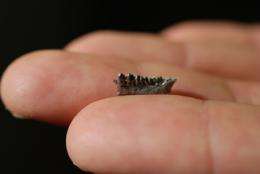
Image of an Algeripithecus mandible, showing the scale of the specimen. © Rodolphe Tabuce, CNRS

Well-preserved craniodental fossil remains from two primate species have been discovered during excavations at an Algerian site. They reveal that the small primate Algeripithecus, which is 50 million years old and until now was considered as the most ancient African anthropoid, in fact belonged to another group, that of the crown strepsirhines.

This research was carried out by a team of French researchers from the Institut des Sciences de l'Evolution (Université de Montpellier, France), working with Algerian paleontologists from the universities of Tlemcen, Oran and Jijel. The resulting publication, published online on the website of the (Biological Sciences) on September 9, 2009, reopens the debate on the African origin of anthropoids, the group to which humans and apes belong.

In 1992, fossilized remains of the small primate Algeripithecus were discovered in the Algerian Sahara. Fifty million years old, weighing just 75 g and known to paleontologists thanks to the remains of two molars, this primate was considered to be the most ancient anthropoid of the African continent. The discovery of Algeripithecus was thus a major contribution to the hypothesis under which Africa was the cradle of anthropoid primates, a group to which humans and apes all belong. The existence of another primate, the Azibius, has been known for longer. This is one of the most ancient African representatives of the crown strepsirhines, another group that today is represented by the lemurs of Madagascar, the galagos of Central Africa and the loris of Southern Asia.

At the Glib Zegdou site in north-eastern Algeria, the French team, working in collaboration with Algerian scientists, recently exhumed cranial and dental fragments from both Algeripithecus and Azibius. They included some nearly complete mandibles. These remains displayed a certain number of traits typical of the crown strepsirhines, notably an adaptation to nocturnal activity and the putative presence of a "toothcomb" in the lower toothrow. The paleontologists concluded that Algeripithecus, like its close relative Azibius, did not in fact belong to the family of anthropoid primates but was very probably one of the most ancient representatives in Africa of the crown strepsirhines.

In Egypt, the presence of more than a dozen fossilized anthropoid primates dating from 30 to 38 million years ago had long been known. This recent Franco-Algerian discovery thus advances the first true appearance of anthropoid primates on the African continent by more than 15 million years. With its major consequences on the evolutionary history of African anthropoid primates, this observation further strengthens the alternative hypothesis of an Asiatic origin for anthropoids. Furthermore, this paleontologic research reveals a hitherto unsuspected diversity and great antiquity of the first crown strepsirhines in Africa.

More information: Tabuce R, Marivaux L, Lebrun R, Adaci M, Bensalah M, Fabre P-H, Fara E, Gomes-Rodrigues H, Hautier L, Jaeger J-J et al. 2009. Anthropoid vs. strepsirhine status of the African Eocene primates Algeripithecus and Azibius: craniodental evidence. Proceedings of the Royal Society of London. Published online before print September 9, 2009, doi: 10.1098/rspb.2009.1339.

Source: CNRS

4.8 /5 (4 votes)  

Filter


Move the slider to adjust rank threshold, so that you can hide some of the comments.


Display comments: newest first

RayCherry
Sep 15, 2009

Rank: 5 / 5 (1)
Well, we weren't born yesterday.

"Asiatic origin" is a bit vague ... the writer could have given examples. Geographically, (rather than geo-politically), I have always thought that Egypt was also in Africa.
mikehevans
Sep 15, 2009

Rank: not rated yet
Agree with Cherry, since when is finding fossils in Africa an indication of non-African origins?
Rank 4.8 /5 (4 votes)
Relevant PhysicsForums posts
  • Stem cell question.
    createdFeb 10, 2012
  • Protease cleavage
    createdFeb 10, 2012
  • Pertubance in a model
    createdFeb 10, 2012
  • Cancer drugs and Alzheimer's, Oh my!
    createdFeb 09, 2012
  • Squishing cells
    createdFeb 09, 2012
  • Any books/articles for evolutionary stable strategy models in humans?
    createdFeb 09, 2012
  • More from Physics Forums - Biology

More news stories

A frank discussion of the power law and linking correlation to causation

(PhysOrg.com) -- Michael Stumpf a mathematics professor at Imperial College in London, and Mason Porter a lecturer at Oxford have teamed together to write and publish a perspective piece in Science regarding the in ...

Other Sciences / Mathematics

created Feb 10, 2012 | popularity 5 / 5 (5) | comments 10 | with audio podcast report

Employers feel no love for unscrupulous practice of 'service sweethearting'

A new study led by two Florida State University marketing professors finds that some frontline service employees who are rewarded for hikes in customer loyalty and satisfaction also may engage in "service ...

Other Sciences / Economics & Business

created Feb 10, 2012 | popularity 3.3 / 5 (3) | comments 11

US workers are 'giving away the store,' costing firms billions

Nearly 70 percent of the nation's service employees give away free goods and services – from hamburgers to cable TV – costing companies billions of dollars a year, according to a groundbreaking study.

Other Sciences / Economics & Business

created Feb 09, 2012 | popularity 3.5 / 5 (4) | comments 10

New insights into how to correct false knowledge

The abundance of false information available on the Internet, in movies and on TV has created a big challenge for educators.

Other Sciences / Social Sciences

created Feb 07, 2012 | popularity 4.9 / 5 (7) | comments 9 | with audio podcast

Neanderthal demise due to many influences, including cultural changes: study

As an ice age crept upon them thousands of years ago, Neanderthals and modern human ancestors expanded their territory ranges across Asia and Europe to adapt to the changing environment.

Other Sciences / Archaeology & Fossils

created Feb 07, 2012 | popularity 4.4 / 5 (5) | comments 8 | with audio podcast


Google might launch Drive for cloud storage soon

(PhysOrg.com) -- Google's next big move, according to the Wall Street Journal, is a cloud storage service called Drive. Hardly first to the plate, Google is simply catching up to introducing its cloud reposi ...

Latin America mining boom clashes with conservation

Latin America is experiencing a mining boom as prices rise fuelled by a hike in global demand, but the region is also being hit by a wave of violent protests, strikes and rallies by environmentalists.

Love a click away in Indonesia's Twitter Republic

He was a geeky kid from Yogyakarta, she a glamorous city girl in Jakarta. In a country with one of the world's most vibrant social networking scenes they fell in love on Twitter.

Walney offshore wind farm is world's biggest (for now)

(PhysOrg.com) -- The Walney wind farm on the Irish Sea--characterized by high tides, waves and windy weather--officially opened this week. The farm is treated in the press as a very big deal as the Walney ...

GPS court ruling leaves US phone tracking unclear

A US Supreme Court decision requiring a warrant to place a GPS device on the car of a criminal suspect leaves unresolved the bigger issue of police tracking using mobile phones, legal experts say.

Europeans protest controversial Internet pact

Tens of thousands of people marched in protests in more than a dozen European cities Saturday against a controversial anti-online piracy pact that critics say could curtail Internet freedom.