Reptiles stood upright after mass extinction
September 15, 2009 Reptiles stood upright after mass extinction

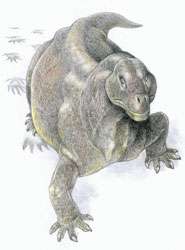
Moschops lived before the end-Permian mass extinction. Photo by © Jim Robins

(PhysOrg.com) -- Reptiles changed their walking posture from sprawling to upright immediately after the end-Permian mass extinction, the biggest crisis in the history of life that occurred some 250 million years ago and wiped out 90% of all species.

In a detailed study of 460 fossil tracks of reptiles from below and above the boundary, Tai Kubo and Professor Mike Benton from the University of Bristol have found that before the Permian extinction all the reptiles moved with their arms and legs held sideways in a sprawling posture, just like and do today.

After the mass extinction, the medium-sized and large reptiles of the subsequent Triassic period, walked with their legs tucked underneath their bodies, just like modern mammals.

Professor Benton said “Dinosaurs - and later the mammals - owe their success to being upright. An upright animal, like an elephant or a Diplodocus, can also be very large because its weight passes directly through the pillar-like legs to the ground. In addition, other upright animals, such as monkeys, could use their arms for climbing or gathering food.”

Walking upright can have great advantages - it means the stride can be longer and the animal can move with much less stress on the knee and elbow joints. Upright walking was the key to the success of the dinosaurs, which originated 25 million years after the great end-Permian crisis. The first dinosaurs were all bipeds and they also became very large. Sprawlers cannot become too big or their legs collapse.

Reptiles stood upright after mass extinction

Reptile posture before and after the mass extinction. Photo by © Simon Powell

Up to now, the transition from a sprawling to an upright was seen as long-term, possibly lasting some 20-30 million years, but the new evidence suggests that the event was much more rapid, and was perhaps initiated by the crisis.

This new understanding shifts the evolutionary assumptions as well. “If the replacement of sprawlers by upright animals had been a long drawn-out affair, then we’d be looking at some process of competitive replacement,” said Professor Benton.

“As it is, the new footprint evidence suggests a more dramatic pattern of replacement, where the sprawling animals that dominated Late Permian ecosystems nearly all died out, and the new groups that evolved after the crisis were upright. Any competitive interactions were compressed into a short period of time.”

The results are published today in Palaeontology.

More information: Kubo, T. and Benton, M.J. 2009. Tetrapod postural shift estimated from Permian and Triassic trackways. Palaeontology. 52, 1029-1037.

Provided by University of Bristol (news : web)


print this article email this article download pdf blog this article bookmark this article     Stumble it Digg this share on Facebook retweet share on Reddit add to delicious
Rate this story - 4 /5 (8 votes)

Rank Filter

Move the slider to adjust rank threshold, so that you can hide some of the comments.


Display comments: newest first

  • otto1923 - Sep 15, 2009
    • Rank: not rated yet
    Perhaps only those animals whose mouths were sufficiently far enough above the muck and ash, and disease-causing pathogens from rotting plants and animals lying in fetid water, survived the extinction event.

September 15, 2009 all stories

Comments: 1

4 /5 (8 votes)
  • Stumble this up

  • Digg this

  • share this

  • hide
  • Related Stories


  • hide
  • Relevant PhysicsForums posts

  • What is transpulmonary pressure?
    created 5 hours ago
  • Is there a gay gene?
    created Nov 23, 2009
  • Super quick question about Starling forces?
    created Nov 22, 2009
  • Questions about diffusion
    created Nov 22, 2009
  • Human Leukocyte Antigen (HLA) typing
    created Nov 21, 2009
  • Breeding program
    created Nov 20, 2009
  • More from Physics Forums - Biology

Other News

Strategic management theory offers fresh take on the economic crisis

Other Sciences / Economics

created 2 hours ago | popularity 3 / 5 (1) | comments 0

The recent financial crisis and resulting global economic downturn has been the most defining global economic event since the Great Depression. Now research which appears in the November issue of Strategic Organization, publis ...


Climate change could boost incidence of civil war in Africa

Other Sciences / Social Sciences

created 21 hours ago | popularity 2.4 / 5 (14) | comments 7

Climate change could increase the likelihood of civil war in sub-Saharan Africa by over 50 percent within the next two decades, according to a new study led by a team of researchers at University of California, Berkeley, ...


Do kids benefit from homework?

Do kids benefit from homework?

Other Sciences / Social Sciences

created 16 hours ago | popularity 4 / 5 (1) | comments 3

(PhysOrg.com) -- Homework is as old as school itself. Yet the practice is controversial as people debate the benefits or consider the shortcomings and hassles. Research into the topic is often contradictory ...


As robots become more common, Stanford experts consider the legal challenges

Other Sciences / Social Sciences

created 19 hours ago | popularity 4.7 / 5 (3) | comments 0

(PhysOrg.com) -- They already detect and defuse bombs, control traffic patterns and do some basic household chores. And scientists predict that pretty soon, robots will be using artificial intelligence to play a larger role ...


The cause behind the characteristic shape of a long leaf revealed

The cause behind the characteristic shape of a long leaf revealed

Other Sciences / Mathematics

created 21 hours ago | popularity 5 / 5 (2) | comments 0

Applied mathematicians dissected the morphology of the plantain lily (Hosta lancifolia), a characteristic long leaf with a saddle-like arc midsection and closely packed ripples along the edges. The simple ...