Aerial Imagery System Helps Save Water
September 15, 2009 By Dennis O'Brien Aerial Imagery System Helps Save Water

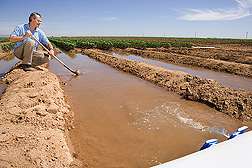
ARS agricultural engineer Doug Hunsaker is developing a way for farmers to do very precise irrigating by using aerial imagery and ground-based sensors to determine the water needs of small sections of cultivated fields.

(PhysOrg.com) -- Agricultural Research Service (ARS) scientists are developing a system that saves water by using aerial imagery and ground-based sensors to determine the irrigation needs of small sections of cultivated fields.

Conventional irrigation practices, even when based on modern management and water application techniques, can be wasteful because they assume crop water needs are the same throughout an entire field, according to Douglas Hunsaker, an agricultural engineer at the ARS Arid-Land Agricultural Research Center in Maricopa, Ariz. It also is extremely difficult to go into a large field and visually observe and quantify different water needs for specific areas.

Farmers are beginning to use remote sensing technology to monitor crop growth, fertilizer needs and field conditions. Hunsaker's goal is to combine one remote sensing aerial image of a field with a system of wireless sensors tied to computer software that will accurately determine the irrigation needs of small areas on a daily basis throughout the season.

Ideally, farmers could identify areas with high or low water needs with data transmitted to their computers and, using either a drip or a sprinkler system, adjust irrigation levels based on the data. The technology could be particularly useful in the parched Southwestern United States, where conserving water is a major priority.

In a recent study, published in Agricultural Water Management, Hunsaker collected remote sensing images from aerial surveys of a 4-acre cotton field divided into 40 plots. The imagery tracked plant growth and water needs by capturing reflected light from the field in red and near ; the bigger the cotton plants, the more infrared light captured in the images. Hunsaker used a computer program to analyze the imagery, determine optimal locations for supplemental ground-based sensors, and predict the variability of crop water needs throughout the field.

By conducting periodic aerial surveys throughout two growing seasons, he found that the system could accurately predict the diversity of crop water needs throughout the field. He is currently evaluating the use of ground-based sensors that would reduce costs by eliminating the need for all but one aerial survey each season.

Read more about this research in the September 2009 issue of Agricultural Research magazine.

Source: Agricultural Research Service


print this article email this article download pdf blog this article bookmark this article     Stumble it Digg this share on Facebook retweet share on Reddit add to delicious
Rate this story - 4 /5 (1 vote)


September 15, 2009 all stories

Comments: 0

4 /5 (1 vote)
  • Stumble this up

  • Digg this

  • share this

  • hide
  • Related Stories

  • Digital cameras, remote satellites measure crop water demand
    created Jul 17, 2008 | popularity not rated yet | comments 0
  • Nutrients in water may be a bonus for agriculture
    created Nov 24, 2008 | popularity not rated yet | comments 0
  • Crop models help increase yield per unit of water used
    created May 04, 2009 | popularity not rated yet | comments 0
  • Where is your soil water? Crop yield has the answer
    created Jul 01, 2008 | popularity not rated yet | comments 0
  • Research project tests remote sensing to measure Earth's water cycle
    created Jul 26, 2006 | popularity not rated yet | comments 0


  • hide
  • Relevant PhysicsForums posts

  • The IPCC and the term "most"
    created Nov 23, 2009
  • Is global warming a fact?
    created Nov 23, 2009
  • Random variability of wind patterns
    created Nov 23, 2009
  • Record precipitation in the UK
    created Nov 22, 2009
  • More from Physics Forums - Earth

Other News

Cutting greenhouse pollutants could directly save millions of lives worldwide

Space & Earth / Environment

created 1hour ago | popularity 1 / 5 (1) | comments 0

Tackling climate change by reducing carbon dioxide and other greenhouse emissions will have major direct health benefits in addition to reducing the risk of climate change, especially in low-income countries, according to ...


Small faults in Southeast Spain reduce earthquake risk of larger ones

Small faults in Southeast Spain reduce earthquake risk of larger ones

Space & Earth / Earth Sciences

created 1hour ago | popularity not rated yet | comments 0

A team of Spanish scientists, studying recent, active deformations in the Baetic mountain range, have shown that the activity of smaller tectonic structures close to larger faults in the south east of the ...


It's not just dirt!

Space & Earth / Environment

created 1hour ago | popularity not rated yet | comments 0

Soil is the linchpin of the environment, where atmosphere, biosphere, and hydrosphere meet. Despite that, many students see soil as "just dirt" - a place to grow plants, but nothing more. Soil science educators are challenged ...


Mars Reconnaissance Orbite

Mars Reconnaissance Orbite Team Plans Uplink of Protective Files

Space & Earth / Space Exploration

created 4 hours ago | popularity 5 / 5 (1) | comments 0

(PhysOrg.com) -- The team operating NASA's Mars Reconnaissance Orbiter plans to uplink protective files to the spacecraft next week as one step toward resuming the orbiter's research and relay activities.


First black holes may have incubated in giant, starlike cocoons, says CU-Boulder study

First black holes may have incubated in giant, starlike cocoons

Space & Earth / Astronomy

created 22 hours ago | popularity 4.5 / 5 (11) | comments 15

(PhysOrg.com) -- The first large black holes in the universe likely formed and grew deep inside gigantic, starlike cocoons that smothered their powerful x-ray radiation and prevented surrounding gases from ...