$21 Billion Orbiting Solar Array will Beam Electricity to Earth
September 15, 2009 by Lin Edwards
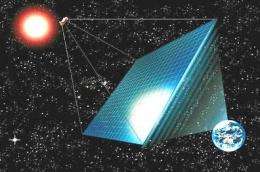
Artist conception of the SSPS (Space solar power system). Image credit: USEF
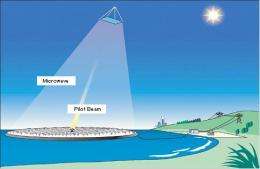
(PhysOrg.com) -- The Japanese are preparing to develop a two trillion yen (approximately $21 billion USD) space solar project that will beam electricity from space in the form of microwaves or lasers to around 300,000 homes in Japan within three decades.
The project, to be undertaken by a research group from 16 companies including Mitsubishi Heavy Industries Ltd, aims to spend the next four years developing the technology needed to beam the electricity produced to earth. They expect that as fossil fuels run out, an orbiting solar power plant in space may be needed to provide a significant source of electricity in the future, according to the Kensuke Kanekiyo, from the Japanese Government's Institute of Energy Economics.
The planned solar station will produce 1 Gigawatt of electricity from its four km2 (approximately 2.5 square miles) array of solar panels, which is enough to power just under 300,000 Tokyo homes, at present usage levels. Since the array will be in orbit some 36,000 km (22,500 miles) above the earth's surface, it will be unaffected by weather conditions and will be able to generate power constantly.
The U.S. agency NASA has been investigating the possibilities of a space-based solar system for several decades and has spent around $80 million on the research. They and other government agencies estimate the cost of electricity supplied from an orbiting solar array could be around $1 billion per megawatt, which is too expensive to be commercially viable.
The Japanese realize the cost of building the solar station in orbit would be prohibitive at the moment, and the array could not be commercially viable at today's prices. The Japanese consortium therefore has to find ways of drastically reducing the costs. With the launch of a single rocket costing around 10 billion yen, the cost of the space solar station could be as high as two trillion yen, according to Koji Umehara, the Director of the Japanese Space Development and Utilization ministry, making the electricity supplied exorbitantly expensive.
The first step in bringing the plans to fruition will be the launch in around 2015 of a satellite fitted with solar panels that will beam electricity to earth.
JAXA, the Japan Aerospace Exploration Agency plans to have the orbiting space solar system operational some time in the 2030s.
More information: http://www.usef.or.jp/english/f3_project/ssps/f3_ssps.html
© 2009 PhysOrg.com


If they forge a better working relationahip with China in the coming decade, solar power may become available at commercially realistic values to all of us - finally.
I don't think we're "hindering progress" so much as leveraging our limited resources in the best way we know how. Nobody anywhere can justify $1 Billion per megawatt. It would probably cost less to have a human crank a turbine by hand... this is a big gamble. Even if they get the cost way, way down, how will they fend off the critics that will claim this can be used as a space-based superweapon? Kudo's to Japan for talking the talk, it'll be fun to watch them try to walk the walk
This is evil and stupid; but 1000 characters barely allows me to scratch the surface.
Money is not the limiting factor; money is just an abstraction. The market generates prices for things incorporating the expectations of all market players; this allows efficient use of scarce resources. Without money and markets you have a knowledge problem(even Lenin recognized this when he suggested keeping one small country capitalist to see what prices looked like). Ignoring prices is squandering resources.
What you're suggesting is that prices allow people to spot bad ideas and avoid them; the only way to circumvent this rational behaviour to further your pet projects is to have government expropriate money through taxes and squander the stolen loot on your pet project(e.g. see corn ethanol or the bridge to nowhere for real world examples of this). This is evil.
If YOU want to squander YOUR resources, more power to ya.
50 years and thousands of studies on everything from radar, microwave ovens, high power radio towers, powerlines, car phones, cell phones, WiFi etc. say otherwise. All it does is dielectric heating; stay out of fields intense enough to overwhelm the self-regulating cooling mechanisms of blood circulation and sweating and you'll be fine.
The collector is tens of square kilometers at 2.4 GHz because of diffraction; it's going to be a lot less intense than sun-light.
However, I would disagree with your implied assertion that private investment is the only type of investment that is worthwhile. Private investment is by its very nature short-term, and cannot be used to fund long-term projects.
IE, no private corporation will ever fund research into FTL, because commercialization of that research is too far into the future to have a decent return on investment (if it proves to be possible at all). But because no corporation will fund the pre-commercialization base research, that research will never get done, so we'll never get to the point where commercialization is possible. It's a catch-22 situation. That's the reason why government funded *basic* research should exist: to fill that unfortunate gap in corporate and private research that would otherwise stifle the economy.
Really??? Can you expand on how you think this would make it more economical?
You're right, did anyone ever think that having a solar array in place would be a huge advantage by the time it is built? Once solar panels are more efficient the procedures to make this cost friendly will be like changing the oil instead of building a new car. What is also disappointing is that there is not enough "money" to fund the research on materials necessary to stabilize a fusion reactor plant.
it's a better idea than dumping the dollar on the open market and crashing the american empire to pieces.
And in that article on the California project, they state: "According to Solaren, the system could generate 1.2 to 4.8 gigawatts of power at a price comparable to that of other renewable energy sources."
Do we have some super-secret method of creating the Orbiting Solar Array? Are the Japanese not nearly as intelligent as the rest of the world gives them credit for? Or is that company, Solaren, blatantly lying ("overestimating") the potential? I vote for the latter
(Personally, I think better drilling technologies will make geothermal energy the best rival to land-based solar energy)
Solar satellites will continue to deliver power even if the ground facility is destroyed, and I assume the beam can be redirected to an emergency location, in the middle of a grid, instead of trying to reconnect to remote supply. This system may be FEMA-inspired idea.
Their money would be much better spent on other energy production methods such as geothermal and wave.
you cannot beam electricity anywhere electricity has to be conducted by a looped flow and return system. it could possible be changed into some sort of carrier but as electricity it would need a pair of cables from the orbiting device to a point on earth, which is practically impossible.
someone suggested your argument in a response to a previous article. From my reading of his work tesla did not appreciate that the Earth also acts as a conductor. If you were to stand on a tiled bathroom floor without any insulation between your feet and the floor and touch a live source you would understand this in an instance. The projections through air that tesla performed used the ground as a return. What electrons do is not important. Electrical flow possibility is exactly what this article considers. As suggested the electricity could be converted to a microwave or laser then reconverted at ground but the losses in two conversions would outway the advantage of having the detector in space.
As I previously said the energy created could be converted we assume to a laser or Microwave transmission. What either of these solutions would provide is a potential space weapon. Either of these could be used to threaten, blackmail or fry members of the human race. Imagine a terrorist group gaining control of such a device, a computer and transmitter is probably all it would take. We should NOT allow anyone to put devices with alternative potential into space. Please.
We already have dedicated airborne and most likely space laser and microwave weapons specifically designed for the purpose. Maybe terrorists could grab control of these beams but I doubt it. If Japan makes one wrong move we zap them back with alacrity. What are you worried about? Ants and magnifying glasses pfffft?
Self-repairing nano panels are needed before this kind of space floater concept is really viable.
This is good news! The earth is getting ready to hatch!
The most obvious solution is to build solar panels on top of roofs of each house, having a distributed solution with all the advantages that distributed solutions have, e.g. internet!
Alternatively the balloon could be tethered to the ground and the electricity could be conducted down the tethering wire.
Hydrogen is being pushed by DOE and one company says it has solved the hydrogen production problem.
They propose using sea water and wind energy to make unlimited amounts of energy forever that is 100% green and renewable !!
Mazda is using hydrogen just like gasoline in their new car with 4 times the gas mileage.
And if we just permanently plugged in the peopl we would have the "MATRIX"
Sunstroke spells out quite clearly that such a space solar power station employing high-intensity microwave beams will be used as a devastating multi-pronged weapon: it can supply electricity to the military, be used to fry enemy ground troops, aircraft, ocean-going vessels, and also be used to disrupt enemy communications as well as destroy their agricultural capabilities. All in the guise of being a "purely civilian alternative energy project". Pure Genius!
One word... F.. I.. C.. T.. I.. O.. N...
What a bunch of whining babies you're all becoming.
"Wha! It could be a weapon"
"Wha! It would never work"
"Wha! Industry was a bad idea and we should Leap Backwards 200 years"
You all make me sick!
First of all everyone should really stop worrying about space weapons, we have enough destructive potential already and hell, we're doing a pretty good job at killing our fellow man and ourselves as it is now. At 21 billion a pop, you could probably build yourself a bunch of nukes and get the job done, especially since noone really has defensive capability against those yet.
Second of all, I'll join the camp that believes that we should be drilling down rather than going up. The Earth has tremendous geo-thermal potential which is for our purposes very comparable to the energy we can harvest from the Sun, and a combination of the two would probably service our needs for a long long time.
A large part of our popoulation is deeply submerged in poverty. While parts of the western world thrive and drive hybrid cars and put solar arrays into space, these people can hardly afford food, in the best cases, and have to drink muddy infested water in the worst.
Even if you gave them clean energy they would have nothing to do with it.
Cleaning up our act is good, but shouldn't we also be researching more proper ways to develop the dirt poor countries of our world, ways to get them water and food? Maybe if we spent more time on selecting reasearch projects more carefully there would be some coins left over for them.
fossil fuel: solar derivative power.
d'oh
A microwave platform in geosynchronous orbit above the equator, south of Japan. A diffuse beam as wide as a football field. Their targets would be limited and the damage potential remote. Wandering beams could be detected at a distance from atmospheric scattering. Scale-up efforts would take months and trigger worldwide condemnation and tangible threats from countries with ICBMs if necessary. Worst case, the platform gets shot down by the Chinese, or we invade California. Offensive potential- negligible. Relax.
Wow, what is a Luddite (a paranoid one at that) doing posting comments on the web?
Otto does not engage in idle speculation like those who don't believe all nations are not part of, and subsidiary to, a single, surreptitious Authority. Relax, everythings under Control.
What does the book say to these arguments?
Also it would take 24/7 constant infrared satellite monitoring of the power-beaming platform and ground rectenna to determine if its lethal microwave beam wandered from its designated path. Due to the extremely high cost of such continuous IR monitoring (especially in a global recession) this is unlikely.
The path loss for something like this using microwave is enormous. At 1GHz, there is 185dB of attenuation from geosync to the ground. At 10GHz, that's 204dB of attenuation. At 100GHz that's 224dB of attenuation.
To recover 1/2 the power with a 100% efficient dish antenna @ 1GHz, it's diameter would be 120,218 Kilometers. (or two dish antennas, one at the generator and one on earth 3,388 Kilometers in diameter)
I just don't see how this can be freezable. Is there something wrong with my math?
Also, since the Physorg staff pulled my cleverness (twice!) because it was "pointless verbage", I'm adding it here where it will be safe, piggybacked on my mild criticism, above. Here it is... "thin energy" would be more cleverly worded as "thinergy". Wow, jumping thru these hoops sucked what little funniness there was right out of this!
The NSA and many others in many countries 24/7 monitor a LOT of things. These deathsats of yours will have a tiny unprotected little core which will go poof when hit by Chinese laser. You will be left with hectares of drifting sailcloth.
Relax! everythings under Control.
Thanks for your comment. Hope this helps.
All of the monitoring in the world will not alleviate these critical environmental issues.
Your highly pertinent comments are greatly appreciated. Thank you again.
Only carbon "nano-fibers" that exist almost theoretically only in the laboratory could possibly provide the raw material for such a cable. But the cost is astronomical. Maybe Japan knows how to safely harness space solar power.
Theoretically, nano carbon-fiber filaments could handle very light loads from geosynch to the ground, but most unfortunately cannot be reinforced to any extent, for reasons you stated. Running the microwave power beam parallel to the cable as you stated could be done, but still wouldn't safeguard against serious mishaps that will occur if the solar power platform transmitting the concentrated microwave beam wanders from its "fixed" position.
Thank you for your valuable input.
You're darn right about severe oscillation impact on the space elevator's cable from terrestrial weather events and satellite fixed-orbit attitudinal correction. They could really over-stress the nano-cable to the breaking point. The weight factor forbids substantial reinforcement, as you well know, but there must be a way to beat these problems. That's why I'm hoping Japan's think tank that's behind their space solar power-beaming project will clue us in here.
Many thanks.