Scientists unravel the chemistry of Titan's hazy atmosphere
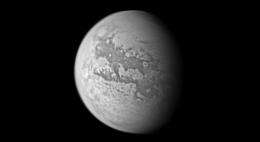
September 15, 2009 Titan

Enlarge

Titan, seen during Cassini's Mar. 31, 2005, flyby

A team of University of Hawai'i at Mānoa researchers led by Ralf Kaiser, physical chemist at UH Mānoa, unraveled the chemical evolution of the orange-brownish colored atmosphere of Saturn's moon Titan, the only solar system body besides Venus and Earth with a solid surface and thick atmosphere. The UH Mānoa team, including Xibin Gu and Seol Kim, conducted simulation experiments mimicking the chemical reactions in Titan's atmosphere utilizing crossed molecular beams in which the consequence of a single collision between molecules can be followed.

The team's experiments indicate that triacetylene can be formed by a single collision of a "radical" ethynyl molecule and a diacetylene molecule. An ethynyl radical is produced in Titan's atmosphere by the photodissociation of by . Photodissociation is a process in which a chemical compound is broken down by photons.

"Surprisingly, the photochemical models show inconsistent mechanisms for the production of polyynes," said Kaiser, who is the principal investigator of this study.

The mechanism involved in the formation of triacetylene, was also confirmed by accompanying theoretical calculations by Alexander Mebel, a theoretical chemist at Florida International University. These theoretical computations also provide the 3D distribution of electrons in atoms and thus the overall energy level of a molecule. To apply these findings to the real atmosphere of , Danie Liang and Yuk Yung, planetary scientists at Taiwan's Academia Sinica and California Institute of Technology, respectively, performed photochemical modeling studies of Titan's atmosphere. All data together suggest that triacetylene may serve as a building block to form more complex and longer polyynes and produce potential precursors for the aerosol-based layers of haze surrounding Titan.

Scientists unravel the chemistry of Titan's hazy atmosphere
Enlarge

Left to right: ball-and-stick images of a radical ethynyl, acetylene, diacetylene and triacetylene molecule. Ethynyl has a lone electron on its terminal carbon atom and it is this lone or radical electron that initiates ethynyl's attack on other molecules. The lone electron is depicted by the white triangle-shaped figure. All atoms in the molecules are connected by either a single or triple bond. Carbon atoms are black and hydrogen atoms are blue. Credit: Ralf Kaiser and Xibin Gu, Department of Chemistry, University of Hawaii at Manoa, Honolulu, Hawaii

The study demonstrated for the first time that a sensible combination of laboratory simulation experiments with theory and modeling studies can shed light on decade old unsolved problems crucial to understand the origin and chemical evolution of the solar system. The researchers hope to unravel next the mystery of the missing ethane lakes on Titan - postulated to exist for half a century, but not detected conclusively within the framework of the Cassini-Huygens mission.

In the future, the UH Mānoa team will combine the research results with terrestrial-based observations of Titan's atmosphere. Alan Tokunaga, astronomer at UH Mānoa's Institute for Astronomy, and Henry Roe from Lowell Observatory in Arizona, are currently collecting observational data using the NASA infrared telescope facility on the snowcapped peak of Mauna Kea.

More information: "Chemical dynamics of triacetylene formation and implications to the synthesis of polyynes in Titan's " is published in the online early edition of Proceedings of the National Academy of Sciences at http://www.pnas.org/content/early/2009/09/11/0900525106.abstract .

Source: University of Hawaii at Manoa


print this article email this article download pdf blog this article bookmark this article     Stumble it Digg this share on Facebook retweet share on Reddit add to delicious
Rate this story - 3.7 /5 (3 votes)


September 15, 2009 all stories

Comments: 0

3.7 /5 (3 votes)
  • Stumble this up

  • Digg this

  • share this

  • hide
  • Related Stories

  • Titan's Purple Haze Points to a Fuzzy Past
    created Aug 02, 2004 | popularity not rated yet | comments 0
  • Titan gives clues to Earth's early history
    created Dec 01, 2005 | popularity not rated yet | comments 0
  • Keck telescope captures Titan but misses Huygens
    created Jan 16, 2005 | popularity not rated yet | comments 0
  • Just How Significant Is Methane On Titan?
    created Sep 12, 2005 | popularity not rated yet | comments 0
  • Organic Materials Spotted in Titan's Atmosphere
    created Apr 26, 2005 | popularity not rated yet | comments 0


  • hide
  • Relevant PhysicsForums posts

  • Question about 2-body gravity
    created Nov 24, 2009
  • life on Mars
    created Nov 24, 2009
  • Semi-major axis from cartesian co-ordinates
    created Nov 23, 2009
  • Primary Mirror grinding
    created Nov 23, 2009
  • More from Physics Forums - General Astronomy

Other News

Cutting greenhouse pollutants could directly save millions of lives worldwide

Space & Earth / Environment

created 41 minutes ago | popularity 1 / 5 (1) | comments 0

Tackling climate change by reducing carbon dioxide and other greenhouse emissions will have major direct health benefits in addition to reducing the risk of climate change, especially in low-income countries, according to ...


It's not just dirt!

Space & Earth / Environment

created 38 minutes ago | popularity not rated yet | comments 0

Soil is the linchpin of the environment, where atmosphere, biosphere, and hydrosphere meet. Despite that, many students see soil as "just dirt" - a place to grow plants, but nothing more. Soil science educators are challenged ...


Small faults in Southeast Spain reduce earthquake risk of larger ones

Small faults in Southeast Spain reduce earthquake risk of larger ones

Space & Earth / Earth Sciences

created 1hour ago | popularity not rated yet | comments 0

A team of Spanish scientists, studying recent, active deformations in the Baetic mountain range, have shown that the activity of smaller tectonic structures close to larger faults in the south east of the ...


First black holes may have incubated in giant, starlike cocoons, says CU-Boulder study

First black holes may have incubated in giant, starlike cocoons

Space & Earth / Astronomy

created 22 hours ago | popularity 4.5 / 5 (11) | comments 15

(PhysOrg.com) -- The first large black holes in the universe likely formed and grew deep inside gigantic, starlike cocoons that smothered their powerful x-ray radiation and prevented surrounding gases from ...


Mars Reconnaissance Orbite

Mars Reconnaissance Orbite Team Plans Uplink of Protective Files

Space & Earth / Space Exploration

created 3 hours ago | popularity 5 / 5 (1) | comments 0

(PhysOrg.com) -- The team operating NASA's Mars Reconnaissance Orbiter plans to uplink protective files to the spacecraft next week as one step toward resuming the orbiter's research and relay activities.