Moving toward a new vision of education
September 15, 2009
Moving toward a new vision of education

Enlarge

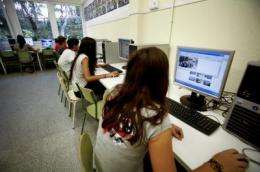
The goals of the study have been to draw up theoretical proposals to help to improve educational practices. Credit: SINC

Successfully introducing Information and Communications Technologies (ICT) into classrooms is one of the biggest challenges proposed by new educational plans. A research group from the University of the Basque Country (UPV-EHU) has studied substituting the current way in which education is structured for a new one that takes full advantage of the potential of new technologies.

Little by little, Information and Communications Technologies (ICT) have started to penetrate the educational sphere. A few years ago, the experts thought that the arrival of computers and the Internet in classrooms would have a drastic effect on the way that classes were given and received. However, "the studies carried out at compulsory level were not able to show the transformation and improvement of learning in schools that had been promised as a result of incorporating technology into the classroom", Asun Martínez, one of the authors involved in the UPV-EHU study, tells SINC.

This group of researchers has spent 10 years working with teaching staff from various school levels to look at the role played by technology in innovation processes within education, training and research, as well as in non-school contexts, such as museums.

"We started this work stressing that ICTs have the potential to spread knowledge beyond the physical limits of time, space and the people to whom one has access within the four walls of the classroom", explain the researchers.

Traditional schooling is perceived as being "rigidly organised, with clear objectives, classes divided according to content and directed on the basis of traditional methodologies and evaluation systems". Once ICTs are incorporated into the school setting, there is no other option but for this to be done within this educational structure (this combination of regulations and methods), meaning the new technologies are used in order to memorise and repeat information instead of to create and research. "So the ICTs become a means of expressing the same contents", says Martínez.

As a result, the goals of the study (http://www.sc.ehu. … @b/index.htm) have been to draw up theoretical proposals to help to improve educational practices, come up with new study areas to enable the relationship between education and technology to be better researched and understood, and to increase the visibility of research within this sphere, disseminating best practices and research results, as well as other related activities.

José Miguel Correa and his team say: "ICTs have the power to change these ingrained rules and principles, but as already indicated by many researchers, they are usually integrated in such a way as to continue with current methods, and not to overturn them in any significant way".

So the question is whether the current structure of education can really change as a result of the arrival of the ICTs. According to the study, "schools and the public at large must be more critical with their assumptions about the educational system. The first step towards making a change is to identify and combat the ordinary way in which things are done within the school system, and to highlight internalised rules and principles in order to make people aware of them".

The experts believe that in-depth research is required, as well as for classes attended by students to be combined with other practical experience outside schools. This would allow the traditional educational structure to be transformed into an alternative school model that is "better adapted to the needs of society today", according to the study.

Source: FECYT - Spanish Foundation for Science and Technology


Rank 3 /5 (3 votes)
Related Stories
Relevant PhysicsForums posts
  • Can I forget a language?
    createdFeb 10, 2012
  • The Biggest Lie Ever
    createdFeb 09, 2012
  • What are the limits of learning?
    createdFeb 06, 2012
  • Isn't that grammatically wrong?
    createdFeb 06, 2012
  • What does it mean when traders are indifferent?
    createdFeb 04, 2012
  • Peak of Our Civilization
    createdFeb 04, 2012
  • More from Physics Forums - Social Sciences

More news stories

A frank discussion of the power law and linking correlation to causation

(PhysOrg.com) -- Michael Stumpf a mathematics professor at Imperial College in London, and Mason Porter a lecturer at Oxford have teamed together to write and publish a perspective piece in Science regarding the in ...

Other Sciences / Mathematics

created Feb 10, 2012 | popularity 5 / 5 (5) | comments 10 | with audio podcast report

Employers feel no love for unscrupulous practice of 'service sweethearting'

A new study led by two Florida State University marketing professors finds that some frontline service employees who are rewarded for hikes in customer loyalty and satisfaction also may engage in "service ...

Other Sciences / Economics & Business

created Feb 10, 2012 | popularity 3.3 / 5 (3) | comments 10

US workers are 'giving away the store,' costing firms billions

Nearly 70 percent of the nation's service employees give away free goods and services – from hamburgers to cable TV – costing companies billions of dollars a year, according to a groundbreaking study.

Other Sciences / Economics & Business

created Feb 09, 2012 | popularity 3 / 5 (5) | comments 10

New insights into how to correct false knowledge

The abundance of false information available on the Internet, in movies and on TV has created a big challenge for educators.

Other Sciences / Social Sciences

created Feb 07, 2012 | popularity 4.9 / 5 (7) | comments 9 | with audio podcast

Neanderthal demise due to many influences, including cultural changes: study

As an ice age crept upon them thousands of years ago, Neanderthals and modern human ancestors expanded their territory ranges across Asia and Europe to adapt to the changing environment.

Other Sciences / Archaeology & Fossils

created Feb 07, 2012 | popularity 4.4 / 5 (5) | comments 8 | with audio podcast


Google might launch Drive for cloud storage soon

(PhysOrg.com) -- Google's next big move, according to the Wall Street Journal, is a cloud storage service called Drive. Hardly first to the plate, Google is simply catching up to introducing its cloud reposi ...

Scientists discover molecular secrets of 2,000-year-old Chinese herbal remedy

For roughly two thousand years, Chinese herbalists have treated Malaria using a root extract, commonly known as Chang Shan, from a type of hydrangea that grows in Tibet and Nepal. More recent studies suggest that halofuginone, ...

New method to examine batteries -- MRI from the inside

There is an ever-increasing need for advanced batteries for portable electronics, such as phones, cameras, and music players, but also to power electric vehicles and to facilitate the distribution and storage of energy derived ...

Lab study raises questions over nano-particle impact

Tests involving chickens have raised questions about the impact on health from engineered nano-particles, the ultra-fine grains commonly used in drugs and processed foods, scientists said on Sunday.

Injured boomers beware: Know when to see doctor

(AP) -- It happened to nurse Jane Byron years after an in-line skating fall, business owner Haralee Weintraub while doing "men's" push-ups, and avid cyclist Gene Wilberg while lifting a heavy box.

A mitosis mystery solved: How chromosomes align perfectly in a dividing cell

Although the process of mitotic cell division has been studied intensely for more than 50 years, Whitehead Institute researchers have only now solved the mystery of how cells correctly align their chromosomes during symmetric ...