One in six Mediterranean mammals face extinction
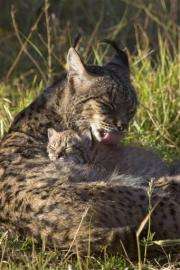
September 15, 2009 A female lynx with her cub at the captive breeding center of the Donana National Park, southern Spain

Enlarge

Iberian Lynx Conservation Breeding Programme photo shows a female lynx with her cub at the captive breeding center of the Donana National Park, southern Spain. One in six Mediterranean mammals is threatened with extinction at the regional level, mainly due to the destruction of their habitat from urbanization, agriculture and climate change, nature body IUCN said Tuesday in a new study.

One in six Mediterranean mammals is threatened with extinction at the regional level, mainly due to the destruction of their habitat from urbanization, agriculture and climate change, nature body IUCN said Tuesday in a new study.

Of the 320 mammal species assessed by the Geneva-based International Union for the Conservation of Nature, 49 were threatened, including 20 that can be found nowhere else in the world, it said in a statement.

Three percent are "critically endangered", including the Mediterranean monk seal and the Iberian lynx, another five percent are "endangered" and eight percent are "vulnerable".

"The number one threat is habitat destruction, which affects 90 percent of the threatened species," said IUCN expert Annabelle Cuttelod, co-author of the report, in a statement released in Spain.

"We need international action to protect key areas and preserve natural habitats to ensure we don?t lose the rich in this area," she added.

High concentrations of threatened species are found in the mountains of Turkey, northwestern Africa and the Levant, the ancient land now comprising Syria, Jordan, Israel, Lebanon and the Palestinian territories.

Large herbivores such as deer and rabbits, and carnivores, are particularly threatened.

Eight species from these groups, including the common and the Mesopotamian fallow deer, have already gone extinct in the Mediterranean region.

"To ensure the survival of large herbivore and carnivore mammals in the Mediterranean, we have to restore habitats and food chains," the report's co-author Helen Temple said.

"We need to encourage people to accept large predators, improve protected areas management and better enforce laws regarding hunting practices," she added.

The study, carried out by over 250 mammal experts, did not include whales and dolphins.

Over one-quarter of Mediterranean mammal species, 27 percent, have declining populations, 31 percent are stable and only three percent are increasing, the study found. The trend for the remaining 39 percent is unknown.

It is the first time that all Mediterranean animals have been assessed for the IUCN Red List of threatened species.

(c) 2009 AFP


print this article email this article download pdf blog this article bookmark this article     Stumble it Digg this share on Facebook retweet share on Reddit add to delicious
Rate this story - 1.3 /5 (3 votes)


September 15, 2009 all stories

Comments: 0

1.3 /5 (3 votes)
  • Stumble this up

  • Digg this

  • share this

  • hide
  • Related Stories

  • List of threatened species still growing
    created May 02, 2006 | popularity not rated yet | comments 0
  • 2010 species pledge set to fail: conservationists
    created Jul 02, 2009 | popularity not rated yet | comments 0
  • Researchers document world's mammals in crisis
    created Oct 06, 2008 | popularity not rated yet | comments 0
  • Extinction alert issued for 800 species
    created Dec 13, 2005 | popularity not rated yet | comments 0
  • New study reveals large scale conservation essential
    created Jun 10, 2008 | popularity not rated yet | comments 0


  • hide
  • Relevant PhysicsForums posts

  • Selenocysteine in pH=7
    created 7 hours ago
  • What is the formula for calculating the speed of thought?
    created 12 hours ago
  • What does word "absorption" mean in the intestine?
    created 12 hours ago
  • What is transpulmonary pressure?
    created Nov 24, 2009
  • More from Physics Forums - Biology

Other News

First-ever blueprint of a minimal cell is more complex than expected

First-ever blueprint of a minimal cell is more complex than expected

Biology / Cell & Microbiology

created 4 hours ago | popularity 5 / 5 (8) | comments 0

What are the bare essentials of life, the indispensable ingredients required to produce a cell that can survive on its own? Can we describe the molecular anatomy of a cell, and understand how an entire organism ...


Ecological speciation by sexual selection on good genes: Is speciation adaptive?

Biology / Ecology

created 5 hours ago | popularity not rated yet | comments 0

Darwin suggested that the action of natural selection can produce new species, but 150 years after the publication of his famous book, 'On the Origin of Species', debate still continues on the mechanisms of speciation. New ...


The six elephants in Sierra Leone were shot and "crudely butchered"

S.Leone elephants 'wiped out' by poachers: official

Biology / Ecology

created 6 hours ago | popularity 5 / 5 (3) | comments 3

Poachers "wiped out" the entire elephant herd in Sierra Leone's only wildlife park, wildlife managers said Thursday after police said they had arrested a gang of 10 poachers.


Knockouts in human cells point to pathogenic targets

Knockouts in human cells point to pathogenic targets

Biology / Cell & Microbiology

created 8 hours ago | popularity not rated yet | comments 0

(PhysOrg.com) -- Whitehead researchers have developed a new approach for genetics in human cells and used this technique to identify specific genes and proteins required for pathogens.


Whiteflies sabotage alarm system of plant in distress

Whiteflies sabotage alarm system of plant in distress

Biology / Plants & Animals

created 9 hours ago | popularity 5 / 5 (1) | comments 0

(PhysOrg.com) -- When spider mites attack a bean plant, the plant responds by producing odours which attract predatory mites. These predatory mites then exterminate the spider mite population, thus acting ...