Brookhaven Lab Patents New Method for Mercury Remediation
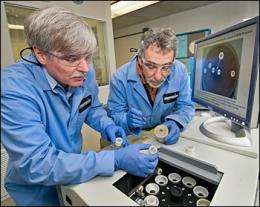
Scientists at the U.S. Department of Energy's Brookhaven National Laboratory have patented a new method to remove toxic mercury from soil, sediment, sludge and other industrial waste. As described in recently awarded U.S. patent number 7,589,248 and application U.S. Publication No. 20080097138, the method allows mercury to be treated in situ - at its original location in the ground.
Brookhaven Science Associates, the company that manages and operates Brookhaven Lab for DOE, holds the patent for the mercury-removal technology invented by Brookhaven researchers Paul Kalb and John Heiser, and Mark Fuhrmann, formerly of Brookhaven.
“When mercury contaminates a large area, it is too expensive to scoop up and transport for remediation,” said Kalb, the principal investigator on the project. “This new method that we are now scaling up can remove mercury without excavating and replacing large volumes of toxic soil or other waste material, reducing both cost and environmental impact.”
The U.S. Environmental Protection Agency requires that mercury-contaminated waste be treated to either remove or stabilize the toxic metal and prevent it from leaching into soil or groundwater. In cases where large areas are contaminated with levels of mercury that are not extremely high, current mercury-extraction methods are expensive and impractical for removing mercury. In contrast, the new Brookhaven process, called “In Situ Mercury Stabilization” (ISMS), can treat and remove mercury contamination from the ground in a cost-effective manner.
In the new process, mercury is drawn to specially designed treatment rods that contain a sulfur-based reagent. When a series of rods is placed in the mercury-contaminated soil or other waste material, the mercury migrates to the rods and reacts with the sulfur reagent to form a mercury sulfide compound. The rod, which contains the stable, insoluble compound, can then be removed for safe disposal at a hazardous waste facility without having to dig up large volumes of soil or waste material.
“Using x-ray fluorescence, we initially tested samples of mercury-contaminated sand in an area about three inches in diameter before and after exposure to the treatment rod,” Kalb said. “After 50 days, the mercury concentration in the sand was 42 times lower than at the start of the test,” Kalb said. “We are now in the process of scaling up our tests to cover an area that is ten times bigger. We believe we can eventually develop the technology so that one rod may be able to remediate a very large area of mercury contamination.”
Brookhaven Lab’s Technology Maturation Program and DOE’s Office of Science and Technology, as well as its Office of Engineering and Technology and Office of Biological and Environmental Research, funded the development of the ISMS method.
Provided by Brookhaven National Laboratory (news : web)


