Craters on Vesta and Ceres Could Hold Key to Jupiter's Age
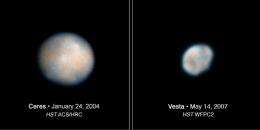
Crater patterns on Vesta and Ceres could help pinpoint when Jupiter began to form during the evolution of the early solar system.
A study modeling the cratering history of the largest two objects in the asteroid belt, which are believed to be among the oldest in the solar system, indicates that the type and distribution of craters would show marked changes at different stages of Jupiter’s development. Results were presented by Dr. Diego Turrini at the European Planetary Science Congress in Potsdam, Germany, on Monday 14 September.
The study, carried out by scientists at the Italian National Institute for Astrophysics in Rome, explored the hypothesis that one or both objects formed during Jupiter’s formation by modeling their cratering histories during the birth of the giant planet. Their simulation described Jupiter’s formation in three stages: an initial accretion of its core followed by a stage of rapid gas accretion. This is, in turn, followed by a phase where the gas accretion slows down while the giant planet reaches its final mass.
During the last two phases, Jupiter’s gravitational pull starts to affect more and more distant objects. For each of these phases, the team simulated how Jupiter affected the orbits of asteroids and comets from the inner and outer solar system, and the likelihood of them being moved onto a collision path with Vesta or Ceres.
“We found that the stage of Jupiter’s development made a big difference on the speed of impacts and the origin of potential impactors," said Turrini. "When Jupiter’s core approaches its critical mass, it causes a sharp increase in low-velocity impacts from small, rocky bodies orbiting nearby to Vesta and Ceres which lead to intense and uniform crater distribution patterns. These low-speed collisions may have helped Vesta and Ceres gather mass. Once Jupiter’s core has formed and the planet starts to rapidly accrete gas, it deflects more distant objects onto a collision course with Ceres and Vesta and the impacts become more energetic. Although rocky objects from the inner solar system are the dominant impactors at this stage, the higher energies of collisions with icy bodies from the outer solar system make the biggest mark.”
The third stage of Jupiter’s formation is complicated by a period known as the Late Heavy Bombardment, which occurred around 3.8 to 4.1 billion years ago. During this time a significant number of objects, rich in organic compounds, from the outer solar system were injected on planet-crossing orbits with the giant planets and may have reached the Asteroid Belt. In addition, Jupiter is thought to have migrated in its orbit around this time, which would have caused an addition flux of impactors on Vesta and Ceres.
The team will have an opportunity to confirm their results when NASA’s Dawn space mission reaches Vesta in 2011 and then flies on for a further rendezvous with Ceres in 2015. Dawn will gather information on the structure and the surface morphology of the two asteroids and send back high-resolution images of crater patterns.
“If we can see evidence of an underlying intense, uniform crater pattern, it will support the theory that one or both of these minor planets formed during the final phases of Jupiter accretion, provided that they aren’t obliterated by the later heavy bombardment," said Turrini. "Dawn will also measure concentrations of organic material, which may give us further information about the collisional history with organic-rich objects from the outer solar system.”
Source: European Planetary Science Congress


