Sophisticated telescope camera debuts with peek at nest of black holes
September 15, 2009 Sophisticated telescope camera debuts with peek at nest of black holes

Enlarge

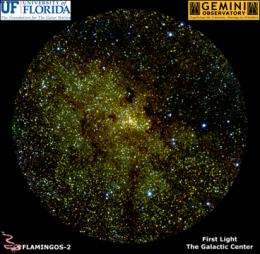
This is a near-infrared image of the galactic center of our Milky Way obtained the week of Sept. 6, 2009, by a newly installed University of Florida-built near-infrared camera and spectrometer. The instrument, called FLAMINGOS-2, captures heat-generated light just beyond the visible spectrum. In this image, a standard camera could capture the scattered blue stars in the foreground, but only a near-infrared camera could “see” the yellow and red stars because their visible light is blocked by clouds of gas and dust. This part of space also contains thousands of exotic black holes and neutron stars, objects UF astronomers plan to locate and identify using the instrument, FLAMINGOS-2. The cluster of bright stars near the center of the image surrounds a gargantuan black hole. FLAMINGOS-2 is also anticipated to become the first instrument to track the growth and evolution of this black hole over the past 4 billion years. (University of Florida/Gemini Observatory)

Less than two months after they inaugurated the world's largest telescope, University of Florida astronomers have used one of the world's most advanced telescopic instruments to gather images of the heavens.

A team led by astronomy professor Stephen Eikenberry late last week captured the first images of the cosmos ever made with a UF-designed and built camera/spectrometer affixed to the Gemini South telescope in Chile. The handful of "first light" images include a yellow and blue orb-like structure that depicts our Milky Way galaxy, home to thousands of - including, at its core, a "supermassive" black hole thought to be as massive as 4 million suns put together.

"We plan to use this instrument to provide the first accurate tracking of the growth and evolution of this black hole over the last 4 billion years," Eikenberry said.

Installation of the instrument, called FLAMINGOS-2, caps a seven-year, $5 million effort involving 30 UF scientists, engineers, students and staff. Once the instrument is scientifically tested — a process expected to last around six months — it will support a range of new science. Astronomers will use FLAMINGOS-2 (FLAMINGOS is short for the Florida Array Multi-object Imaging Grism Spectrometer) to hunt the universe's first galaxies, view stars as they are being born, reveal black holes and investigate other phenomena.

"Achieving first light is a great achievement and important milestone," said Nancy Levenson, deputy director of the Gemini Observatory.

The 8-meter Gemini South telescope in the Chilean Andes is one of only about a dozen 8- to 10-meter telescopes worldwide. All require technologically sophisticated instruments to interpret the light they gather. FLAMINGOS-2 "sees" near-infrared or heat-generated light beyond the range of human vision. It can reveal objects invisible to the eye, such as stars obscured by , or objects so far away they have next to no visible light

The instrument joins other near-infrared imagers installed on other large telescopes. But it is unusual in its ability to also act as a spectrometer, dividing the light into its component wavelengths. Astronomers analyze these wavelengths to figure out what distant objects are made of, how hot or cold they are, their distance from Earth, and other qualities.

Uniquely, FLAMINGOS-2 can take spectra of up to 80 different objects simultaneously, speeding astronomers' hunt for old galaxies, black holes or newly forming stars and planets.
Sophisticated telescope camera debuts with peek at nest of black holes
Enlarge

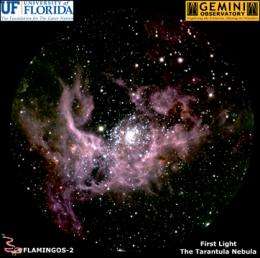
This is a near-infrared image of the Tarantula Nebula in the Large Magellanic Cloud, the largest satellite galaxy circling the Milky Way. This image reveals a huge cluster of young stars being born from a cloud of gas. The large concentration of massive young stars in the very center of the image is illuminating the surrounding hydrogen gas with ultraviolet light, creating the glowing red nebula in the image. (University of Florida/Gemini Observatory)

"At a cost of $1 per second for operating the Gemini telescope, it will make a huge gain in the scientific productivity and efficiency of the observatory," Eikenberry said. "What would take an entire year previously can now be done in four nights. This is a real game changer."

Astronomers compete heavily for time on the world's largest telescopes, often waiting months or years for the opportunity to make observations. Eikenberry said his FLAMINGOS-2 agreement with Gemini South entitles him to at least 25 nights of observations. He will use the time to contribute to three large studies, or surveys, of the sky headed by UF astronomers.

The first is aimed at learning more about the thousands of black holes and neutron stars at the Milky Way's center. The second will probe the formation and evolution of galaxies across time, while the third will investigate the birth of new stars.

Levenson said the Gemini telescopes are well-known for their excellent image quality. With its wide large field of view and ability examine dozens of objects at once, FLAMINGOS-2 is a good match with the Gemini South telescope.

"The center of our is a very dusty, very crowded environment, so infrared measurements and the ability to separate the fine details of the different stars and other objects are very important," she said.

FLAMINGOS-2's debut comes less than two months after UF astronomers helped inaugurate the Gran Telescopio Canarias, the world's largest telescope, in Spain's Canary Islands. UF, which owns a 5 percent share of the 10-meter , is the only participating U.S. institution.

The Gemini Observatory is the lead sponsor of FLAMINGOS-2 and the source of the $5 million for design and construction. The original FLAMINGOS, a smaller prototype that pioneered the approach used successfully in the larger version, was designed and built by the late UF astronomy professor Richard Elston. Elston was at work on the early stages of FLAMINGOS-2 when he died of cancer in 2004 at age 43.

Source: University of Florida (news : web)


print this article email this article download pdf blog this article bookmark this article     Stumble it Digg this share on Facebook retweet share on Reddit add to delicious
Rate this story - 4.8 /5 (13 votes)


September 15, 2009 all stories

Comments: 0

4.8 /5 (13 votes)
  • Stumble this up

  • Digg this

  • share this

  • hide
  • Related Stories

  • Astronomers, royalty, rock stars to inaugurate world's largest telescope
    created Jul 13, 2009 | popularity not rated yet | comments 0
  • Stellar birth control in the early universe
    created Oct 01, 2006 | popularity not rated yet | comments 0
  • World’s largest telescope to make first observations Friday
    created Jul 09, 2007 | popularity not rated yet | comments 0
  • Our Galaxy may be bigger than we thought
    created Aug 10, 2005 | popularity not rated yet | comments 0
  • Baby booms and birth control in space
    created Sep 25, 2007 | popularity not rated yet | comments 0


  • hide
  • Relevant PhysicsForums posts

  • Sideral question
    created Nov 21, 2009
  • Doppler shifted blackbody spectrum
    created Nov 21, 2009
  • Earth v. Moon
    created Nov 21, 2009
  • help me with coordinates and orbits
    created Nov 21, 2009
  • basic 'our universe' question..
    created Nov 20, 2009
  • deriving keplers law
    created Nov 19, 2009
  • More from Physics Forums - General Astronomy

Other News

Baby can wait as expectant dad finishes spacewalk (AP)

Baby can wait as expectant dad finishes spacewalk

Space & Earth / Space Exploration

created 20 hours ago | popularity 3 / 5 (2) | comments 0

(AP) -- A spacewalking astronaut put aside the impending birth of his daughter and blazed through his first-ever venture outside the International Space Station on Saturday.


Commuters wait on the platform shrouded by fog in London

Climate change not man-made, say majority of Britons: poll

Space & Earth / Environment

created Nov 15, 2009 | popularity 3.3 / 5 (15) | comments 46

Less than half of Britons believes that human activity is to blame for global warming, according to a poll carried out for The Times newspaper and published on Saturday.


Mysteriously warm times in Antarctica

Mysteriously warm times in Antarctica

Space & Earth / Earth Sciences

created Nov 18, 2009 | popularity 4.2 / 5 (21) | comments 28

(PhysOrg.com) -- A new study of Antarctica's past climate reveals that temperatures during the warm periods between ice ages (interglacials) may have been higher than previously thought. The latest analysis ...


UN: Fight climate change with free condoms (AP)

UN: Fight climate change with free condoms

Space & Earth / Environment

created Nov 18, 2009 | popularity 3.1 / 5 (11) | comments 30

(AP) -- The battle against global warming could be helped if the world slowed population growth by making free condoms and family planning advice more widely available, the U.N. Population Fund said Wednesday.


Mystery of the Solar Tsunami -- Solved

Mystery of the Solar Tsunami -- Solved (w/ Video)

Space & Earth / Astronomy

created Nov 19, 2009 | popularity 4.9 / 5 (24) | comments 8

(PhysOrg.com) -- Sometimes you really can believe your eyes. That's what NASA's Solar Terrestrial Relations Observatory (STEREO) is telling researchers about a controversial phenomenon on the sun known as ...