Direct evidence of role of sleep in memory formation is uncovered
September 15, 2009
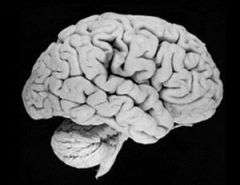
Modern human brain. Image source: Univ. of Wisconsin-Madison Brain Collection.
A Rutgers University, Newark and Collége de France, Paris research team has pinpointed for the first time the mechanism that takes place during sleep that causes learning and memory formation to occur.
It's been known for more than a century that sleep somehow is important for learning and memory. Sigmund Freud further suspected that what we learned during the day was "rehearsed" by the brain during dreaming, allowing memories to form. And while much recent research has focused on the correlative links between the hippocampus and memory consolidation, what had not been identified was the specific processes that cause long-term memories to form.
As posted online September 11, 2009 by Nature Neuroscience, György Buzsaki, professor at the Center for Molecular and Behavioral Neuroscience at Rutgers University, Newark, and his co-researchers, Gabrielle Girardeau, Karim Benchenane, Sidney I. Wiener and Michaël B. Zugaro of the Collége de France, have determined that short transient brain events, called "sharp wave ripples," are responsible for consolidating memory and transferring the learned information from the hippocampus to the neocortex, where long-term memories are stored.
Sharp wave ripples are intense, compressed oscillations that occur in the hippocampus when the hippocampus is working "off-line," most often during stage four sleep, which, along with stage three, is the deepest level of sleep.
During stage four sleep, Buzsaki explains, "it's as if many instruments and members of the orchestra come together to generate a loud sound, a sound so loud that it is heard by wide areas of the neocortex. These sharp, 'loud' transient events occur hundreds to thousands of times during sleep and 'teach' the neocortex to form a long-term form of the memory, a process referred to as memory consolidation." The intensity and multiple occurrence of those ripples also explain why certain events may only take place once in the waking state and yet can be remembered for a lifetime, adds Buzsaki.
The researchers were able to pinpoint that sharp wave ripples are the cause behind memory formation by eliminating those ripple events in rats during sleep. The rats were trained in a spatial navigation task and then allowed to sleep after each session. Those rats that selectively had all ripple events eliminated by electrical stimulation were impeded in their ability to learn from the training, as compressed information was unable to leave the hippocampus and transfer to the neocortex.
Identification of a specific brain pattern responsible for strengthening learned information could facilitate applied research for more effective treatment of memory disorders.
"This is the first example that if a well-defined pattern of activity in the brain is reliably and selectively eliminated, it results in memory deficit; a demonstration that this specific brain pattern is the cause behind long-term memory formation," says Buzsaki.
The research also represents a move toward a new direction in neuroscience research. While previous research largely has focused on correlating behavior with specific brain events through electroencephalogram, neuronal spiking and functional magnetic resonance imaging studies, increasingly researchers are challenging those correlations as they seek to identify the specific process or processes that cause certain events and behaviors to take place.
More information: http://www.nature. … nn.2384.html
-
Stages of sleep have distinct influence on process of learning and memory
Feb 25, 2009 |
not rated yet |
0
-
Memory experts show sleeping rats may have visual dreams
Dec 18, 2006 |
not rated yet |
0
-
Sleep helps build long-term memories
Jun 24, 2009 |
not rated yet |
0
-
Aging impairs the 'replay' of memories during sleep
Jul 29, 2008 |
not rated yet |
0
-
MIT researcher explains how rats think
Feb 12, 2006 |
not rated yet |
0
-
Fast photon control brings quantum photonic technologies closer
1 hour ago |
5 / 5 (2) |
0
-
Engineers build first sub-10-nm carbon nanotube transistor
Feb 01, 2012 |
4.9 / 5 (33) |
30
-
Something old, something new: Evolution and the structural divergence of duplicate genes
Jan 31, 2012 |
4.6 / 5 (7) |
1
-
The hidden nanoworld of ice crystals: Revealing the dynamic behavior of quasi-liquid layers
Jan 30, 2012 |
5 / 5 (5) |
1
-
Stock market network reveals investor clustering
Jan 27, 2012 |
3.9 / 5 (23) |
8
-
Is Everyday Technology Killing Us?
Feb 08, 2012
-
Exercise and weight loss
Feb 08, 2012
-
Why do we have head aches? Our brains can't feel anything.
Feb 07, 2012
-
"The end of diseases" by David Agus, interview from Daily Show with Jon Stewart
Feb 04, 2012
-
Oncolytic adenovirus
Feb 04, 2012
-
Nutrition label stuffs and diets
Feb 02, 2012
- More from Physics Forums - Medical Sciences
More news stories
'It's not nutritious until it's eaten'
As part of her "Let's Move! Initiative," First Lady Michelle Obama unveiled a new web resource highlighting new changes in the Chefs Move to Schools, during a CMST gathering in Dallas, TX today. CMTS advocates ...
1 hour ago |
not rated yet |
0
New ability to regrow blood vessels holds promise for treatment of heart disease
(Medical Xpress) -- University of Texas at Austin researchers have demonstrated a new and more effective method for regrowing blood vessels in the heart and limbs a research advancement that could have ...
1 hour ago |
5 / 5 (3) |
0
|
Motivation to exercise affects behavior
(Medical Xpress) -- For many people, the motivation to exercise fluctuates from week to week, and these fluctuations predict whether they will be physically active, according to researchers at Penn State. In an effort to ...
1 hour ago |
not rated yet |
0
|
New tumor suppressor gene identified
A recent study published in Clinical Cancer Research suggests that the protein hVps37A suppresses tumor growth in ovarian cancer. The work, which was funded by the Austrian Science Fund FWF, shows, for th ...
2 hours ago |
4.7 / 5 (3) |
0
Social psychologist: Lust makes you smarter and evidence that seven deadly sins are good for you
(Medical Xpress) -- Good news for lovers on Valentine’s Day - the seven deadly sins, including Lust, are good for you. University of Melbourne social psychologist Dr Simon Laham uses modern research to make a compelling ...
Medicine & Health / Psychology & Psychiatry
4 hours ago |
3.3 / 5 (3) |
0
Fast photon control brings quantum photonic technologies closer
(PhysOrg.com) -- Using photons instead of electrons to transmit information could lead to faster and more secure ways to communicate, among other advantages. Now a team of physicists has taken another step toward realizing ...
Planck mission steps closer to the cosmic blueprint
(PhysOrg.com) -- ESA's Planck mission has revealed that our Galaxy contains previously undiscovered islands of cold gas and a mysterious haze of microwaves. These results give scientists new treasure to mine ...
Slowing ocean current caused Earth to spin faster
(PhysOrg.com) -- Most people probably didn’t notice it, but back in 2009, the Earth spun around on its axis a tiny bit faster than usual, making for some slightly shorter days. It only happened for a ...
Independent group inspects Apple supplier
(AP) -- An independent group, the Fair Labor Association, has started auditing Apple Inc.'s Chinese supplier Foxconn after a request by Apple.
New European rocket lifts off on maiden flight
Europe on Monday successfully launched a new lightweight rocket carrying a test payload, culminating a more than 12-year quest to master the entire range of space launchers.
New molecule has potential to help treat genetic diseases and HIV
(PhysOrg.com) -- Chemists at The University of Texas at Austin have created a molecule that's so good at tangling itself inside the double helix of a DNA sequence that it can stay there for up to 16 days before ...
Sep 15, 2009
Rank: 5 / 5 (2)