New X-ray technique illuminates reactivity of environmental contaminants
September 15, 2009
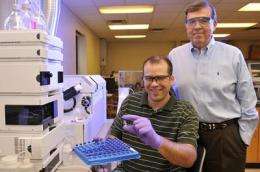
Pictured are Matthew Ginder-Vogel, left, and Donald Sparks, S. Hallock du Pont Chair of Plant and Soil Sciences and director of the Delaware Environmental Institute at the University of Delaware. Credit: Kathy F. Atkinson/University of Delaware
Thanks to a new analytical method employed by researchers at the University of Delaware, scientists can now pinpoint, at the millisecond level, what happens as harmful environmental contaminants such as arsenic begin to react with soil and water under various conditions.
Quantifying the initial rates of such reactions is essential for modeling how contaminants are transported in the environment and predicting risks.
The research method, which uses an analytical technique known as quick-scanning X-ray absorption spectroscopy (Q-XAS), was developed by a research team led by Donald Sparks, S. Hallock du Pont Chair of Plant and Soil Sciences and director of the Delaware Environmental Institute at UD. The work is reported in the Sept. 10 Early Edition of the Proceedings of the National Academy of Sciences and will be in the Sept. 22 print issue.
Postdoctoral researcher Matthew Ginder-Vogel is the first author of the study, which also involved Ph.D. student Gautier Landrot and Jason Fischel, an undergraduate student at Juniata College who has interned in Sparks's lab during the past three summers.
The research method was developed using beamline X18B at the National Synchrotron Light Source at Brookhaven National Laboratory in Upton, N.Y. The facility is operated by the U.S. Department of Energy.
"This method is a significant advance in elucidating mechanisms of important geochemical processes, and is the first application, at millisecond time scales, to determine in real-time, the molecular scale reactions at the mineral/water interface. It has tremendous applications to many important environmental processes including sorption, redox, and precipitation," Sparks said.
"My group and I have been conducting kinetics studies on soils and soil minerals for 30 years," Sparks added. "Since the beginning I have been hopeful that someday we could follow extremely rapid reaction processes and simultaneously collect mechanistic information."
X-ray spectroscopy was invented years ago to illuminate structures and materials at the atomic level. The technique has been commonly used by physicists, chemists, materials scientists, and engineers, but only recently by environmental scientists.
"In studying soil kinetics, we want to know how fast a contaminant begins to stick to a mineral," Ginder-Vogel says. "In general, these reactions are very rapid -- 90 percent of the reaction is over in the first 10 seconds. Now we can measure the first few seconds of these reactions that couldn't be measured before. We can now look at things as they happen versus attempting to freeze time after the fact," he notes.
For their study, the UD researchers made millisecond measurements of the oxidation rate of arsenic by hydrous manganese oxide, which is a mineral that absorbs heavy metals and nutrients.
Contamination of drinking water supplies by arsenic is a serious health concern in the United States and abroad. The poisonous element occurs naturally in rocks and minerals and is also used in a wide range of products, from wood preservatives and insecticides, to poultry feed.
The toxicity and availability of arsenic to living organisms depends on its oxidation state -- in other words, the number of electrons lost or gained by an atom when it reacts with minerals and microbes. For example, arsenite [As(III)] is more mobile and toxic than its oxidized counterpart, arsenate [As(V)].
"Our technique is important for looking at groundwater flowing through minerals," Ginder-Vogel notes. "We look at it as a very early tool that can be incorporated into predictive modeling for the environment."
-
Scientists Describe New Way to Peer Inside Bacteria
Aug 29, 2005 |
not rated yet |
0
-
Water-stingy agriculture reduces arsenic in rice markedly
Jul 28, 2008 |
not rated yet |
0
-
Rice grown in United States contains less-dangerous form of arsenic
May 19, 2008 |
not rated yet |
0
-
Nanoscience will change the way we think about the world
Mar 20, 2008 |
not rated yet |
0
-
Water quality improvements likely using new understanding of ion interaction
Jul 06, 2006 |
not rated yet |
0
-
Engineers build first sub-10-nm carbon nanotube transistor
Feb 01, 2012 |
4.9 / 5 (33) |
30
-
Something old, something new: Evolution and the structural divergence of duplicate genes
Jan 31, 2012 |
4.6 / 5 (7) |
1
-
The hidden nanoworld of ice crystals: Revealing the dynamic behavior of quasi-liquid layers
Jan 30, 2012 |
5 / 5 (5) |
1
-
Stock market network reveals investor clustering
Jan 27, 2012 |
3.9 / 5 (23) |
8
-
Of microchemistry and molecules: Electronic microfluidic device synthesizes biocompatible probes
Jan 26, 2012 |
5 / 5 (2) |
0
-
How to tell if ionic compound has a higher melting point?
3 hours ago
-
How to determine zinc in a plant.
Feb 11, 2012
-
Stoichiometry
Feb 10, 2012
-
Boiling and melting point of impure substances
Feb 10, 2012
-
Safe nitrogen compound to decompose a 500 deg C in a furnace?
Feb 09, 2012
-
[ask]electron inside drinking water
Feb 08, 2012
- More from Physics Forums - Chemistry
More news stories
Scientists discover molecular secrets of 2,000-year-old Chinese herbal remedy
For roughly two thousand years, Chinese herbalists have treated Malaria using a root extract, commonly known as Chang Shan, from a type of hydrangea that grows in Tibet and Nepal. More recent studies suggest that halofuginone, ...
15 hours ago |
4.5 / 5 (19) |
16
|
New method to examine batteries -- MRI from the inside
There is an ever-increasing need for advanced batteries for portable electronics, such as phones, cameras, and music players, but also to power electric vehicles and to facilitate the distribution and storage of energy derived ...
Chemistry / Analytical Chemistry
15 hours ago |
5 / 5 (7) |
0
|
Hydrogen from acidic water: Researchers develop potential low cost alternative to platinum for splitting water
A technique for creating a new molecule that structurally and chemically replicates the active part of the widely used industrial catalyst molybdenite has been developed by researchers with the Lawrence Berkeley ...
Feb 09, 2012 |
4.8 / 5 (16) |
21
|
Fool's gold may prove an unlikely alternative to overexploited catalytic materials
Catalytic materials, which lower the energy barriers for chemical reactions, are used in everything from the commercial production of chemicals to catalytic converters in car engines. However, with current catalytic materials ...
Feb 10, 2012 |
4.4 / 5 (8) |
9
|
Research provides octagonal window of opportunity for carbon capture
(PhysOrg.com) -- Filtering carbon dioxide, a greenhouse gas, from factory smokestacks is a necessary, but expensive part of many manufacturing processes. However, a collaborative research team from the National ...
Feb 08, 2012 |
5 / 5 (2) |
6
|
Rapunzel, Leonardo and the physics of the ponytail
(PhysOrg.com) -- New research provides the first mathematical understanding of the shape of a ponytail and could have implications for the textile industry, computer animation and personal care products.
Cognitive impairment in older adults often unrecognized in the primary care setting
A new study published in the Journal of the American Geriatrics Society reveals that brief cognitive screenings combined with offering further evaluation increased new diagnoses of cognitive impairment in older veterans two to ...
Climate change causes harmful algal blooms in North Atlantic: study
Warming oceans and increases in windiness could be causing of an abundance of harmful algal blooms in the North Atlantic Ocean and North Sea, according to new research.
Hacker claims porn site users compromised
A hacker claims to have compromised the personal information of more than 350,000 users after breaking into a disused website operated by pornography provider Brazzers.
Primary care program helps obese teen girls manage weight, improve body image and behavior
Teenage girls gained less weight, improved their body image, ate less fast food, and had more family meals after participating in a 6- month program that involved weekly peer meetings, consultations with primary care providers ...
AT&T customers surprised by 'unlimited data' limit
(AP) -- Mike Trang likes to use his iPhone 4 as a GPS device, helping him get around in his job. Now and then, his younger cousins get ahold of it, and play some YouTube videos and games.