First Solid Evidence for a Rocky Exoplanet (w/ Video)
September 16, 2009
First Solid Evidence for a Rocky Exoplanet

Enlarge

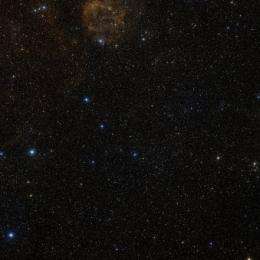
The star CoRoT-7 is located towards the constellation of Monoceros (the Unicorn) at a distance of about 500 light-years. This image shows a larger field of view around the star, covering about 9 square degrees or about 11 times the size of the Full Moon. CoRoT-7 is in the centre of the image. Image: ESO/Digitized Sky Survey

(PhysOrg.com) -- The longest set of HARPS measurements ever made has firmly established the nature of the smallest and fastest-orbiting exoplanet known, CoRoT-7b, revealing its mass as five times that of Earth's. Combined with CoRoT-7b's known radius, which is less than twice that of our terrestrial home, this tells us that the exoplanet's density is quite similar to the Earth's, suggesting a solid, rocky world. The extensive dataset also reveals the presence of another so-called super-Earth in this alien solar system.

"This is science at its thrilling and amazing best," says Didier Queloz, leader of the team that made the observations. "We did everything we could to learn what the object discovered by the CoRoT satellite looks like and we found a unique system."

This video is not supported by your browser at this time.

The star CoRoT-7 is located towards the constellation of Monoceros (the Unicorn) at a distance of about 500 light-years. Slightly smaller and cooler than our Sun, CoRoT-7 is also thought to be younger, with an age about 1.5 billion years. It is now known to have two planets, one of them being the first to be found with a density similar to that of Earth. Image: ESO/Digitized Sky Survey/A. Fuji

In February 2009, the discovery by the CoRoT satellite of a small exoplanet around a rather unremarkable star named TYC 4799-1733-1 was announced one year after its detection and after several months of painstaking measurements with many telescopes on the ground, including several from ESO. The star, now known as CoRoT-7, is located towards the of Monoceros (the Unicorn) at a distance of about 500 light-years. Slightly smaller and cooler than our Sun, CoRoT-7 is also thought to be younger, with an age of about 1.5 billion years.

Every 20.4 hours, the planet eclipses a small fraction of the light of the star for a little over one hour by one part in 3000. This planet, designated CoRoT-7b, is only 2.5 million kilometres away from its , or 23 times closer than Mercury is to the Sun. It has a radius that is about 80% greater than the Earth's.

The initial set of measurements, however, could not provide the mass of the exoplanet. Such a result requires extremely precise measurements of the velocity of the star, which is pulled a tiny amount by the gravitational tug of the orbiting exoplanet. The problem with CoRoT-7b is that these tiny signals are blurred by stellar activity in the form of "starspots" (just like sunspots on our Sun), which are cooler regions on the surface of the star. Therefore, the main signal is linked to the rotation of the star, with makes one complete revolution in about 23 days.

To get an answer, astronomers had to call upon the best exoplanet-hunting device in the world, the High Accuracy Radial velocity Planet Searcher (HARPS) spectrograph attached to the ESO 3.6-metre telescope at the La Silla Observatory in Chile.

"Even though HARPS is certainly unbeaten when it comes to detecting small exoplanets, the measurements of CoRoT-7b proved to be so demanding that we had to gather 70 hours of observations on the star," says co-author François Bouchy.

HARPS delivered, allowing the astronomers to tease out the 20.4-hour signal in the data. This figure led them to infer that CoRoT-7b has a mass of about five Earth masses, placing it in rare company as one of the lightest exoplanets yet found.

"Since the planet's orbit is aligned so that we see it crossing the face of its parent star ― it is said to be transiting ― we can actually measure, and not simply infer, the mass of the exoplanet, which is the smallest that has been precisely measured for an exoplanet," says team member Claire Moutou. "Moreover, as we have both the radius and the mass, we can determine the density and get a better idea of the internal structure of this planet."
First Solid Evidence for a Rocky Exoplanet
Enlarge

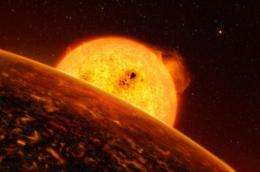
The exoplanet Corot-7b is so close to its Sun-like host star that it must experience extreme conditions. This planet has a mass five times that of Earth’s and is in fact the closest known exoplanet to its host star, which also makes it the fastest — it orbits its star at a speed of more than 750 000 kilometres per hour. The probable temperature on its “day-face” is above 2000 degrees, but minus 200 degrees on its night face. Theoretical models suggest that the planet may have lava or boiling oceans on its surface. Our artist has provided an impression of how it may look like if it were covered by lava. The sister planet, Corot-7c, is seen in the distance. Image: ESO/L. Calcada

With a mass much closer to that of Earth than, for example, ice giant Neptune's 17 Earth masses, CoRoT-7b belongs to the category of "super-Earth" exoplanets. About a dozen of these bodies have been detected, though in the case of CoRoT-7b, this is the first time that the density has been measured for such a small exoplanet. The calculated density is close to Earth's, suggesting that the planet's composition is similarly rocky.

"CoRoT-7b resulted in a 'tour de force' of astronomical measurements. The superb light curves of the space telescope CoRoT gave us the best radius measurement, and HARPS the best mass measurement for an exoplanet. Both were needed to discover a rocky planet with the same density as the Earth," says co-author Artie Hatzes.

CoRoT-7b earns another distinction as the closest known exoplanet to its host star, which also makes it the fastest — it orbits its star at a speed of more than 750 000 kilometres per hour, more than seven times faster than the Earth's motion around the Sun. "In fact, CoRoT-7b is so close that the place may well look like Dante's Inferno, with a probable temperature on its 'day-face' above 2000 degrees and minus 200 degrees on its night face. Theoretical models suggest that the planet may have lava or boiling oceans on its surface. With such extreme conditions this planet is definitively not a place for life to develop," says Queloz.

As a further testament to HARPS' sublime precision, the astronomers found from their dataset that CoRoT-7 hosts another slightly further away than CoRoT-7b. Designated CoRoT-7c, it circles its host star in 3 days and 17 hours and has a mass about eight times that of Earth, so it too is classified as a super-Earth. Unlike CoRoT-7b, this sister world does not pass in front of its star as seen from Earth, so astronomers cannot measure its radius and thus its density.

Given these findings, CoRoT-7 stands as the first star known to have a planetary system made of two short period super-Earths with one that transits its host.

More information: This research was presented in a paper to appear in a special issue of the Astronomy and Astrophysics journal on CoRoT, volume 506-1, 22 October 2009: "The CoRoT-7 planetary system: two orbiting Super-Earths", by D. Queloz et al.

Provided by ESO (news : web)

4.6 /5 (14 votes)  

Filter


Move the slider to adjust rank threshold, so that you can hide some of the comments.


Display comments: newest first

omatumr
Sep 16, 2009

Rank: 3 / 5 (2)
OH NO,

Rocky planets were first observed many years ago orbiting the pulsar, PSR 1257+12. The results were reported, first in Nature, and later in Science.

This landmark observation seems to have been forgotten.

With kind regards,
Oliver K. Manuel
Joeviocoe
Sep 16, 2009

Rank: 5 / 5 (1)
OH NO,

Rocky planets were first observed many years ago orbiting the pulsar, PSR 1257+12. The results were reported, first in Nature, and later in Science.

This landmark observation seems to have been forgotten.

With kind regards,
Oliver K. Manuel


Actually, of the 3 confirmed (1 possible) planets around this pulsar, none of them have "solid" evidence that they have densities close to Earth's. For those planets orbiting PSR 1257+12, only the masses are known because the detection method is Pulsar timing which only tells us the mass and semimajor axis of the planet not it's radius which is needed to calculate the average density and postulate the material (rock).

Since CoRoT-7b was detected using both the Transit method (the planet passing between our view of the star) and the Radial velocity (the stars wobble due to the gravity of the planet), both the radius and mass are known and can give us a confirmed density.

So in conclusion,
The title is quite accurate!
Rank 4.6 /5 (14 votes)
Related Stories
Relevant PhysicsForums posts
  • Titan's lack of impact craters
    created23 hours ago
  • Real pictures of black hole eating a star?
    createdFeb 08, 2012
  • Hypothetical way to travel faster than light, but not technically exceed lightspeed
    createdFeb 06, 2012
  • How do scientists monitor the Sun's activity?
    createdFeb 05, 2012
  • Search patterns in observational studies
    createdFeb 05, 2012
  • Derivation of Pogson's law
    createdFeb 03, 2012
  • More from Physics Forums - General Astronomy

More news stories

Domestic consumption main contributor to Africa's growing e-waste

West Africa faces a rising tide of e-waste generated by domestic consumption of new and used electrical and electronic equipment, according to a new United Nations report. Domestic consumption makes up the majority (up to ...

Space & Earth / Environment

created 50 minutes ago | popularity not rated yet | comments 0

Humans may have helped the decline of African rainforests 3000 years ago

(PhysOrg.com) -- Large areas of rainforests in Central Africa mysteriously disappeared over three thousand years ago, to be replaced by savannas. The prevailing theory has been that the cause was a change ...

Space & Earth / Environment

created 5 hours ago | popularity 5 / 5 (3) | comments 4 | with audio podcast report

Could Venus be shifting gear?

(PhysOrg.com) -- ESA’s Venus Express spacecraft has discovered that our cloud-covered neighbour spins a little slower than previously measured. Peering through the dense atmosphere in the infrared, the ...

Space & Earth / Space Exploration

created 1 hour ago | popularity 5 / 5 (3) | comments 4 | with audio podcast

Clam fields found at deep, low-temperature Mariana vents

(PhysOrg.com) -- Scientists have marveled at the unusual life forms thriving at high temperature hydrothermal vents of the deep ocean.

Space & Earth / Earth Sciences

created 2 hours ago | popularity not rated yet | comments 0 | with audio podcast

Mars Science Laboratory computer issue resolved

(PhysOrg.com) -- Engineers have found the root cause of a computer reset that occurred two months ago on NASA's Mars Science Laboratory and have determined how to correct it.

Space & Earth / Space Exploration

created 2 hours ago | popularity 5 / 5 (4) | comments 2 | with audio podcast


Fool's gold may prove an unlikely alternative to overexploited catalytic materials

Catalytic materials, which lower the energy barriers for chemical reactions, are used in everything from the commercial production of chemicals to catalytic converters in car engines. However, with current catalytic materials ...

Curry spice component may help slow prostate tumor growth

Curcumin, an active component of the Indian curry spice turmeric, may help slow down tumor growth in castration-resistant prostate cancer patients on androgen deprivation therapy (ADT), a study from researchers ...

What lies beneath: Mapping hidden nanostructures

The ability to diagnose and predict the properties of materials is vital, particularly in the expanding field of nanotechnology. Electron and atom-probe microscopy can categorize atoms in thin sheets of material, ...

Netflix light on flicks as viewers soak up TV shows

Like most fresh faces that arrive in Hollywood, Netflix wanted to be a movie star. But now it's learning what many in Tinseltown have known for decades: Movies are sexy, but the real money is in television.

To avoid early labor and delivery, weight and diet changes not the answer

One of the strongest known risk factors for spontaneous or unexpected preterm birth – any birth that occurs before the 37th week of pregnancy, most often without a known cause – is already having had one. For women ...

Arthritic knees, but not hips, have robust repair response

Researchers at Duke University Medical Center used new tools they developed to analyze knees and hips and discovered that osteoarthritic knee joints are in a constant state of repair, while hip joints are not.