Sending science down the phone: New technology will map research across the world
September 16, 2009
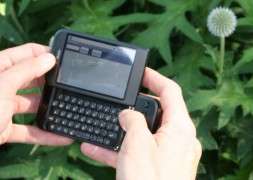
Researchers in the field can analyse data on the 'smartphone'.
(PhysOrg.com) -- New mobile phone software will help epidemiologists and ecologists working in the field to analyse their data remotely and map findings across the world, without having to return to the lab, according to research published in PLoS One today. The authors of the study, from Imperial College London, say the software will also enable members of the public to act as 'citizen scientists' and help collect data for community projects.
The researchers have developed an application for 'smartphones' that allows a scientist or member of the public to collect and record data, photos and videos - for example to document the presence of an animal or plant species - and then send this information to a central web-based database. The website records the user's location, using the phone's GPS system, and it can then display all of the data collected on this topic across the world, using Google Maps.
Users can also use their smartphones to request and view all the maps and analyses available. The new technology, which is funded by the Wellcome Trust, means that groups of researchers should be able to quickly and easily build up and share maps of, for example, the distribution of an endangered species or cases of a disease, and analyse patterns that emerge. The Imperial team is currently using the software, known as EpiCollect, as a tool in their studies of the epidemiology of bacterial and fungal infectious diseases.
David Aanensen, lead author of the paper from the Department of Infectious Disease Epidemiology at Imperial College London said: "We're excited about launching this new software - researchers have been able to send information by phone before, but this is the first time that we have been able to link all the functionality of smartphone technology to a web-based database for scientists to use. Our software is ideal for projects where multiple people collect data in the field and submit these to a central website for mapping and analysis. A key advantage is that data collected by researchers can also be requested from the website and displayed and analysed directly on the smartphone".
The researchers suggest that members of the public could also get involved in scientific research using the tool and that schools could also use the software, for example on biology field courses.
Aanensen adds: "If a research team or a group of school children wants to look at how a particular species is spread across their locality, or the world, they can download the application for free and start collecting and submitting data to a project website. We hope that EpiCollect could also be used for community projects, for example projects that ask members of the public to track sightings of birdlife in their garden. It should be much quicker and simpler to submit sightings to the website by phone than email or the post."
Suitable smartphones for EpiCollect use the Android open-source operating system, developed by Google and the Open Handset Alliance. It means that software developers can produce their own applications to run on the phones and anybody can download the software for free. There are currently several different handsets available in the UK and the new software will be available to anybody with one of these phones. The researchers have also produced a beta version for the iPhone, so the software will soon be available to even more people.
In order to use the new system, a researcher sets up a web database for their particular study and a specific version of EpiCollect is produced that can be loaded on multiple phones, allowing users to start collecting and submitting data.
More information: "EpiCollect: Linking Smartphones to Web Applications for Epidemiology, Ecology and Community data collection." PLoS One, 16 September 2009.
-
Google G1 Phone: Security Flaw Exposed
Oct 28, 2008 |
not rated yet |
0
-
FalconView Mapping Software Goes Open Source
Aug 12, 2009 |
not rated yet |
0
-
Online collaboration identifies bacteria
Feb 19, 2009 |
not rated yet |
0
-
Google Maps tracking traffic flow
Aug 26, 2009 |
not rated yet |
0
-
Android Trademark Lawsuit Against Google & Open Handset Manufacturers: Who's Confused?
May 04, 2009 |
not rated yet |
0
-
Engineers build first sub-10-nm carbon nanotube transistor
Feb 01, 2012 |
4.9 / 5 (31) |
30
-
Something old, something new: Evolution and the structural divergence of duplicate genes
Jan 31, 2012 |
4.6 / 5 (7) |
1
-
The hidden nanoworld of ice crystals: Revealing the dynamic behavior of quasi-liquid layers
Jan 30, 2012 |
5 / 5 (3) |
1
-
Stock market network reveals investor clustering
Jan 27, 2012 |
3.9 / 5 (23) |
8
-
Of microchemistry and molecules: Electronic microfluidic device synthesizes biocompatible probes
Jan 26, 2012 |
5 / 5 (1) |
0
-
Calling function with no input argument
6 hours ago
-
Force free body diagram problem on gym equipment
7 hours ago
-
Empirical data regarding shower heads and water
14 hours ago
-
feed hold button on CNC lathe
Feb 09, 2012
-
RFAC in Fortran
Feb 09, 2012
-
dynamics 2/32
Feb 08, 2012
- More from Physics Forums - General Engineering
More news stories
CIA website offline, Anonymous takes credit
The website of the Central Intelligence Agency was unresponsive on Friday after the hacker group Anonymous claimed to have knocked it offline.
26 minutes ago |
5 / 5 (1) |
2
New error-correcting codes guarantee the fastest possible rate of data transmission
Error-correcting codes are one of the triumphs of the digital age. Theyre a way of encoding information so that it can be transmitted across a communication channel such as an optical fiber o ...
Technology / Computer Sciences
8 hours ago |
5 / 5 (3) |
4
|
Small modular reactor design could be a 'SUPERSTAR'
(PhysOrg.com) -- Though most of today's nuclear reactors are cooled by water, we've long known that there are alternatives; in fact, the world's first nuclear-powered electricity in 1951 came from a reactor ...
Technology / Energy & Green Tech
8 hours ago |
4.2 / 5 (10) |
17
|
New power source discovered
(PhysOrg.com) -- Researchers at the Massachusetts Institute of Technology (MIT) and RMIT University have made a breakthrough in energy storage and power generation.
Technology / Energy & Green Tech
7 hours ago |
5 / 5 (8) |
3
|
Advanced power-grid model finds low-cost, low-carbon future in West
(PhysOrg.com) -- The least expensive way for the Western U.S. to reduce greenhouse gas emissions enough to help prevent the worst consequences of global warming is to replace coal with renewable and other ...
Technology / Energy & Green Tech
8 hours ago |
5 / 5 (2) |
7
|
Complex wiring of the nervous system may rely on a just a handful of genes and proteins
Researchers at the Salk Institute have discovered a startling feature of early brain development that helps to explain how complex neuron wiring patterns are programmed using just a handful of critical genes. ...
Q&A: Obama and the birth control controversy
(AP) -- What birth control debate? A half-century after the introduction of the pill, acceptance of birth control by American women is virtually universal.
The power of estrogen -- male snakes attract other males
A new study has shown that boosting the estrogen levels of male garter snakes causes them to secrete the same pheromones that females use to attract suitors, and turned the males into just about the sexiest ...
Human cognitive performance suffers following natural disasters, researchers find
Not surprisingly, victims of a natural disaster can experience stress and anxiety, but a new study indicates that it might also cause them to make more errors - some serious - in their daily lives. In their upcoming Human Fa ...
Humans may have helped the decline of African rainforests 3000 years ago
(PhysOrg.com) -- Large areas of rainforests in Central Africa mysteriously disappeared over three thousand years ago, to be replaced by savannas. The prevailing theory has been that the cause was a change ...
Both maternal and paternal age linked to autism
Older maternal and paternal age are jointly associated with having a child with autism, according to a recently published study led by researchers at The University of Texas Health Science Center at Houston (UTHealth).