Robots Reveal Insights into Evolution
September 16, 2009 By Lisa Zyga
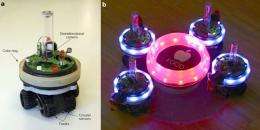
(A) The robot used for the experiments, which has floor sensors to distinguish food and poison sources, and a ring of blue lights. (B) Robots emitting blue light near a food source. Image copyright: Sara Mitri, et al.
(PhysOrg.com) -- In an ironic twist to our understanding of life, robots may offer a greater degree of realism for studying some of the intricacies of natural selection and evolution than real organisms offer. In a recent study, scientists have used evolutionary robots to investigate the evolution of social information. Their results mirror theoretical predictions more closely than results from experiments with real organisms, and may provide an explanation for some of the observed variation in animal species.
“Evolving robots can result in important insights for evolutionary biology, in particular for understanding the evolution of communication,” Sara Mitri of the Ecole Polytechnique Fédérale de Lausanne in Switzerland told PhysOrg.com.
In their study, Mitri and coauthors Dario Floreano, also of the Ecole Polytechnique Fédérale de Lausanne, and Laurent Keller of the University of Lausanne, will publish their results in an upcoming issue of the Proceedings of the National Academy of Sciences. The researchers experimented with computer simulations of populations of 1,000 robots that mimic the dynamic properties of real robots.
In the game-like scenario, the robots competed with each other to find a food source that emitted red light and avoid a poison. Robots received one point for every unit of time spent in the vicinity of food, and lost a point per unit of time spent near poison. Once a robot had located the food, it could stay near the food for the remainder of the game to accumulate as many points as possible. The robots also had the ability to emit blue light, and could sense light emitted by other robots.
As the researchers explained, each robot had 33 genes that were initially set to random values, so that the behavior of the robots was random in the first generation. The genes controlled characteristics such as how the robots processed sensory information and produced motor actions, such as emitting flashes of light.
Once robots evolved the ability to find food and stay nearby, their increased density near the food source also caused an increased density of flashing blue lights near the food, providing a source of information for other robots. After about nine generations, the robots became significantly attracted to blue light, resulting in even more robots crowding around the food. In response to this crowding, the robots began to be selected to decrease their own rate of blue light emission.
However, blue light emission never completely decreased to zero, even after 500 generations of evolving robots. As the researchers explained, this somewhat surprising result can be explained by the reduced selection pressure on light emission reduction. As light emission decreased, it became less informative to other robots, and less of a liability to the robots emitting the light.
“Evolutionary processes do not necessarily lead to ‘optimal’ solutions (in this case, a complete suppression of information) but consist of a complex interplay of selection pressure and variation,” Mitri said.
One important consequence of the reduced selection pressure on light emission is that, at equilibrium, there was a large amount of variation in both the production of and response to light among the robots. While most robots exhibited only a low attraction to blue light and rarely or never emitted light near food, a significant number of robots was still highly attracted (or even negatively attracted) to light, and some still emitted a lot of light near the food. The researchers speculate that complete suppression of light might never be achieved, since a reduction in this information will simultaneously reduce selection pressure on information reduction.
In general, this result means that, as selection pressure decreases on a trait, phenotypic diversity of that trait increases. This finding agrees with previous studies that have found higher than expected variation in populations’ signaling strategies; for instance, the great degree of coloration in moths has so far eluded explanation. Perhaps, as the robot experiments suggest, these moth populations have experienced a decrease in selection pressure on their coloring.
As the researchers conclude, evolutionary robotic systems like the one here may provide insight into understanding evolution and natural selection due to their implicit, inadvertent behaviors, such as emitting and sensing light while foraging. The experimental results here are also more in line with theoretical predictions than other empirical studies, supporting the view that more controlled experiments are needed in studies with real organisms.
“Because we can watch how robots evolve over many generations, we can formulate hypotheses and predictions regarding evolutionary systems in nature,” Mitri said. “These predictions can then be used to inspire biologists working with the real animals by providing them with potential explanations for what they observe. We do not claim that our robots are the same as any animals, but we suggest what biologists may want to test next to answer their questions.”
More information: Sara Mitri, Dario Floreano, and Laurent Keller. “The evolution of information suppression in communicating robots with conflicting interests.” Proceedings of the National Academy of Sciences. To be published.
Copyright 2009 PhysOrg.com.
All rights reserved. This material may not be published, broadcast, rewritten or redistributed in whole or part without the express written permission of PhysOrg.com.


Your points are well taken, and of course I am aware of the fact that the robots didn't evolve. My point is that, precisely because the robots can't physically evolve, the use of the term "evolution" and "evolutionary" to describe what happened in the experiment is entirely inappropriate and not representative of what the experiment actually demonstrated.
While I don't disagree with your statement that robots can't evolve (obviously), that doesn't mean that they can't give insight into the mechanism of evolution (which is all this title states), a result of which is adaptation. Frankly I have a bigger problem with it being a computer simulation of robots than their paring of evolution with said simulated robots.
Plus, I'm really curious about your use of "claim". You say that as if evolution isn't a logical, demonstrable mechanism.
In order to address your comment, I need your definition of "evolution". Otherwise, you could be describing apples and I could be describing oranges. By my definition,"claim" is the right word for me to have used, but I'm almost positive that my definition of "evolution" is not the same as yours. For example, if I understand you correctly, the "logical, demonstrable mechanism" you mention is something I would not use the word "evolution" to describe.
Using real food/poison in this way just doesn't make sense - I suppose there is some proximity to reality which they're looking for, but Occam's razor might well be applied here, and successfully at that.
If the performance of robot species feeds the imagination (and knowledge) of the human assistants, then the humans feed the robots with energy and through the process of iterative development cause the creation of the future generations of robots until such a time as the robots are developed sufficiently to feed themselves and create their next generation without the current necessity of the human assistants.
However, just like the 'blue flashing light' that does not get switched off completely, the symbiotic relationship between the human and robot species maintains as long as the benefits of the relationship outweigh any risk.
In the future the scientists may be studying why the humans are doing what the robots want them to do, just as today they study why humans do what their pets (particularly cats) want them to do.
Why is it that Earth's first explorers on other planets are robots?
I hate to say it, but is that not akin to creationists saying that the bible may offer a greater degree of realism than real organisms offer? Nothing is realer than the real thing, and its clearly erroneous to ever say so.
It wasn't used loosely and it is correct. Evolutionary processes resulted in adaptation. That the genes were there at the start does not change that. The genes changed over time to alter to robots behavior. Evolution is not limited to biological processes.
Ethelred
KingWigid, Although I won't discount the fact that in the future robots building themselves a "speaker" may be (probably will be) possible, the fact is this: it's not evolution. If you went to a doctors office, without the doctor there, turned on a laser, and gave yourself eye surgery (assuming you had the skill), would you call that evolution? I sure wouldn't. Caliban had an excellent point by bringing up that evolution involves an exchange of genetic material. (On the flip side, maybe we can consider evolution an exchange of information. This way maybe in the future it will work...) Perhaps this can get you thinking about what is/will be possible. And by my word "EVER", i was talking about this particular robot. You can't take the robot from the experiment and have him do anything like that. He'll just eventually rust out. Not procreate, not pass on information.
My definition would be that of evolution as found in biology; the mechanism through which a segment of a group of interbreeding biotic organisms is made more likely to successfully reproduce through it's genetics (phenotype, etc.), given a change in external factors (environment), which leads to a divergence of that segment's offspring from the "original" interbreeding group's genetics (phenotype, etc.) and eventual speciation.
AND/OR
The divergence of a segment of a group of interbreeding biotic organism's genetics (phenotype, etc.), into two distinct genetics (pheontype, etc.) and eventual speciation after generations of offspring, due to genetic mutation.
I think that should roughly cover it.
Is this a definition which you see as a falsifiable claim?
Thanks for the clarification; both definitions are falsifiable, IMHO, so are good scientific definitions. Of course, one catch in both of them require knowing what a "species" is, since obviously one must know what a species is in order to determine if speciation has taken place. My point in bringing that up is because in biology, this is known as the "species problem". At this time there are a number of definitions of species, which for someone who used to think that a species was a clearly definable unit, is a little disturbing. I've always thought that if two organisms that are morphologically similar can interbreed and yield offspring nearly identical to themselves, then they are of the same species. If their offspring are of many different morphologies, then the parents are not species, but hybrids. But apparently this is not a cut and dried definition, and debate remains on this subject. Since Darwin's seminal work was 'The Origin of Species' . . .
Generally a species is defined as organisms that can AND DO interbreed with each other. If they can but don't they are considered a separate species. I am not thrilled with that myself. I prefer a strictly genetic decision of an ability to interbreed with viable offspring. If mules were viable almost all the time I would consider horses and donkeys the same species for instance despite the strong differences between them.
As for morphologically similar I think dogs take that right out. Chihuahuas and Irish Wolfhounds do not strike me as morphologically similar.
In any case it is not that hard to come up with a working definition of species. Unless you just don't want one.
Any debate on this subject is mostly splitting hares vs rabbits.
Ethelred
Your point is well taken. However since it is evolution we are falsifying here, the thrust of your argument is then that evolution is not affirmable (falsifiable) as species is not affirmable (falsifiable)?
I disagree. Certainly a species is always two organisms which can produce viable (fertile) offspring. I'm not aware of any case in which two organisms are labeled of the same species but cannot successfully reproduce (note that it does not matter that there are separate species which can produce viable offspring, the absolution of species is not what we are affirming).
So, can we not at least affirm that evolution is A mechanism of speciation? Speciation here being the process through which two organism's developmental reproduction results in the cessation of viable reproduction.
Interestingly this validates your original post well. What the robots did was not even close to our agreeable definition (if it is agreeable).
Just my 2 cents
LariAnn: evolution does not necessarily require the creation of new genes. In fact, such mutations usually lead to a quick death. Evolution more often occurs through gradual "drifts" in gene frequencies or expression (such as you're seeing with these robots). Recall that humans and chimps share almost all genes in common, with gene expression/frequency accounting for most of the morphological differences.
The robots have the equivalent of asexual reproduction, with probably much more short term variation than is normally found in such. They also have an environment which has a set of rules, which is what all reproducing species have. The only difference is that the robots have a much more restricted and controllable environment.