Mini-Comets within a comet lit up 17P/Holmes during megaoutburst
September 16, 2009 Mini-Comets within a comet lit up 17P/Holmes during megaoutburst

Enlarge

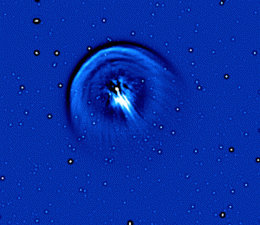
Animated movie showing the expansion of the coma of comet Holmes over 9 nights in 2007 November. The images have been spatially filtered to reveal fine structure. Inside the expanding envelope of the dust coma, a set of faint objects and their associated dust trails can be seen receding from the nucleus. Black/white circles that jump from image to image are background stars. Credit:Jewitt/Stevenson/Kleyna (Click Enlarge)

Astronomers from the University of California, Los Angeles and the University of Hawaii have discovered multiple fragments ejected during the largest cometary outburst ever witnessed. Images and animations showing fragments rapidly flying away from the nucleus of comet 17P/Holmes will be presented by Rachel Stevenson at the European Planetary Science Congress in Potsdam, Germany, on Wednesday 16 September.

Stevenson, together with colleagues Jan Kleyna and David Jewitt, began observing Holmes in October 2007 soon after it was reported that the small (3.6 km wide) body had brightened by a million times in less than a day. They continued observing for several weeks after the outburst using the Canada- France- Hawaii Telescope in Hawaii and watched as the ejected by the comet grew to be larger than the Sun.

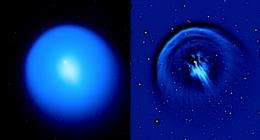
The astronomers examined a sequence of images taken over nine nights in November 2007 using a digital filter that enhances sharp discontinuities within images. The filter, called a Laplacian filter, is particularly good at picking out faint small-scale features that would otherwise remain undetected against the bright background of the expanding comet. They found numerous small objects that moved radially away from the nucleus at speeds up to 125 metres per second (280 mph). These objects were too bright to simply be bare rocks, but instead were more like mini-comets creating their own dust clouds as the ice sublimated from their surfaces.
Mini-Comets within a comet lit up 17P/Holmes during megaoutburst
Enlarge

Image of comet Holmes from the 3.6-meter Canada-France-Hawaii telescope on Mauna Kea showing the large expanding dust coma. On the left, a 'raw' image is shown, in which the brightness reflects the distribution of dust in the coma of the comet (the nucleus is in the bright, point-like region to the upper left of center). On the right is shown the same image after application of the Laplacian spatial filter, to emphasize fine structures. The white/black circular objects are background stars enhanced by the Laplacian filter. Credit: Jewitt, Stevenson, Kleyna

“Initially we thought this comet was unique simply because of the scale of the outburst," said Stevenson. “But we soon realized that the aftermath of the outburst showed unusual features, such as these fast-moving fragments, that have not been detected around other comets."

While cometary outbursts are common, their causes are unknown. One possibility is that internal pressure built up as the comet moved closer to the Sun and sub-surface ices evaporated.

The pressure eventually became too great and part of the surface broke away, releasing a huge cloud of dust and gas, as well as larger fragments.

Surprisingly, the solid nucleus of comet Holmes survived the outburst and continued on its orbit, seemingly unperturbed. Holmes takes approximately 6 years to circle the Sun, and travels between the inner edge of the asteroid belt to beyond Jupiter. The comet is now moving away from the Sun but will return to its closest approach to the Sun in 2014, when astronomers will examine it for signs of further outbursts.

Source: Europlanet


print this article email this article download pdf blog this article bookmark this article     Stumble it Digg this share on Facebook retweet share on Reddit add to delicious
Rate this story - 4.5 /5 (2 votes)

Rank Filter

Move the slider to adjust rank threshold, so that you can hide some of the comments.


Display comments: newest first

  • earls - Sep 16, 2009
    • Rank: 5 / 5 (1)
    "One possibility is that internal pressure built up as the comet moved closer to the Sun and sub-surface ices evaporated."

    Wasn't the comet moving away from the Sun when the outburst began?

    What is the temperature difference between the comet's aphelion and perihelion?

September 16, 2009 all stories

Comments: 1

4.5 /5 (2 votes)
  • Stumble this up

  • Digg this

  • share this

  • hide
  • Related Stories

  • Hubble zooms in on heart of mystery comet
    created Nov 15, 2007 | popularity not rated yet | comments 0
  • Mystery Comet Explodes into Brightness
    created Oct 26, 2007 | popularity not rated yet | comments 0
  • Catch a Comet - No Telescope Required
    created Oct 31, 2007 | popularity not rated yet | comments 0
  • Evidence for more dust than ice in comets
    created Oct 13, 2005 | popularity not rated yet | comments 0
  • ESA's New Camera Follows Disintegration of 73P/Schwassmann-Wachmann 3 Comet
    created May 19, 2006 | popularity not rated yet | comments 0


  • hide
  • Relevant PhysicsForums posts

  • Question about 2-body gravity
    created Nov 24, 2009
  • life on Mars
    created Nov 24, 2009
  • Semi-major axis from cartesian co-ordinates
    created Nov 23, 2009
  • Primary Mirror grinding
    created Nov 23, 2009
  • More from Physics Forums - General Astronomy

Other News

Cosmic 'dig' reveals vestiges of the Milky Way's building blocks

Cosmic 'Dig' Reveals Vestiges of the Milky Way's Building Blocks

Space & Earth / Astronomy

created 9 hours ago | popularity 4.9 / 5 (12) | comments 1

(PhysOrg.com) -- Peering through the thick dust clouds of our galaxy's "bulge" (the myriads of stars surrounding its center), a team of astronomers has unveiled an unusual mix of stars in the stellar grouping ...


No Wheel Stall in Diagnostic Drive

Spirit Mars Rover: No Wheel Stall in Diagnostic Drive

Space & Earth / Space Exploration

created 4 hours ago | popularity 5 / 5 (1) | comments 0

(PhysOrg.com) -- On Sol 2095 (Tuesday, Nov. 24), Spirit performed a set of diagnostic actions related to a stall of the right-rear wheel on the previous drive, three days earlier.


Monster Waves on the Sun are Real

Monster Waves on the Sun are Real (w/ Video)

Space & Earth / Astronomy

created 4 hours ago | popularity 5 / 5 (8) | comments 0

Sometimes you really can believe your eyes. That's what NASA's STEREO (Solar Terrestrial Relations Observatory) spacecraft are telling researchers about a controversial phenomenon on the sun known as the "solar ...


Oceanic crust formation is dynamic after all

Oceanic crust formation is dynamic after all

Space & Earth / Earth Sciences

created 8 hours ago | popularity 4.3 / 5 (3) | comments 0

Imagine the Earth's crust as the planet's skin: Some areas are old and wrinkled while others have a fresher, more youthful sheen, as if they had been regularly lathered with lotion.


Climate experts debate strategies for reducing atmospheric carbon and future warming

Climate experts debate strategies for reducing atmospheric carbon and future warming

Space & Earth / Environment

created 5 hours ago | popularity 3 / 5 (4) | comments 4

(PhysOrg.com) -- Reducing carbon dioxide to safe levels may require extracting carbon from the air, says Cornell climate researcher.