Global view of valleys on Titan shows north south contrast
September 16, 2009
Global view of valleys on Titan shows north south contrast

Enlarge

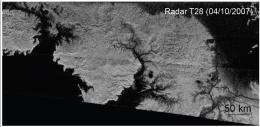
Fluvial valleys in the north polar region of Titan. Credit: Cassini Radar Team, ESA, JPL, NASA

A team of international scientists led by Mirjam Langhans, from the German Aerospace Center (DLR), will present first results of a global analysis of spatial patterns, occurrence and origin of river channels on Titan at the European Planetary Science Congress in Potsdam, Germany, on Wednesday 16 September.

To date scientists have focused their investigations on single channels due to the fact that radar and spectral data have only been captured for some narrow areas of the surface below the thick nitrogen atmosphere of this mysterious moon of Saturn. This data jigsaw puzzle is increasingly being filled in through further fly bys of by NASA’s Cassini spacecraft. Now, for the first time, the DLR team has developed a global perspective of the deposits of , such as and , and their effected forms of erosion.

Beside the Earth, Titan is the only body in the Solar System where liquids directly have been proved to exist. The moon’s exceptionally thick atmosphere, where chemical reactions occur at freezing temperatures of -179 degrees Celsius, makes this second largest moon of the Solar System of special interest for planetary science.
Global view of valleys on Titan shows north south contrast
Enlarge

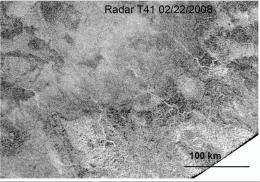
Canyons in the equator region of Titan (detail). Credit: Cassini Radar Team, ESA, JPL, NASA

The DLR scientists have compiled a global map of Titan, which combines all radar data and details the surface of Titan down to 300 meters in size. Furthermore, data in near infrared wavelengths have been captured for a wide band around the equator by Cassini’s Visual and (VIMS) with a resolution of up to 300 meters per pixel.

On this equatorial band, bright continent areas and extensive dune regions can be distinguished. Dark spots on the continent areas are of special interest, because they are supposed to be fluvial deposits. Additional radar data show channels precisely linked to them, which are dry, canyon-like, and broadly distributed.
Global view of valleys on Titan shows north south contrast
Enlarge

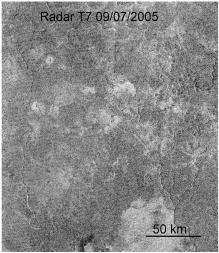
Part of the south polar region of Titan. Credit: Cassini Radar Team, ESA, JPL, NASA

Towards the north pole, the picture is much richer. There is a dense network of branching, active river systems similar to those on Earth. They are visible down to small tributaries on radar images and can be seen flowing into multiple lakes. Contrastingly, hardly any channels are found at the south pole.

“The observations of the extensive river structures at the north pole have led the team to a fascinating conclusion: there must be heavy and frequent rain of liquid hydrocarbons. Furthermore the measured channels provide first clues about the composition and relative age of different regions of Titan,” said Langhans.

Source: Europlanet

4.5 /5 (10 votes)  

Rank 4.5 /5 (10 votes)
Related Stories
Relevant PhysicsForums posts
  • Never ending outer space.....
    created13 hours ago
  • Neutron Star fragments?
    created15 hours ago
  • stationary or not?
    created19 hours ago
  • Scale of the Universe
    createdFeb 10, 2012
  • Titan's lack of impact craters
    createdFeb 09, 2012
  • Real pictures of black hole eating a star?
    createdFeb 08, 2012
  • More from Physics Forums - General Astronomy

More news stories

Latin America mining boom clashes with conservation

Latin America is experiencing a mining boom as prices rise fuelled by a hike in global demand, but the region is also being hit by a wave of violent protests, strikes and rallies by environmentalists.

Space & Earth / Environment

created 6 hours ago | popularity not rated yet | comments 0

Political leaders play key role in how worried Americans are by climate change: study

More than extreme weather events and the work of scientists, it is national political leaders who influence how much Americans worry about the threat of climate change, new research finds.

Space & Earth / Environment

created Feb 06, 2012 | popularity 5 / 5 (6) | comments 72

NASA budget will axe Mars deal with Europe: scientists

US President Barack Obama's budget proposal to be submitted next week for 2013 will cut NASA's budget by 20 percent and eliminate a major partnership with Europe on Mars exploration, scientists said Thursday.

Space & Earth / Space Exploration

created Feb 10, 2012 | popularity 5 / 5 (3) | comments 55

Humans may have helped the decline of African rainforests 3000 years ago

(PhysOrg.com) -- Large areas of rainforests in Central Africa mysteriously disappeared over three thousand years ago, to be replaced by savannas. The prevailing theory has been that the cause was a change ...

Space & Earth / Environment

created Feb 10, 2012 | popularity 4.1 / 5 (14) | comments 20 | with audio podcast report

Study shows global glaciers, ice caps, shedding billions of tons of mass annually

Earth's glaciers and ice caps outside of the regions of Greenland and Antarctica are shedding roughly 150 billion tons of ice annually, according to a new study led by the University of Colorado Boulder.

Space & Earth / Earth Sciences

created Feb 08, 2012 | popularity 4.4 / 5 (9) | comments 14 | with audio podcast


Google might launch Drive for cloud storage soon

(PhysOrg.com) -- Google's next big move, according to the Wall Street Journal, is a cloud storage service called Drive. Hardly first to the plate, Google is simply catching up to introducing its cloud reposi ...

Love a click away in Indonesia's Twitter Republic

He was a geeky kid from Yogyakarta, she a glamorous city girl in Jakarta. In a country with one of the world's most vibrant social networking scenes they fell in love on Twitter.

Europeans protest controversial Internet pact

Tens of thousands of people marched in protests in more than a dozen European cities Saturday against a controversial anti-online piracy pact that critics say could curtail Internet freedom.

Walney offshore wind farm is world's biggest (for now)

(PhysOrg.com) -- The Walney wind farm on the Irish Sea--characterized by high tides, waves and windy weather--officially opened this week. The farm is treated in the press as a very big deal as the Walney ...

Navy to begin tests on electromagnetic railgun prototype launcher

The Office of Naval Research (ONR)'s Electromagnetic (EM) Railgun program will take an important step forward in the coming weeks when the first industry railgun prototype launcher is tested at a facility ...

Explained: Sigma

It's a question that arises with virtually every major new finding in science or medicine: What makes a result reliable enough to be taken seriously? The answer has to do with statistical significance -- but ...