A New Glance on Microscopic Images
September 16, 2009
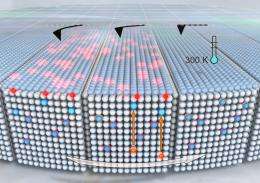
Schematic drawing of a Kelvin probe force microscopy probe above a doped semiconductor with a thin oxide layer (grey blue atomic layer). Occupied surface states at the interface between the oxide layer and the semiconductor are animated in red and the same number of unscreened dopant atoms is animated in dark blue. The resulting asymmetric electric dipole causes the deflection of the probe (left). By applying a bias mobile majority charge carriers are injected into the semiconductor (animated in orange) and screen the unscreened ionized dopant atoms (center). As a result the electrostatic force onto the cantilever vanishes. The cantilever moves back to its normal position (right). The applied bias is measured and depends on the concentration of dopant atoms.
A doctoral student at the research center Forschungszentrum Dresden-Rossendorf (Germany) suggests interpreting the images generated by Kelvin probe force microscopy in a new way. She recently published her insights in the journal Physical Review B.
The last years have seen a tremendous progress in microscopic technologies. Modern microscopes are able to three-dimensionally map molecules, to identify smallest structures like single atoms, or even to distinguish between different sorts of atoms. Atomic force microscopy is well-known even in the public as a versatile tool for the production of images on the nanoscale level. Kelvin probe force microscopy is a special type of this imaging technique named after Lord Kelvin. When brought to the market in 1991, a scientific description of how to interprete the images was delivered. To this, physicist Christine Baumgart, a doctoral student of the nanospintronics group at the FZD, has now added new features.
Atomic force microscopes come along with a resolution even beyond the nanoscale level (the gap between two atoms averages 0.2 nanometers). Such a microscope generates an image of the surface topography by moving a tiny tip fixed on a small beam (cantilever) over the sample under investigation. The tip interacts with the atoms sitting on the surface of the sample, allowing the atoms to exert a force on the tip. This force affects the cantilever as well, whose deformation can be measured by a laser system. A Kelvin probe force microscope uses an electrically conducting tip. Therefore it measures not only the surface topography of the sample, but also the electric force between the tip and the sample. Hence surface phenomena like catalytic or electric activity of ion doped materials can thoroughly be investigated. While this microscopic technique is advantageous for non-destructive investigation of electric properties, the complicated measuring procedure, which even affects the reproducibility of the scientific outcome, is considered to be its main disadvantage. Furthermore, scientists have relied on an incomplete explanation for the values they measured because it has been believed that the electric potential between the tip and the surface of the sample was measured.
Christine Baumgart now discovered what exactly is measured by Kelvin probe force microscopy. It is the electric potential which is needed to move electrons or holes from the inside to the surface of a semiconductor. Her new findings will simplify the microscopic technique itself, and will lead to unambiguous and reproducible results concerning the structure and electronic properties of samples. Also, Kelvin probe force microscopy, which has been used mainly in materials science and semiconductor physics so far, is likely to become more attractive for other areas like biotechnology.
But how exactly does a Kelvin probe force microscope work? The tip is deflected by the electrostatic force between cantilever and sample when moved over the sample. By applying bias to the sample, electrons and holes are moved to the surface of the semiconductor and the electrostatic force decreases. The cantilever moves back to its original position and the applied bias is stored as the signal measured. To be more precise, there is a quantitative relation between the measured Kelvin bias and the difference between the calculated Fermi energy and respective semiconductor band edge independent of the work function of the probing microscope tip. Thus, Christine Baumgart’s novel explanation of how the Kelvin probe force microscope works elucidates why the signal depends on the bias necessary for injecting majority charge carriers towards the interface between insulator and semiconductor.
In her dissertation work under the supervision of Dr. Heidemarie Schmidt, Christine Baumgart deals with materials for future nanospintronic devices. Usually, foreign atoms are implanted into these materials. To describe doped semiconductors thoroughly, she uses various microscopic techniques like the Kelvin probe force microscope. Christine Baumgart: “I wanted to understand more precisely how this microscope works. At the Ion Beam Center of the FZD we are able to produce especially well defined samples. While working with such semiconducting samples, I found out what exactly the Kelvin probe force microscope measures and that the signal has not been interpreted sufficiently. The good news is that the measurement itself has always been correct.”
More information: Physical Review B: "Quantitative dopant profiling in semiconductors: A Kelvin probe force microscopy model", C. Baumgart, M. Helm, H. Schmidt, DOI: 10.1103/PhysRevB.80.085305
Source: Forschungszentrum Dresden Rossendorf
-
New, unique microscope for nanotech
Dec 09, 2005 |
not rated yet |
0
-
Femtogram-level chemical measurements now possible
Mar 27, 2008 |
not rated yet |
0
-
Molecular Imaging of Cells Likely with New Take on Atomic Force Microscopy
Jul 17, 2006 |
not rated yet |
0
-
Shimmering ferroelectric domains
Jul 18, 2008 |
not rated yet |
0
-
Fast AFM probes measure multiple properties of biomolecules or materials simultaneously
Apr 16, 2008 |
not rated yet |
0
-
Engineers build first sub-10-nm carbon nanotube transistor
Feb 01, 2012 |
4.9 / 5 (33) |
30
-
Something old, something new: Evolution and the structural divergence of duplicate genes
Jan 31, 2012 |
4.6 / 5 (7) |
1
-
The hidden nanoworld of ice crystals: Revealing the dynamic behavior of quasi-liquid layers
Jan 30, 2012 |
5 / 5 (4) |
1
-
Stock market network reveals investor clustering
Jan 27, 2012 |
3.9 / 5 (23) |
8
-
Of microchemistry and molecules: Electronic microfluidic device synthesizes biocompatible probes
Jan 26, 2012 |
5 / 5 (2) |
0
-
Can Plasma Be Solid
1 hour ago
-
What is delta Δ ?
2 hours ago
-
Need some help understanding Hertz–Knudsen formula
2 hours ago
-
Anatomy of Fat man: implosion-critical bomb
4 hours ago
-
what makes two sounds similar???
5 hours ago
-
What would happen when a jet travelling at Mach 10 experiences engine failure
11 hours ago
- More from Physics Forums - General Physics
More news stories
Lab study raises questions over nano-particle impact
Tests involving chickens have raised questions about the impact on health from engineered nano-particles, the ultra-fine grains commonly used in drugs and processed foods, scientists said on Sunday.
Nanotechnology / Bio & Medicine
7 hours ago |
5 / 5 (5) |
0
New kind of solar cell could capture significantly more energy than current cells
New solar cells could increase the maximum efficiency of solar panels by over 25%, according to scientists from the University of Cambridge.
Feb 08, 2012 |
4.5 / 5 (13) |
14
|
Nanoshell whispering galleries improve thin solar panels
Visitors to Statuary Hall in the U.S. Capitol Building may have experienced a curious acoustic feature that allows a person to whisper softly at one side of the cavernous, half-domed room and for another on ...
Nanotechnology / Nanomaterials
Feb 07, 2012 |
4.4 / 5 (7) |
6
|
'Dark plasmons' transmit energy
Microscopic channels of gold nanoparticles have the ability to transmit electromagnetic energy that starts as light and propagates via "dark plasmons," according to researchers at Rice University.
Feb 09, 2012 |
4.8 / 5 (10) |
1
|
Revealing how a battery material works
Since its discovery 15 years ago, lithium iron phosphate (LiFePO4) has become one of the most promising materials for rechargeable batteries because of its stability, durability, safety and ability to deliver ...
Nanotechnology / Nanomaterials
Feb 08, 2012 |
5 / 5 (6) |
0
|
Scientists discover molecular secrets of 2,000-year-old Chinese herbal remedy
For roughly two thousand years, Chinese herbalists have treated Malaria using a root extract, commonly known as Chang Shan, from a type of hydrangea that grows in Tibet and Nepal. More recent studies suggest that halofuginone, ...
New method to examine batteries -- MRI from the inside
There is an ever-increasing need for advanced batteries for portable electronics, such as phones, cameras, and music players, but also to power electric vehicles and to facilitate the distribution and storage of energy derived ...
A mitosis mystery solved: How chromosomes align perfectly in a dividing cell
Although the process of mitotic cell division has been studied intensely for more than 50 years, Whitehead Institute researchers have only now solved the mystery of how cells correctly align their chromosomes during symmetric ...
Google might launch Drive for cloud storage soon
(PhysOrg.com) -- Google's next big move, according to the Wall Street Journal, is a cloud storage service called Drive. Hardly first to the plate, Google is simply catching up to introducing its cloud reposi ...
Overeating may double risk of memory loss
New research suggests that consuming between 2,100 and 6,000 calories per day may double the risk of memory loss, or mild cognitive impairment (MCI), among people age 70 and older. The study was released today and will be ...
Starve a virus, feed a cure? Findings show how some cells protect themselves against HIV
A protein that protects some of our immune cells from the most common and virulent form of HIV works by starving the virus of the molecular building blocks that it needs to replicate, according to research published online ...